深圳溯源
无法加载取货服务可用情况
一、工艺:指尖上的星河
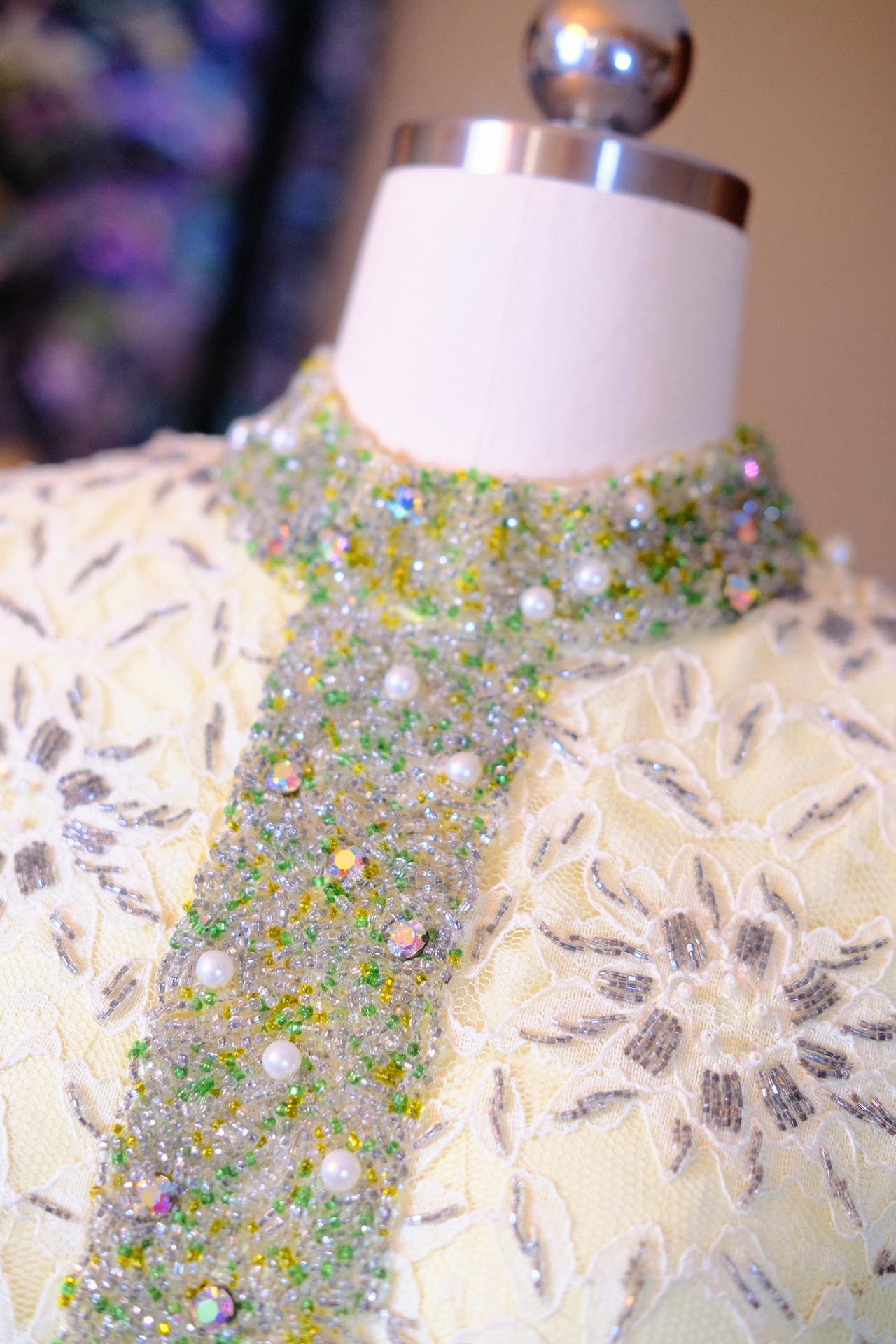
这件鸡尾酒礼服裙的精髓,在于其令人叹为观止的手工钉珠工艺。
- 领口与门襟:视觉的焦点集中在高领与前襟处,
- 裙身蕾丝:裙身通体覆盖着精致的法国蕾丝,
二、形制:摩登时代的“直筒美学”
这件礼服采用了六十年代标志性的直筒廓形,
- 无袖高领:无袖设计展露出优雅的肩颈线条,
- 鸡尾酒裙长:裙长及膝,是当时社交场合中最得体的长度。
三、故事:Woo女士的“高光时刻”
这件礼服的主人Woo女士,是加拿大Super Store的老板之一,亦是那个时代叱咤风云的女性。
- 在六十年代,
- 这件衣服见证了她的辉煌与荣耀,
四、稀缺性:消逝的手工技艺
如今这件礼服的珍贵,不仅在于其面料与设计的绝美,
- 六十年代的手工钉珠工艺,需要数名工匠耗时数月才能完成一件。
- 如今,当我们凝视这件礼服,看到的不仅是璀璨的珠光,
The absolute soul of this cocktail dress resides in its breathtaking, manual hand-beading engineering. Far more than a mere garment, it operates as a dimensional embroidered canvas draped gracefully over the posture:
The Mandarin Collar and Placket Articulation: The definitive visual focus is anchored at the structured high neck and along the front opening, both featuring remarkably dense, heavy-gauge tambour beading. Senior artisans meticulously interlaced microscopic seed beads, translucent sequins, and radiant pearls. The color theory utilizes an organic composition of tender green, bright yellow, and iridescent silver filaments—mimicking morning dew drops catching early spring light to scatter a prismatic luster. Securing every single bead demanded extraordinary geometric precision and patience; a density and micro-refinement achievable exclusively within elite mid-century haute couture ateliers.
The Lace Field Architecture: The main body of the gown is entirely blanketed in exquisite French lace, punctuated by trailing configurations of silver bugle beads. These tubular components are engineered to track the organic contour of the botanical lace patterns, creating a fluid, kinetic play of shadow and light. Under directional lighting, the complete silhouette activates—yielding a shifting, wave-like shimmer that echoes the breath and poise of the wearer.
The architectural framework of the dress adopts the definitive, iconic straight-cut shift silhouette of the 1960s, deliberately abandoning the cinched, restrictive corsetry rules of the 1950s in favor of absolute kinetic freedom and elongated geometric lines:
The Sleeveless High-Neck Geometry: The sleeveless tailoring beautifully exposes the clean line of the shoulders, balanced by a proud, structural standing mandarin collar that projects instant nobility and poise. This strategic pairing of exposure and modesty perfectly mirrors the confident, self-directed identity of mid-century women.
The Cocktail Hemline: Terminating precisely at the knee, the hemline represents the absolute gold standard of appropriateness for mid-century international social codes. It moves effortlessly from sunlit garden receptions to formal evening cocktail salons, perfectly tracking the multifaceted lifestyle of a high-society tastemaker.
The custodian of this artifact, Ms. Woo, operated as a co-director of a major Canadian enterprise, standing as a commanding and visionary figure within the mid-century corporate and social landscape:
Throughout the 1960s, this luminescent gown served as her definitive sartorial armor for high-stakes commercial banquets and elite philanthropic galas. As she stepped into the grand salons of the era, the dense configuration of jewel-work around her collar caught the ambient chandeliers, casting an unforgettable aura of refinement that instantly commanded the room.
This garment stands as a tactile monument to her triumphs and public honors, capturing the profound narrative of an international corporate pioneer navigating the global stage with unyielding resilience and grace. As fashion historian Valerie Steele beautifully observed, "Fashion is a dialogue between the body and society." Through this precise silhouette, Ms. Woo articulated her personal taste, cultural authority, and uncompromising independence to the world.
The modern rarity of this cocktail dress extends far beyond its raw material worth or its complex optical performance; it stands as a pristine archive of a highly specialized, completely vanished sartorial ecosystem:
During the 1960s, executing this level of manual hand-beading required multiple master artisans working in absolute unison across several months to complete a single garment. With the subsequent global ascension of automated, mass-market industrial production scales, these resource-heavy, time-intensive manual methods completely dissolved from mainstream fashion.
To view this silhouette today is to look beyond the surface brilliance of shifting beadwork and confront the twilight of pure artisan dedication. It survives as a peerless, one-of-a-kind monument—a living fragment of fashion history, recording the romance, industry, and uncompromising artistry of a golden era.