Flowing Radiance & Purple Vines: A 1960s Hong Kong Hand-Painted Ink-Wash Rose Qipao
I. Fishing from the Sea of History: The "In the Mood for Love" Era of the 1960s
"It is an elegance that has vanished, existing only within bygone dreams."
1960s Hong Kong stood at the zenith of East-West cultural convergence. By this decade, the Qipao had moved past the generous fullness and ornate trimmings of 1930s Haipai (Shanghainese) dress, embracing the razor-sharp, body-skimming contours of Western tailoring. This Qipao is an authentic creation of that golden era—when master tailors gathered in Hong Kong, drawing inspiration from Hollywood and French couture to prize exact fit and clean, sculptural lines.
More than mere clothing, this piece serves as a living fossil of that era’s "Hollywood of the East" aesthetic sensibility.
II. Woven Fine Brushwork: Artisanal Care Between Stitch and Seam
-
Silhouette (Silhouette): A quintessential 1960s sleeveless design (Sleeveless). Unlike traditional set-in sleeves, the smooth, unbroken shoulder line flatters the feminine shoulder with a soft, rounded grace, subtly reflecting the mid-century pursuit of natural posture and wearable ease.
-
Cut (Cut): A snug high mandarin collar (Mandarin Collar) opens slightly at the throat to lengthen and frame the neck, pairing modesty with quiet allure. Precision darts (Darts) gather the fabric cleanly through the waist and abdomen to trace an S-curve silhouette—the hallmark of three-dimensional tailoring (3D Tailoring) that 1960s Hong Kong tailors took immense pride in mastering.
III. Pigment into the Grain: Tales of Purple Vines and Blossoms at the Fingertips
-
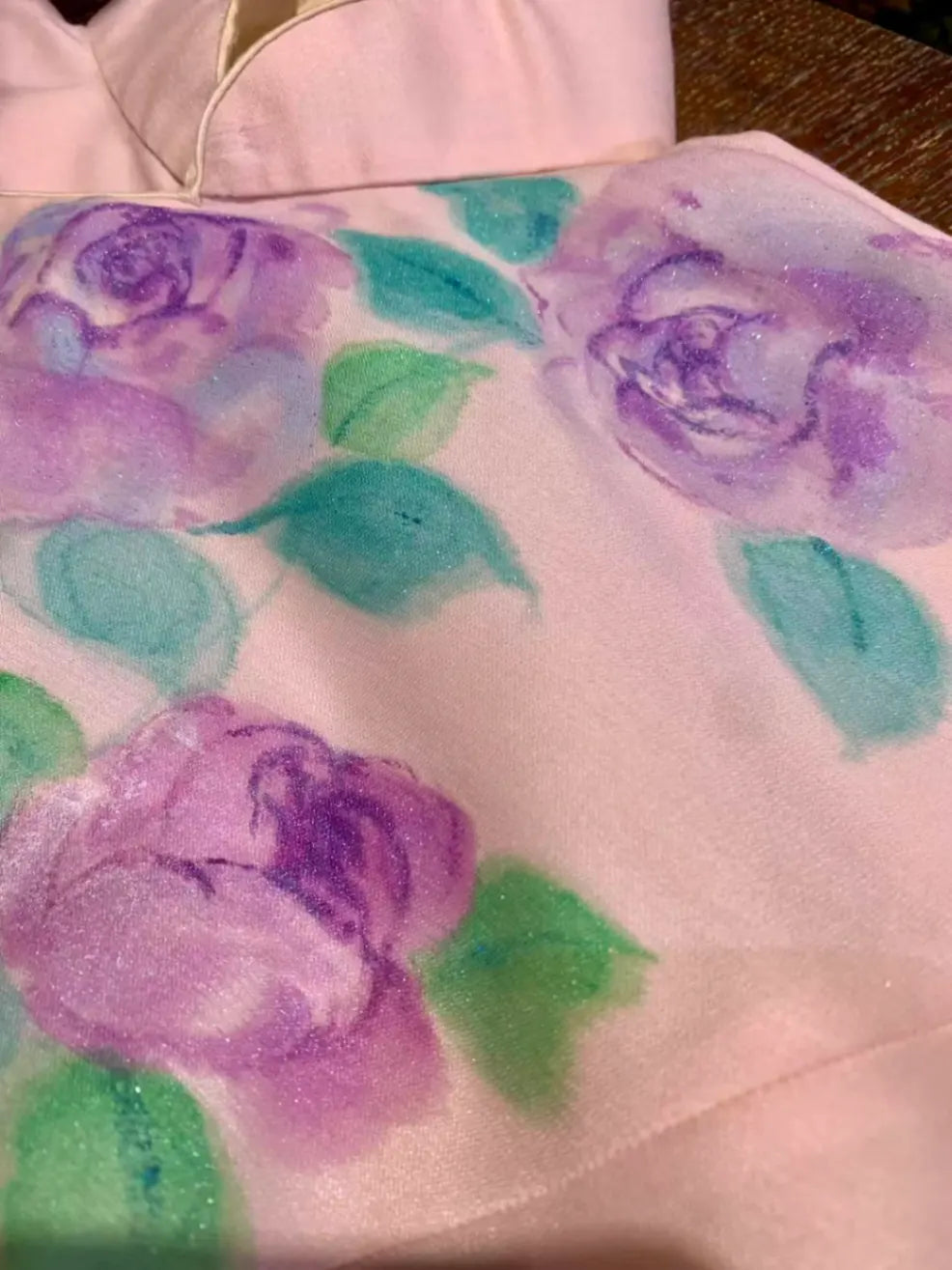
Craftsmanship (Craftsmanship): Rather than mechanical printing, the motif is executed through painstaking traditional hand-painting (Hand-painted). Working with a brush in place of a needle and pigment in place of thread, the artist used deeply penetrating textile paints layered in washes to achieve the luminous bleeding effects of a watercolor painting.
-
Motif (Motif): The focal motif features cascading purple roses (Climbing Purple Roses) tumbling from the right shoulder and winding toward the hem like climbing vines brimming with organic vitality. In classical Chinese literary tradition, purple and trailing wisteria evoke "auspicious purple mist arriving from the East" and mysterious nobility; in 1960s Hong Kong, pairing a Western rose subject with a freehand (Xieyi) Chinese brushwork sensibility stands as an ideal footnote to East-West aesthetic fusion.
-
Details (Details): A closer look across the petals reveals faint accents of gold powder or sequins—an inventive touch by the artist designed so that beneath the lights of a dance floor, the garment catches the wearer’s movement and shimmers like a river of stars.
IV. Literary Footnote: Fragrant Robes and Shadowed Tresses, Years Gilded in Gold
"Most heartbreaking in this mortal world is what cannot be held: rosy youth bids farewell to the mirror, and blossoms part from the bough."
This Qipao brings to mind the old Hong Kong chronicles of Lilian Lee, or the finely wrought women of Eileen Chang’s prose dressed in "scallion green paired with peach pink." It does not belong to a noisy modern bustle; it belongs to evenings lit through floor-to-ceiling windows, accompanied by jazz melodies and the turning of a gramophone.
Slipping into it almost lets one catch the scent of period perfume and hear the crisp tap of heels against timber floors—a purple rose that never fades, blooming in the crevices of time to dazzle the years and soften the passing seasons.
Archival Note for the Collector
Far more than a garment, this is a passage of history you can wear. It bears witness to the brilliance of Hong Kong’s fashion craft and carries the Eastern woman’s devoted pursuit of beauty. May whoever claims this piece read the myriad stories and subtleties held within its folds.