溯源
无法加载取货服务可用情况
历史的注脚:六十年代的“东情西韵”
这件时装裙最引人瞩目的,便是它身上那种奇妙的文化交融感。这恰好是二十世纪六十年代时装史上一个极具代表性的特征。
彼时,旗袍这门技艺的中心已迁移至香港。随着大批技艺精湛的红帮裁缝南迁,旗袍迎来了它的高光时刻。为了迎合战后国际时尚的审美与女性对现代性的追求,旗袍不再拘泥于传统的平面裁剪。西方的立体剪裁(Princess Line)被大量引入,通过“收省”、“装袖”等工艺,使服装能完美贴合人体的胸、腰、臀曲线,展现出迷人的S形。这种改良后的旗袍被称为“港式旗袍”或“长衫”,成为了“东情西韵”的最佳代名词。
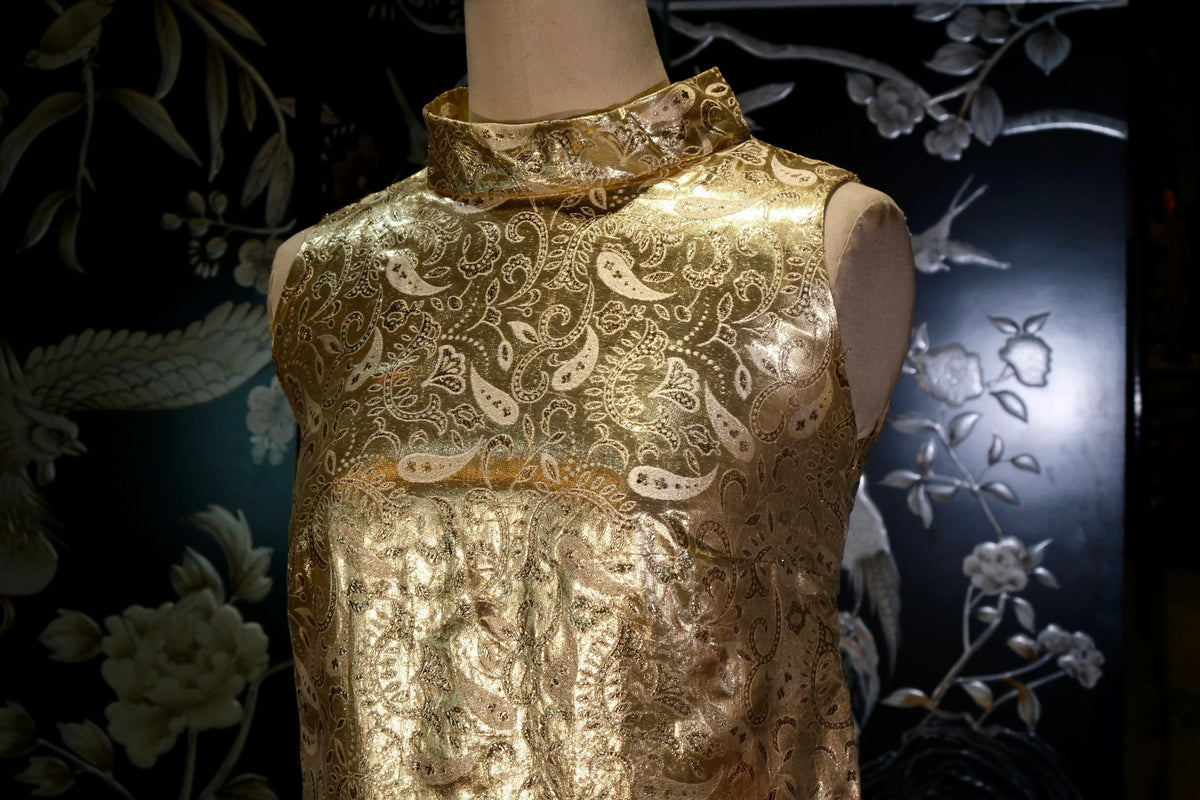
图片中这件时装裙,正是这一历史时期的完美产物。
工艺的解构:当东方形制邂逅意大利提花
现在,让我们来细细品味这件华服的匠心独运之处。
* 面料之魂:意大利提花
这件裙装的面料堪称灵魂所在。它采用了一种极其奢华的金色提花(Brocade)工艺。从光泽和质感判断,其中极可能融入了当时备受追捧的金属丝线(Lurex),这在六十年代的意大利高级成衣中颇为流行。这种面料赋予了衣物如阳光下的流金般耀眼的光泽,在光线下明暗变化,宛如流动的盛宴。
* 图案之美:佩斯利(Paisley)的异域风情
满织的图案是经典的佩斯利花纹(Paisley)。这种源于古印度的生命之树图腾,在十九世纪传入苏格兰,并在六十年代成为风靡全球的时尚符号,代表着自由、波西米亚式的浪漫与对异域文化的向往。当这一充满生命律动的西式纹样,织造在象征东方华贵的金色提花之上,便碰撞出一种独特的、超越地域的奢华美学。
* 版型之妙:海派旗袍的“减法”与“立体化”
* 廓形:裙身采用了改良的A字廓形,线条简洁利落,没有传统旗袍繁复的滚边、盘扣,体现了六十年代崇尚的简约现代主义精神。
* 细节:高而挺括的中式立领,是这件衣服的“文眼”。它克制而内敛,如同一个庄重的引言,瞬间点明了其东方的文化基因。而最引人注目的,莫过于其背部的大胆“水滴形”挖空设计。这一极具现代感与挑逗意味的细节,与正面端庄的立领形成了绝妙的戏剧性对比,是西方时装设计思维的极致体现,既保留了东方的神秘,又展露了现代的自信。
文学的遐想:金缕一曲
若要以文学的笔触为这件华服写一段注脚,我想它应该是这样的:
它诞生于一个流光溢彩的时代,身上交织着两种截然不同的文明密码。
远渡重洋的意大利金线,编织着关于奢华与浪漫的西方绮梦;而领口那一道含蓄的立领,则是东方美学最后的矜持。佩斯利花纹如藤蔓般蔓延,诉说着对自由与远方的渴望。
当穿着者转身,那道如惊鸿一瞥般的背部镂空,是六十年代女性自我意识觉醒的宣言——既有古典的优雅,亦有现代的果敢。这不仅是一件衣服,更是一首用针线写就的、关于融合与变革的诗。
总而言之,这套60年代的意大利提花时装裙,是一件将特定历史时期的文化风貌、精湛的纺织工艺与超越时代的设计美学完美融合的杰作。它既是西方高级时装的华美篇章,也是东方旗袍演变史上的璀璨明珠。
The most arresting dimension of this gown resides in its wondrous sense of cultural synthesis—a quintessential hallmark defining 1960s fashion history.
During that era, the epicenter of Qipao craftsmanship had migrated to Hong Kong. Accompanying the southward migration of master Shanghai tailors (Red Band Tailors), the Qipao entered its golden epoch. To align with post-war international aesthetic sensibilities and women’s pursuit of modernity, the garment abandoned rigid, flat two-dimensional pattern-making. Western three-dimensional tailoring—such as princess lines (Princess Line)—was widely integrated. Through techniques like precision darting and set-in sleeve construction, garments impeccably contoured the bust, waist, and hip curves into a captivating S-shape. This evolved form, celebrated as the "Hong Kong-style Qipao" or Changshan, became the ultimate synonym for East-West fusion.
This dress stands as a flawless creation of that historical epoch.
The Soul of the Textile: Italian Jacquard Brocade The dress's fabric constitutes its absolute soul, deploying an extraordinarily luxurious metallic jacquard brocade (Brocade). Judging by its luster and body, it highly likely incorporates metallic threads (Lurex)—a fiber immensely popular throughout 1960s Italian haute couture and ready-to-wear. This textile endows the garment with a radiance akin to molten gold beneath the sun, refracting light and shadow to create a truly moveable feast.
The Beauty of Motif: The Exotic Romance of Paisley The full-coverage motif features classic Paisley patterns (Paisley). Originating from ancient India's tree-of-life totem, Paisley traveled to Scotland in the 19th century before emerging as a global sartorial phenomenon in the 1960s—symbolizing freedom, bohemian romance, and a yearning for exotic cultures. When this dynamic Western motif is woven across a gold jacquard ground signifying Eastern majesty, it sparks a unique, trans-regional aesthetic of luxury.
The Ingenuity of Tailoring: Minimalist Refinement of the Shanghainese Qipao
Silhouette: The dress adopts a modernized A-line contour (A-line Silhouette) defined by clean, sharp lines. Dispensing with traditional multi-layered piping and frog button closures, it mirrors the minimalist modernist spirit championed in the 1960s.
Details: The high, crisp mandarin collar (Mandarin Collar) functions as the literary anchor of the design. Restrained and introverted, it acts like a solemn prologue, instantly establishing its Eastern cultural DNA. Yet the most striking feature remains the bold, back teardrop cutout (Keyhole Back Cutout). This modern, alluring detail creates a dramatic contrast against the decorous front collar, epitomizing Western couture thinking—preserving Eastern mystery while asserting modern self-confidence.
If a literary footnote were penned for this creation, it might read as follows:
Born into a luminous epoch, it carries the intertwined codes of two distinct civilizations. Cross-oceanic Italian gold threads weave a Western dream of luxury and romance, while the subtle mandarin collar maintains the final, dignity of Eastern aesthetics. Paisley vines cascade across the expanse, whispering of freedom and distant horizons. As the wearer turns, the breathtaking keyhole cutout at the back serves as a manifesto of 1960s female self-awakening—marrying classical elegance with modern courage. This transcends mere apparel to become a poem inscribed in needle and thread, chronicling fusion and transformation.
This 1960s Italian jacquard dress remains a masterpiece seamlessly harmonizing period history, sublime textile engineering, and timeless design aesthetics—a brilliant chapter in Western couture and a radiant jewel in the evolution of Eastern fashion.