深圳溯源
无法加载取货服务可用情况
衣服尺寸:
胸围/腰围/臀围:84/68/98 厘米
衣长:135 厘米
细节描述:
【引言:衣以载道,红妆倾城】
张爱玲曾言:“对于不会说话的人,衣服是一种语言,随身带着的是袖珍戏剧。” 这件诞生于上世纪六十年代香港的红色旗袍,便是一出无声却跌宕起伏的戏剧。它不仅是那个黄金时代的见证者,更是中国传统织造技艺与西式立体剪裁完美融合的孤本。
【图案与肌理:浮雕般的触感美学】
请凝视这抹醉人的朱砂红。这并非普通的平面印染,而是一种极为罕见的“膨织”工艺。
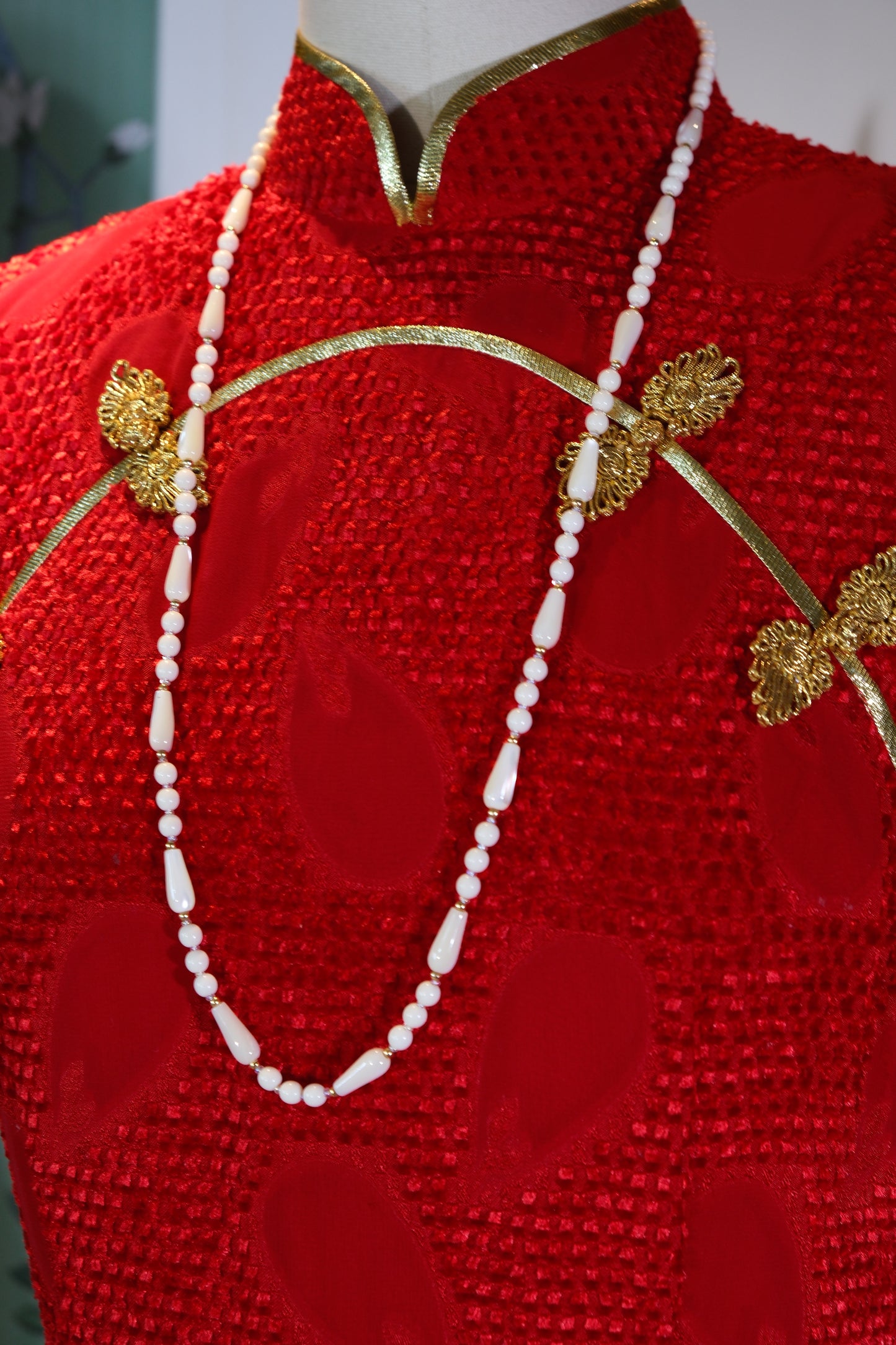
- 视觉与触觉的双重盛宴: 面料表面呈现出一种类似浮雕的立体肌理。底纹是细密如鱼子般的颗粒感,而在其上,错落有致地浮凸着巨大的水滴状(或称叶片状)暗纹。这种设计打破了传统丝绸的平滑单调,赋予了织物如同建筑般的雕塑感。
- 光影的捕捉者: 这种特殊的织法使得光线在衣物表面流转时,会产生丰富的漫反射。随着穿着者的走动,那些红色的“水滴”仿佛在呼吸,明暗交替间,尽显奢华而不张扬的高级质感。
【形制与工艺:西风东渐下的极致优雅】
这件旗袍的剪裁,精准地复刻了六十年代香港旗袍的巅峰形态——那是中西文化碰撞最激烈的时刻。
- 独特的双襟设计: 不同于常见的单开襟,此衣采用了极具装饰性的双襟结构。金色的滚边如游龙般勾勒出领口与肩部的线条,并在胸前形成优雅的弧线。
- 精致的盘扣点缀: 肩部与领口处,镶嵌着四枚金线编织的蝴蝶结状盘扣(或类花型扣),它们不仅仅是功能性的系带,更像是停驻在红衣上的金色蝴蝶,为庄重的红色增添了一丝灵动与俏皮。
- 曳地的仪式感: 裙长及踝甚至曳地,配合无袖削肩的设计,极大地拉长了身形比例。这种长度在六十年代通常只出现在晚宴或极其隆重的场合,象征着穿着者尊贵的身份与从容的气度。
【历史的回响:香江旧梦与稀缺价值】
为何说它是稀缺的孤品?
- 工艺的失传: 六十年代的香港纺织业虽发达,但这种高成本的“浮雕膨织”面料因工序繁复、成品率低,往往只供极少数定制客户。随着成衣工业化浪潮的席卷,这种不计成本的面料早已消失在历史长河中。
- 时代的绝唱: 这件旗袍处于传统手工盘扣向现代拉链过渡的微妙时期,保留了最纯正的手工温度。它让人联想到电影《花样年华》中苏丽珍的背影,那是属于那个时代特有的含蓄与风情。
【结语:引经据典,传世之作】
《诗经·秦风》有云:“锦衣狐裘,颜如渥丹。” 古人以锦衣华服喻君子之德与美人之姿。这件红袍,色泽如渥丹般纯正热烈,肌理如锦缎般繁复精美。
它不仅仅是一件衣服,它是六十年代香江名媛们夜夜笙歌的缩影,是东方女性曲线美的极致表达。在这个快时尚泛滥的年代,拥有一件这样经得起放大镜审视的古董旗袍,便是拥有了一段可以触摸的历史,一份永不褪色的东方雅致。
Measurements / Size Guide:
Bust / Waist / Hips: 84/68/98 cm
Total Length: 135 cm
Detailed Description:
Within the matrix of antique costume curation, an archival garment operates far beyond the boundaries of standard fashion; it serves as a highly complex visual recording of a specific historical anchor. As the iconic modern writer Eileen Chang famously observed in her archival fashion critique Chronicle of Changing Clothes (更衣记):
"For those who are unable to speak, clothes are a language—a pocket drama that they carry around with them everywhere."
This exceptional 1960s Hong Kong-produced crimson evening qipao stands as the undisputed protagonist of that mid-century pocket drama. It exists as a rare museum-grade specimen capturing the precise historical moment where ancestral imperial textile traditions merged seamlessly with post-war Western haute couture pattern drafting.
The immediate design triumph of this garment rests within its deep, captivating cinnabar crimson color register. Rejecting flat, superficial surface printing entirely, this textile achieves its dramatic depth through a highly sophisticated, historical embossed cloqué weaving process (pengzhi).
The Tactile Low Relief: The fabric face presents a complex, multi-registered structural texture. The underlying foundation register features a hyper-dense, granular matrix reminiscent of fine caviar. Rising prominently above this ground is an asymmetrical layout of macro water-drop (or leaf-shaped) medallions woven directly in high-relief. This architectural choice shatters the visual flatness typical of older regional silks, granting the textile an undeniable sense of sculptural mass.
The Capture of Light: This specialized weaving method transforms the surface into an active capture mechanism for ambient light, generating rich diffuse reflections across the crimson pile. As the wearer moves, the embossed drop motifs appear to expand and contract sequentially, shifting through gradations of light and shadow to project a deeply disciplined, elite luxury.
The pattern drafting faithfully revives the absolute peak design standard of 1960s Hong Kong bespoke tailoring (gang-gong banxing), an era celebrated across costume history for its fearless hybrid aesthetics.
The Double-Pajin Framework: Departing from the ubiquitous single diagonal closure, this gown deploys an intricate, highly decorative symmetrical double-front bodice layout (shuang-pajin). Luxury gold bullion thread piping encases the entire perimeter like a fluid line, tracing clean geometric trajectories across the mandarin collar, armscyes, and shoulder seams to map out a commanding, elegant upper bodice line.
The Metallic Frog Matrix: Nestled symmetrically across the throat and shoulder lines are four hand-sculpted, butterfly-knot metallic frog closures (pankou). Operating far beyond simple functional fasteners, these hand-coiled gilded accents function as high-jewelry statements, breaking up the density of the crimson canvas with micro-points of brilliant illumination.
The Imperial Length: The dramatic floor-sweeping hemline combined with an aggressive, recessed sleeveless shoulder draft (xiao-jian) works mathematically to elongate the human form. This specialized layout confirms the gown was never engineered for daily wear; it was custom-commissioned as elite evening wear tailored exclusively for high-society galas, formal banquets, or diplomatic circles.
From an academic perspective within material history, this artifact commands immense valuation based on its preservation of vanishing handcraft and structural rarity:
The Extinction of Cloqué Matrixes: While the post-war Hong Kong textile sector was globally renowned, this specific breed of high-cost embossed cloqué fabric was produced in highly limited numbers, reserved exclusively for the most prestigious custom couture clients due to its complex mechanical setup and low factory yield rates. Following the subsequent waves of rapid mass-market industrialization, this uncompromising material vanished completely from global commercial supply chains.
The Golden Transition of Fasteners: This specimen captures a critical, fleeting evolutionary step in modern costume history. Positioned at the precise mid-century transition where traditional manual frog closures were beginning to give way to automated Western metal zippers, this gown proudly preserves the absolute peak of hand-executed structural warmth. It manifests the exact material atmosphere captured in classic mid-century cinematic masterpieces—a silent, evocative monument to mid-century Eastern grace.
The ancient anthology The Book of Odes (诗经·秦风) famously observes: "Clad in fine brocades and furs, her countenance shines like pure vermilion." Throughout costume history, the ultimate textile weight has always been weaponized to reflect both the inner character of the individual and the peak of societal achievement.
This crimson gown transcends the parameters of standard attire; it is a sealed, material dream of mid-century Hong Kong. In a contemporary landscape dominated by disposable fast fashion, this antique artifact stands as an immutable anchor of tactile history, offering an uncompromising standard of cross-cultural elegance that time can never diminish.
Suyuan Silk Archive — Preserving the soul of historic textiles, documenting the lineage of master craft.