深圳溯源
无法加载取货服务可用情况
衣服尺寸:
胸围/腰围/臀围:100/86/104 厘米
衣长:125 厘米
细节描述:
“锦衣若水,流光回溯。”
在服装史的浩瀚长河中,二十世纪六十年代的台湾正处于一个微妙的文化交汇点。彼时,西风东渐与东方传统在此激烈碰撞又温柔融合。这件旗袍,便是那个黄金时代最优雅的注脚。它并非出自寻常裁缝铺的随手之作,而是当时台湾高级成衣工坊引进日本进口精密机绣蕾丝面料后的匠心结晶。
一、 纹样解构:几何秩序下的浪漫主义
凝视这件旗袍的面料,我们看到的不仅是花,更是一种严谨的视觉韵律。
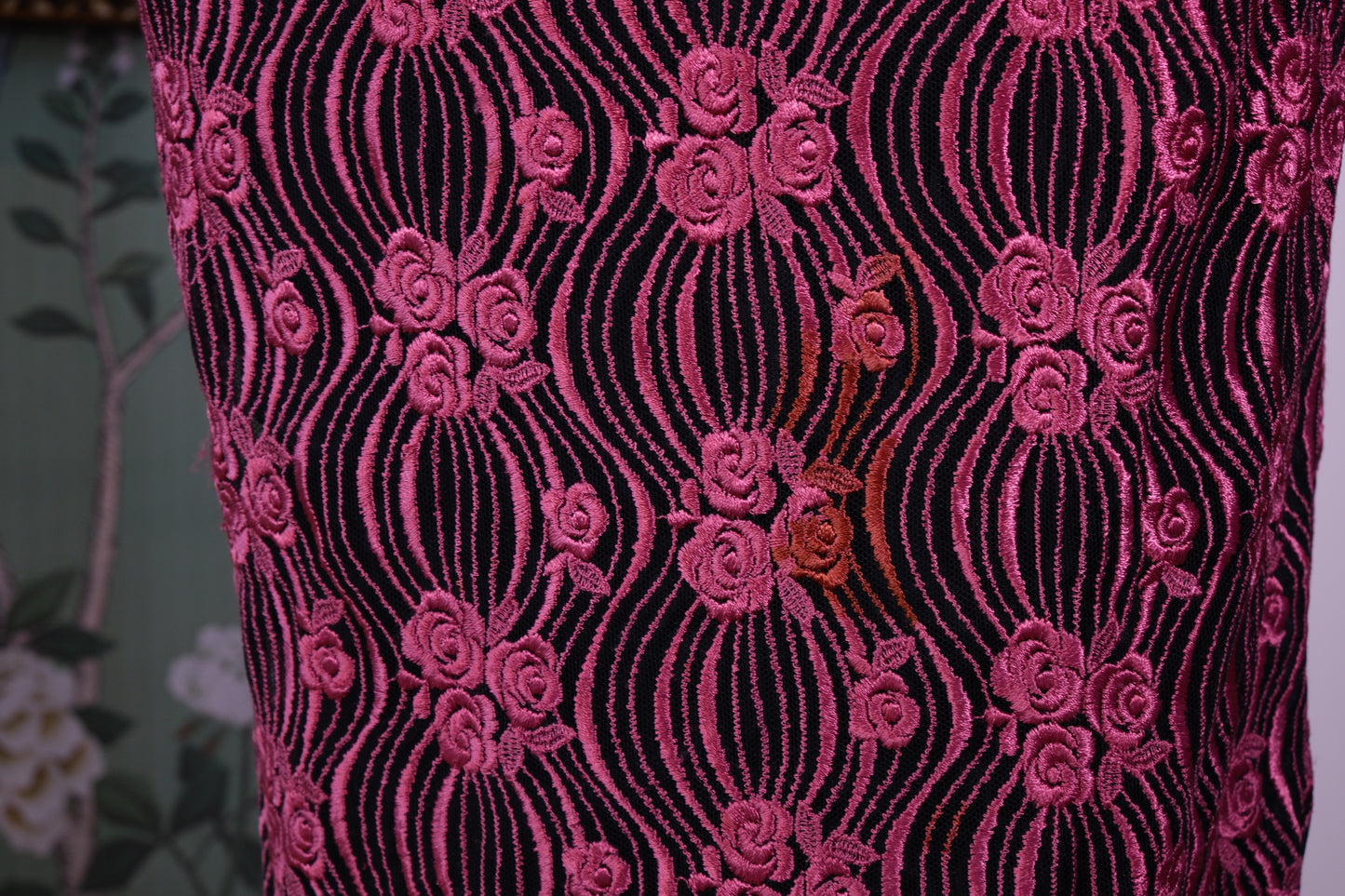
- 底纹的流动性: 面料底色采用了深邃的暗夜黑,其上交织着如同水波般起伏的粉色流线。这种波浪纹样(Wave Pattern)在装饰艺术(Art Deco)晚期至现代主义过渡时期极为流行,象征着流动的生命力与摩登时代的节奏感。
- 玫瑰的立体叙事: 在这流动的波纹之上,盛开着朵朵立体的粉色玫瑰。请注意这些玫瑰并非平面印染,而是通过高难度的日式机绣工艺(Machine Embroidery),利用丝线的堆叠营造出浮雕般的质感。玫瑰花瓣层层叠叠,既有西方植物学的写实结构,又兼具东方刺绣的细腻温婉。
- 色彩的张力: 艳丽的洋红与沉稳的黑底形成强烈的视觉反差,正如张爱玲笔下那种“热烈而苍凉”的美学——在压抑中爆发出的生命力。
二、 剪裁与形制:海派风骨的延续与改良
从形制上看,这件旗袍完美继承了海派旗袍“中西合璧”的精髓,并带有明显的六十年代特征:
- 连袖与装袖的博弈: 它采用了改良式的短袖设计,肩部线条圆润自然,既保留了传统连袖的含蓄,又通过剪裁技巧适应了当时对于女性挺拔身姿的审美追求。
- 极致的收腰: 六十年代的审美开始强调女性的曲线美。这件旗袍的腰身收得极紧,臀围处却处理得圆润饱满,这种S型曲线的塑造,是对穿着者身材极大的考验,也是当时上流社会女性自信展示身体语言的证明。
- 立领的坚守: 经典的元宝领高度适中,紧扣颈部,不仅修饰了颈项线条,更在视觉上拉长了身形,透出一股不可侵犯的高贵与端庄。
三、 历史回响:稀缺性与文化隐喻
《诗经·秦风》云:“锦衣狐裘,颜如渥丹。”
古人以锦衣华服喻指尊贵的身份与美好的容颜。而这件旗袍,则是那个特定年代“锦衣”的现代演绎。
- 材质的断代史: 这种日本进口的机绣蕾丝面料,在当时属于昂贵的奢侈品。六十年代的台湾纺织业虽然发达,但此类高精度的提花与刺绣面料多依赖进口。随着时间推移,这种特定工艺的库存面料早已绝迹,存世量极少。
- 工艺的不可复制性: 现代的机器刺绣往往追求效率而失之于匠气,而这件古董衣上的针法,明显带有老式缝纫机特有的顿挫感与手工修整的痕迹。每一朵玫瑰的走向,都记录着当年那位不知名工匠的指尖温度。
- 岁月的包浆: 经过半个多世纪的沉淀,面料的光泽已不再是初出织机时的生硬贼光,而是转化为一种温润如玉的哑光质感。这是时间赋予古董衣独有的“包浆”,是新衣永远无法模仿的灵魂。
【结语】
这不仅是一件用来穿着的衣服,更是一件可以传世的织物艺术品。它见证了东亚时尚从传统向现代转型的关键一刻。穿上它,你穿上的不只是六十前的风情,更是一段关于美、关于技艺、关于那个流金岁月的无声史诗。
适合场合: 高端私人晚宴、复古主题派对、艺术展览开幕式、重要纪念日。
注释:瑕疵特价
Measurements / Size Guide:
Bust / Waist / Hips: 100/86/104 cm
Total Length: 125 cm
Detailed Description:
"Fine clothing flows like water; time ripples backward."
In the vast river of costume history, Taiwan during the 1960s occupied a delicate cultural intersection. At that time, the eastward shift of Western trends and local Eastern traditions collided intensely yet merged tenderly. This qipao stands as the most elegant footnote to that golden generation. It is no ordinary product of a common tailor shop, but a masterful crystallization of a high-end Taiwanese ready-to-wear atelier utilizing premium imported Japanese precision machine-embroidered lace fabric.
Gazing upon the fabric of this qipao, what we perceive is not merely a floral arrangement, but a highly disciplined visual rhythm.
The Mobility of the Ground Texture: The primary background of the textile utilizes a deep, nocturnal black, interwoven with undulating pink fluid lines that mimic soft water ripples. This wave pattern was exceptionally prevalent during the transition period from late Art Deco to early modernism, symbolizing fluid vitality and the kinetic rhythm of the modern era.
The Three-Dimensional Narrative of the Roses: Atop these flowing ripples, dimensional pink roses blossom in full form. Please note that these roses are not flat prints; they are sculpted via high-difficulty Japanese machine embroidery (Machine Embroidery), relying on the precise layering of silk filaments to create a low-relief tactile surface. The rose petals stack layer upon layer, balancing the realistic botanical structures of the West with the delicate, gentle warmth of Eastern embroidery.
Chromatic Tension: The brilliant magenta contrasts sharply with the deep, steady black ground, perfectly materializing the "passionate yet desolate" aesthetic famously described by Eileen Chang—a burst of vital life force breaking out from absolute confinement.
From the perspective of its structural framework, this qipao perfectly inherits the core essence of the Shanghai style’s (海派) synthesis of East and West, while projecting distinct 1960s design characteristics:
The Dynamic Between Continuous and Set-in Sleeves: It adopts a modified short sleeve configuration where the shoulder line remains rounded and natural. This design preserves the modest restraint of the traditional continuous sleeve while utilizing tailored adjustments to accommodate the generation's preference for an upright, commanding posture.
Extreme Waist Reduction: The design language of the 1960s placed immense emphasis on the natural curves of the female form. The waistline of this qipao is drawn in exceptionally tight, while the hip measurement is sculpted to appear full and rounded. The execution of this sharp S-curve profile serves as a strict test of the wearer's anatomy and stands as definitive physical proof of the confidence high-society women possessed in displaying their physical body language.
The Persistence of the Standing Collar: The classic Yuanbao collar is moderate in height and fastens securely at the throat. It does more than frame the neck contours; it visually elongates the entire stature, projecting an unyielding noble dignity and poise.
As the ancient text The Book of Songs • Qin Wind (《诗经·秦风》) states: "Dressed in fine brocades and fox furs, her face is as radiant as red cinnabar."
The ancients utilized exquisite embroidered robes as metaphors for noble status and beautifulcountenances. This qipao serves as a modern manifestation of that historical "fine clothing."
A Chronological Specimen of Material History: This type of imported Japanese machine-embroidered lace yardage operated as an expensive luxury commodity during that era. Although Taiwan's localized textile sector was growing rapidly in the 1960s, high-precision jacquard and embroidered fabrics of this caliber relied heavily on international imports. With the passage of decades, the original stock of this specific textile run has completely vanished, rendering surviving specimens exceptionally rare.
The Irreproducibility of Hand-Finished Craft: Modern automated embroidery consistently pursues rapid efficiency at the cost of human character. Conversely, the stitch passes across this antique garment carry the distinct cadence of vintage machinery paired with honest traces of manual hand-finishing. The pathing of every single rose records the absolute fingertip warmth of an anonymous mid-century artisan.
The Patina of Time: Spanning more than half a century of natural settlement, the luster of the textile has shed the harsh, artificial shine common to fresh loom-work. It has transformed instead into a muted, soft matte depth resembling aged jade. This is the exclusive chronological patina that time bestows upon authentic antique garments—a living soul that new reproductions can never replicate.
This is far more than a functional garment meant for wear; it stands as an irreplaceable, transmissible work of textile art. It bears silent witness to the critical milestone when East Asian fashion transitioned from ancestral tradition to global modernism. To slip it on is to wrap oneself in far more than sixty years of mid-century glamour; it is to step directly into a silent epic of beauty, handcraft, and that unforgettable golden era.
Optimal Settings for Display: Haute private evening galas, retro-themed heritage events, fine art exhibition openings, and landmark anniversaries.
Suyuan Archival Textile Registry — Documenting the material culture, preserving the technical lineage of ancestral craft.
Note:As-Is Special Price