深圳溯源
无法加载取货服务可用情况
衣服尺寸:
胸围/腰围/臀围/衣长:88/74/98/101 厘米
细节描述:
一、 器物之美:繁花深处的东方隐喻
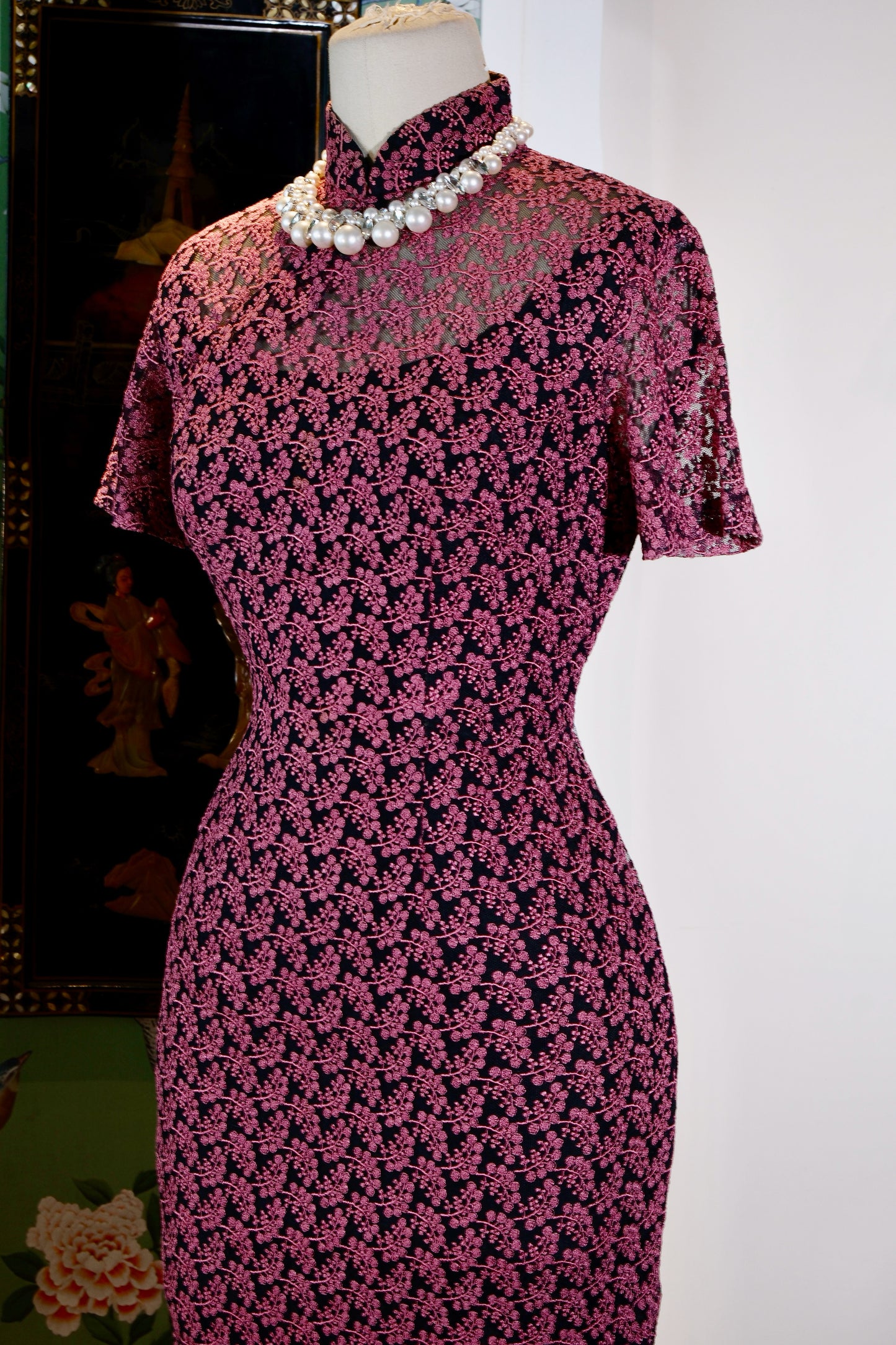
凝视这件旗袍,首先映入眼帘的是那如夜色般深邃的底布上,盛开着层层叠叠的紫红色梅花。
这并非寻常的印花,而是典型的日本进口机绣蕾丝(Japanese Machine-made Lace)工艺。在那个年代,这种面料本身就是奢华的代名词。工匠利用精密的纺织机械,将人造丝或棉线织就出极具立体感的镂空花纹。
* 图案解读: 衣身上的纹样是经典的“折枝梅”变体。梅花在中国传统文化中象征着“傲骨”与“高洁”,《诗经·召南》有云:“标有梅,其实七兮。”而在日本文化中,樱花与梅花皆代表着物哀之美与生命的绽放。
* 色彩美学: 底色选用沉稳的黑色或深藏青,如同静谧的夜空;而刺绣部分则采用了带有光泽感的紫红(Magenta)色调。这种配色在视觉上极具张力,既保留了传统东方的含蓄,又大胆吸收了西方Art Deco(装饰艺术)时期对对比色的运用,显得摩登而艳丽。
* 透视之魅: 请注意领口至胸前的“挖胸”设计(Keyhole Cutout)与半透明的蕾丝肩部。这是五十年代旗袍受好莱坞电影影响的显著特征。它在传统的立领之下,巧妙地露出一抹肌肤,这种“犹抱琵琶半遮面”的性感,比直接的裸露更具高级感,完美诠释了张爱玲笔下那种“世俗的华丽”。
二、 历史回响:跨海而来的时尚迁徙
这件旗袍的身世,是一部微缩的东亚近代史。
标签上的“台湾制造”与面料来源的“日本进口”,揭示了1950年代特殊的贸易背景。彼时,台湾正处于光复后的重建期,也是旗袍发展的黄金余晖。当时的台湾轻工业正在起步,但高端纺织原料仍高度依赖日本进口。
这不仅是一件衣服,它是那个时代“台日纺织贸易”的实物见证。我们可以想象,一位生活在台北或上海的时髦女性,在裁缝店里挑选了这块昂贵的日本进口蕾丝,特意嘱咐师傅做成最时兴的改良款式。她或许刚刚看完一场露天电影,或许正准备去参加一场舞会。这件衣服,承载了战后一代女性对美好生活的向往与追求。
三、 稀缺价值:不可复制的工业遗产
为何说它稀缺?
1. 工艺的断代: 这种老式的日本机绣蕾丝,随着化纤工业的变革和廉价纺织品的冲击,早已停产。现代机器虽然能模仿花纹,却难以复刻那种经过岁月沉淀后依然挺括、光泽温润的质感。
2. 保存的难度: 蕾丝面料娇贵,极易勾丝、脆化。这件旗袍历经七十年风雨,依然品相完好,色泽如初,甚至连原本的弹性都保留了几分,这在古董衣收藏界属于“博物馆级”的品相。
3. 版式的绝唱: 五十年代的旗袍正处于从“传统平面剪裁”向“西式立体省道”完全过渡的时期。你看它腰部的收省(Darts)非常精准,完美贴合人体曲线,这是后来成衣化大规模生产所逐渐丢失的手工温度。
四、 结语:穿在身上的文学
沈从文先生曾在《中国古代服饰研究》中感叹服饰变迁之快。而这件旗袍,恰恰定格了那个新旧交替、中西合璧的最美瞬间。
它不仅仅是一块布料,它是“花间一壶酒”的诗意,是“夜来香”的芬芳。当你穿上它,你穿上的不仅是五十年代的优雅,更是一份对逝去时光的深情致敬。
Measurements / Size Guide:
Bust / Waist / Hips / Total Length: 88/74/98/101 cm
Detailed Description:
Gazing upon this qipao, one’s eyes are instantly captured by the layers of rich magenta plum blossoms blooming across a background substrate as deep and silent as the night.
This layout is by no means a conventional surface print, but a textbook execution of mid-century Japanese Machine-made Lace (日本进口机绣蕾丝) technology. In that decade, this specific textile was the absolute definition of material luxury. Utilizing precision textile machinery, artisans wove rayon or fine-spun cotton threads to construct a highly dimensional, openwork lace matrix.
Motif Interpretation: The surface patterns present a classic variation of the "broken-branch plum blossom" (折枝梅). Within the traditional Chinese cultural lexicon, the plum blossom symbolizes pride, resilience, and noble purity, as the ancient Book of Odes (Shijing: Shaonan) poetically notes: "The plums are falling from the tree, only seven-tenths of them remain." Concurrently, within Japanese aesthetics, both the cherry blossom and the plum blossom represent the ephemeral beauty of mono no aware and the magnificent blooming of life.
Color Aesthetics: The background substrate implements a composed black or deep midnight blue, resembling a quiet night sky, while the embroidered elements utilize a lustrous magenta. This color pairing delivers immense visual tension—preserving traditional Eastern restraint while boldly absorbing the high-contrast color theory of the Western Art Deco movement, yielding an aesthetic that is simultaneously modern and opulent.
The Allure of Transparency: Observe the delicate Keyhole Cutout (挖胸) at the collarbone and the semi-transparent lace shoulders. This design is a defining hallmark of 1950s qipaos influenced by Hollywood cinema. Placed strategically beneath the traditional standing collar, it reveals a subtle glimpse of skin. This "partially hidden, partially revealed" sensuality is far more sophisticated than direct exposure, flawlessly translating the "secular splendor" so beautifully captured in Eileen Chang's literature.
The provenance of this qipao serves as a micro-history of modern East Asia.
The juxtaposition of the "Made in Taiwan" manufacture label alongside the "Imported from Japan" textile origin reveals the highly unique trade dynamics of the 1950s. During this post-war reconstruction era, Taiwan experienced the golden twilight of the qipao's evolution. While Taiwan's domestic light industry was beginning to take flight, high-end luxury textile yardage remained heavily dependent on imports from Japan.
This garment stands as a primary physical document of that historic "Taiwan-Japan textile trade." One can easily envision a fashionable woman living in Taipei or Shanghai, selecting this expensive imported Japanese lace at a bespoke tailoring salon and instructing the master tailor to construct the latest modified silhouette. Perhaps she had just finished watching an outdoor movie, or was preparing for a grand evening gala. This garment archives the post-war generation of women's profound yearning for beauty and a refined life.
What drives the extraordinary curatorial scarcity of this piece?
The Chronological Discontinuity of the Craft: This species of vintage Japanese mechanical embroidery lace has long been out of production, swept away by the post-1960s synthetic fiber revolution and the onslaught of cheap mass-produced textiles. While modern machinery can easily mimic the decorative patterns, it cannot replicate the crisp hand-feel, structural weight, and soft, jade-like luster settled through decades of time.
The Extreme Difficulty of Preservation: Lace is inherently delicate, highly vulnerable to snagging, fiber breakdown, and structural oxidation. For this qipao to journey through seventy years of history while retaining absolute structural integrity, its original color saturation, and even a degree of its original textile elasticity, is a statistical anomaly. Within the antique clothing market, this piece commands a strict "museum-grade" preservation rating.
The Swan Song of Pattern Drafting: The 1950s marked the critical transition where the qipao shifted completely from "traditional flat pattern drafting" to "Western three-dimensional darting." Observe the precision of the structural waist and bust darts (收省); they mathematically contour to the anatomical curves of the human form, capturing a level of manual warmth and bespoke fitting that was permanently lost to later industrial mass production.
In his seminal work Research on Ancient Chinese Costumes, Mr. Shen Congwen lamented the rapid, fleeting nature of sartorial evolution. This qipao permanently freezes that magnificent, transient moment where the old guard met the new, and where East and West seamlessly merged.
It is far more than a simple assembly of woven threads; it carries the poetic grace of "a pot of wine amidst the blossoms" and the lingering fragrance of evening primrose. To step into its form is not merely to don the elegance of the 1950s, but to pay a deep, soulful tribute to a bygone golden era.