海上花列传:六十年代香港织金钉珠古董裙
在时光的褶皱里,藏着几件会呼吸的“海上花”。这五套六十年代的古董礼服,是旧上海摩登余韵与香港黄金时代的对话,更是面料、工艺与时代精神的三重奏。
面料:意大利织金提花,流动的液态黄金
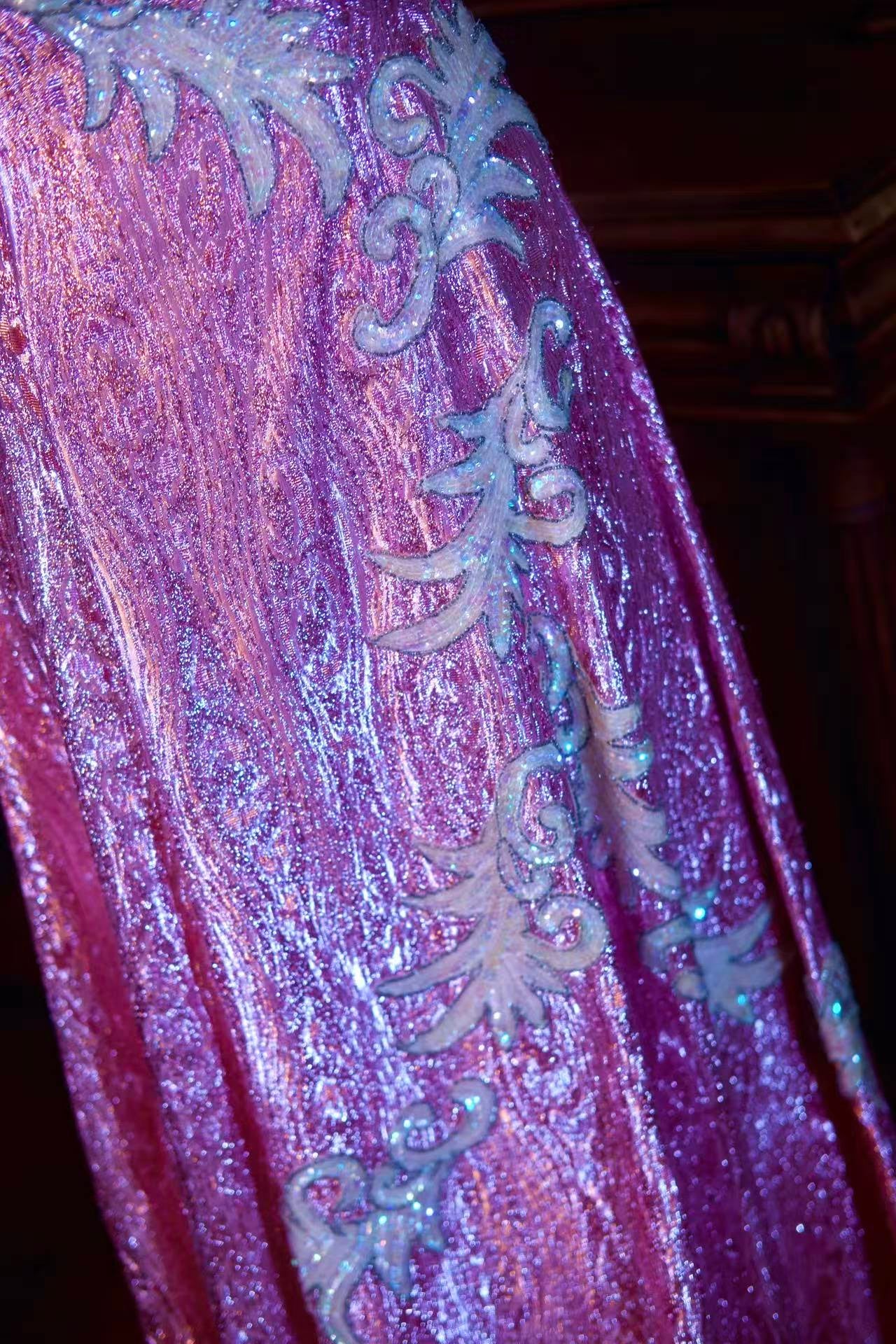
这些礼服的面料来自意大利进口的织金提花,以桑蚕丝为经,金银线为纬,在织机上交织出“金屑铺翠”的视觉盛宴。面料上的图案,是典型的“缠枝西番莲”与“宝相花”的变体——银线勾勒的花瓣如月光流淌,金线编织的藤蔓似星河蜿蜒,每一朵花的开合都暗合“花开见佛性”的东方禅意,每一缕纹的流转都藏着巴洛克式的奢华。
工艺:手工钉珠,针尖上的星河
领口、袖口与裙摆的钉珠,是香港老师傅的“指尖魔法”。每一颗米珠(米粒大小的玻璃珠)都用鱼线手工缝缀,排列成“璎珞垂云”的样式,行走时珠帘轻晃,仿佛《红楼梦》里“金翠辉煌、珠光宝气”的薛宝钗,又似《海上花列传》中“鬓云欲度香腮雪”的倌人。珠子的密度、光泽、排列角度,皆是“一针一线总关情”的匠心,这种纯手工钉珠工艺,如今已近乎绝迹。
款式:新中式廓形,东西方的温柔碰撞
五套礼服皆为“新中式”廓形:领口是改良的“元宝领”(圆领微敞,露出锁骨的风情),袖型是“琵琶袖”(短袖微喇,似琵琶半遮面),裙摆是“A字大摆”(行走时如莲花绽放)。这种设计,既保留了旗袍的“东方骨”,又融入了西方礼服的“西洋肉”,是六十年代香港“中西合璧”文化的缩影——正如张爱玲在《更衣记》中所写:“中国的衣服,是‘遮’的哲学;西方的衣服,是‘露’的哲学。而香港的衣服,是‘遮’与‘露’的辩证。”
故事:从米兰到香港,从名媛到古董
这些礼服的面料,原是意大利贵族定制的“宫廷面料”,因六十年代香港纺织业的崛起,被香港裁缝买下并改良成礼服。它们的主人,或许是某位南洋富商的太太,或许是某位电影明星,曾在兰桂坊的舞会、半岛酒店的晚宴、浅水湾的派对上,成为全场焦点。如今,它们成了“会说话的古董”——每一根丝线都藏着旧时光的温度,每一颗珠子都映着老香港的霓虹。
艺术风格:巴洛克的华丽,东方的含蓄
这些礼服的艺术风格,是“巴洛克的华丽”与“东方的含蓄”的完美融合。意大利织金提花的奢华,如同巴洛克教堂的穹顶;手工钉珠的精致,如同东方刺绣的细腻;新中式廓形的优雅,如同水墨画的留白。它们不是简单的“衣服”,而是“穿在身上的艺术品”,正如沈从文在《中国古代服饰研究》中所言:“衣服是文化的载体,是时代的镜子。”
这些礼服,不是用来“穿”的,是用来“读”的——读面料里的意大利阳光,读钉珠里的香港月光,读廓形里的东方诗意,读故事里的时代回响。它们是“海上花”的列传,是“旧时光”的情书,更是“古董衣”的灵魂。
备注: 只有最后两件在卖,其他三件均已售出
Flowers of the Haunted Sea: 1960s Hong Kong Vintage Gowns with Gold Brocade and Hand-Beading
Within the folds of time lie several "Flowers of the Sea" that seem to breathe. These five sets of 1960s vintage formal gowns represent a dialogue between the modern lingering charms of old Shanghai and the Golden Age of Hong Kong—a symphony of fabric, craftsmanship, and the spirit of an era.
Fabric: Italian Gold Brocade, a Flow of Liquid Gold
The fabric of these gowns is imported Italian gold brocade, using mulberry silk as the warp and gold or silver threads as the weft, creating a visual feast on the loom akin to "gold dust sprinkled upon emerald." The patterns are typical variations of "interlocking passionflowers" and "rosette motifs"—silver-threaded petals flow like moonlight, while gold-woven vines meander like the galaxy. The opening and closing of each flower subtly align with the Oriental Zen concept of "seeing one's nature upon the blooming of a flower," while every swirling line hides a sense of Baroque opulence.
Craftsmanship: Hand-Beading, a Galaxy on a Needlepoint
The beading on the necklines, cuffs, and hems is the "fingertip magic" of old Hong Kong master tailors. Every seed bead (glass beads the size of a grain of rice) is hand-sewn with fishing line, arranged in the style of "hanging jade and drifting clouds." When in motion, the bead curtains sway gently, reminiscent of the "brilliant gold and kingfisher feathers, shimmering with jewels" described for Xue Baochai in Dream of the Red Chamber, or the famous courtesans in The Sing-song Girls of Shanghai. The density, luster, and alignment of the beads all reflect a craftsman’s heart where "every stitch and thread conveys deep feeling." This pure hand-beading technique has nearly vanished today.
Silhouette: Neo-Chinese Style, A Gentle Collision of East and West
All five gowns feature a "Neo-Chinese" silhouette: the neckline is a modified "Yuanbao collar" (a high collar slightly parted to reveal the grace of the collarbone), the sleeve is a "Pipa sleeve" (short and slightly flared, like a lute half-hidden), and the skirt is a "full A-line" (blooming like a lotus as one walks). This design preserves the "Oriental bones" of the qipao while integrating the "Western flesh" of evening gowns. It is a microcosm of Hong Kong’s "East-meets-West" culture in the 1960s—as Eileen Chang wrote in Chinese Life and Fashions: "Chinese clothing is a philosophy of 'concealing'; Western clothing is a philosophy of 'revealing.' Hong Kong clothing is the dialectic between 'concealing' and 'revealing'."
Story: From Milan to Hong Kong, From Socialite to Antique
The fabric of these gowns was originally "palace fabric" customized for Italian nobility. With the rise of the Hong Kong textile industry in the 1960s, it was acquired by Hong Kong tailors and refashioned into formal wear. Their owners might have been the wives of wealthy Southeast Asian tycoons or film stars who once became the center of attention at Lan Kwai Fong balls, Peninsula Hotel galas, or Repulse Bay parties. Today, they have become "speaking antiques"—every silk thread hides the warmth of bygone days, and every bead reflects the neon lights of old Hong Kong.
Artistic Style: Baroque Splendor Meets Oriental Restraint
The artistic style of these gowns is a perfect fusion of "Baroque splendor" and "Oriental restraint." The luxury of the Italian gold brocade is like the dome of a Baroque cathedral; the exquisiteness of the hand-beading is like the delicacy of Eastern embroidery; the elegance of the Neo-Chinese silhouette is like the "white space" in an ink wash painting. They are not merely "clothes" but "wearable works of art." As Shen Congwen noted in Researches on Ancient Chinese Costumes: "Clothing is the carrier of culture and the mirror of an era."
These gowns are not meant to be "worn," but to be "read"—read the Italian sunshine in the fabric, the Hong Kong moonlight in the beading, the Oriental poetry in the silhouette, and the echoes of an era in the stories. They are the chronicles of the "Flowers of the Sea," the love letters of "Old Times," and the very soul of "Vintage Fashion."
Note: Only the last two pieces are currently available; the other three have been sold.