深蓝夜曲:民国三十年织银真丝绒礼服裙与“旧梦余温”
一、衣上深蓝:真丝绒的“沉金之质”
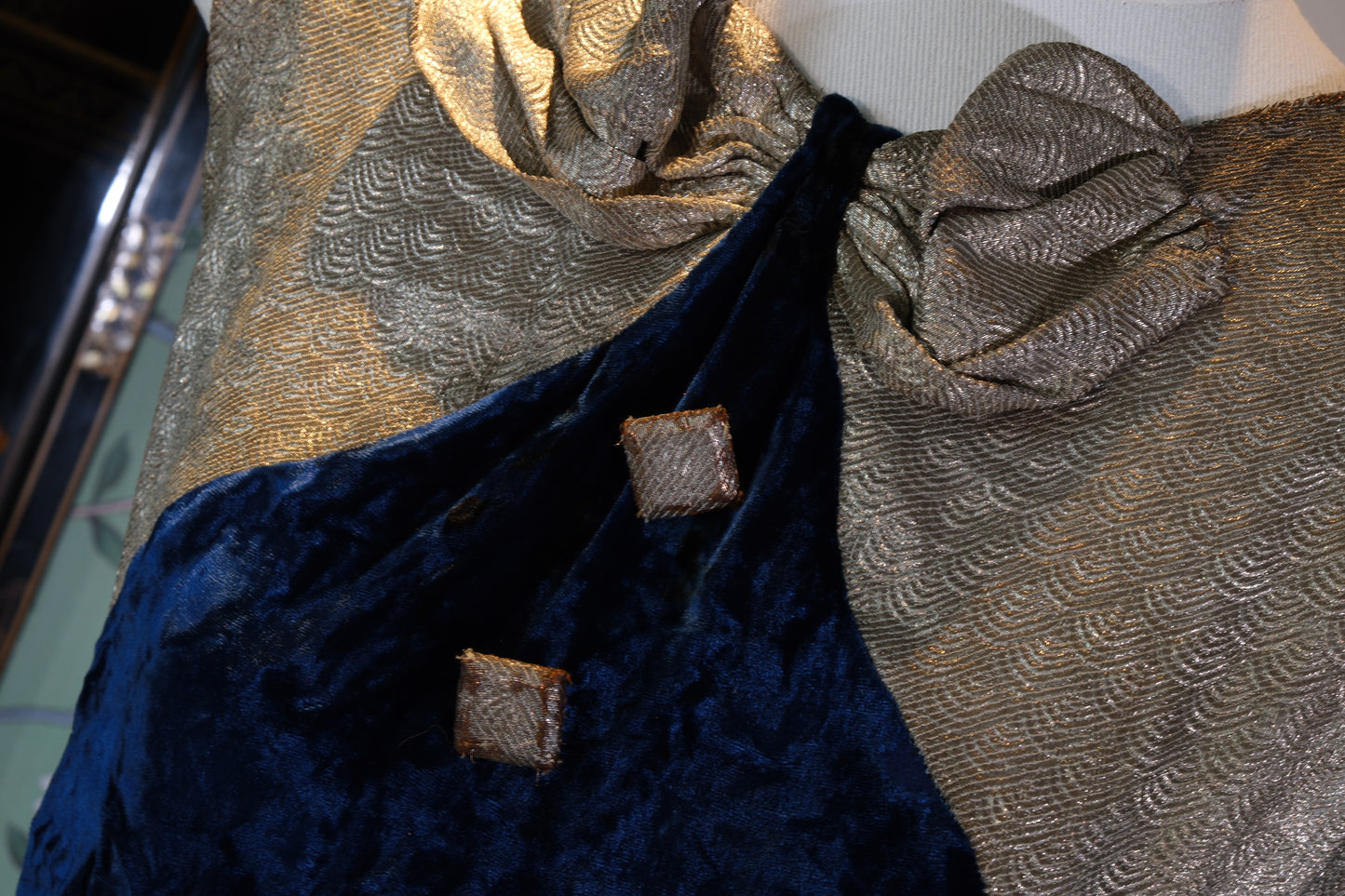
这件民国三十年代的织银真丝绒礼服裙,以“深蓝夜曲”之姿,将东方真丝绒的温润与西方礼服的优雅凝于经纬。裙身主体采用深蓝色真丝绒,经纬间流淌着“深海沉金”的幽光——不同于普通绒布的粗糙,这种真丝绒需经“三经三纬”的特殊织造,方能织出“绒而不腻,滑而不飘”的质感,恰合《长物志》“宁厚无薄,宁沉无浮”的造物哲学。
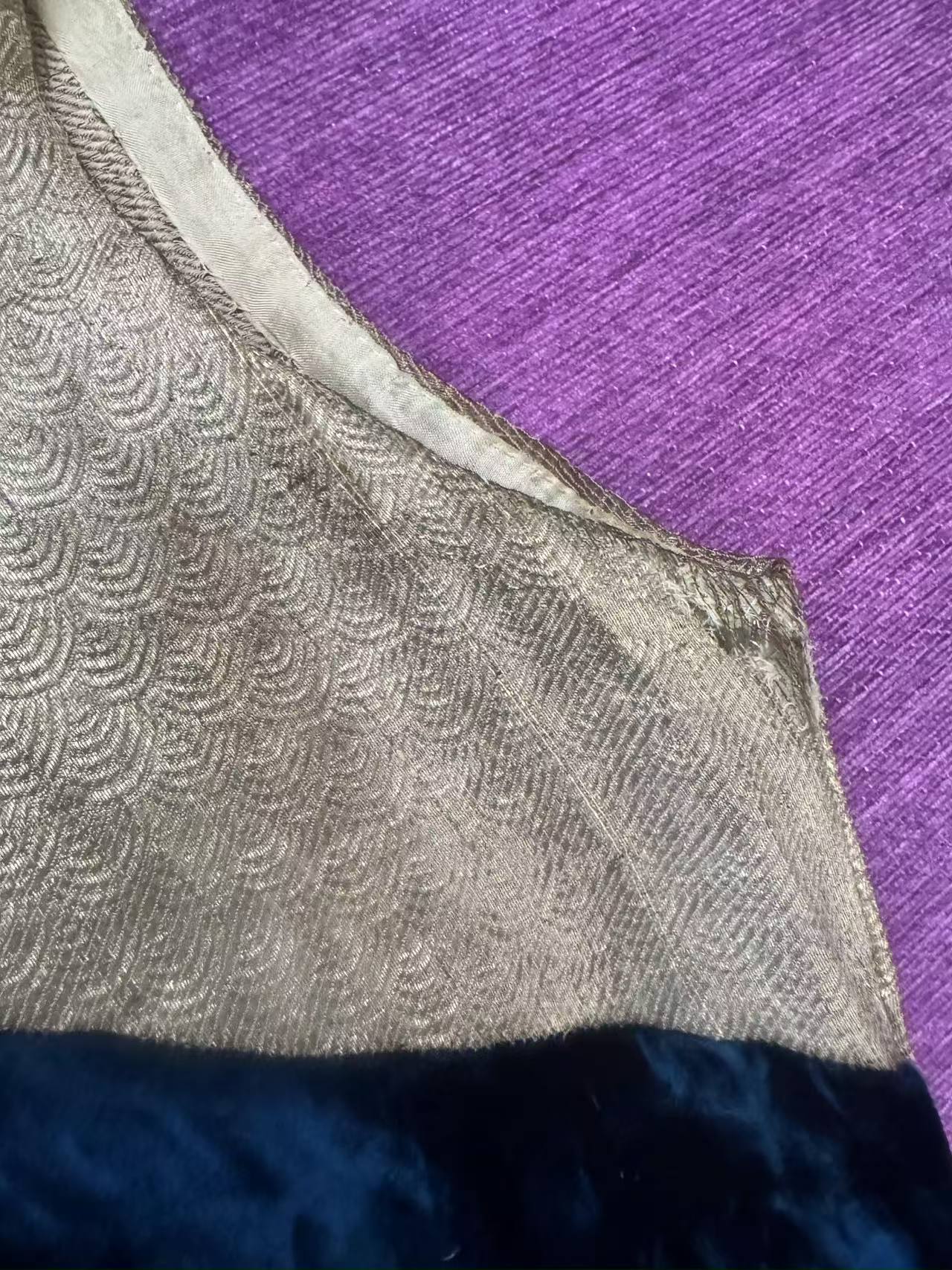
肩部的织银真丝,以“海水江崖”的传统纹样覆盖,每一根银丝都需匠人以“捻金织银”的绝技,将银丝与真丝交织成“波光粼粼”的视觉效果,暗合“海纳百川”的东方意境,却又以“西方式立体剪裁”重构了传统纹样的平面感,形成了“一古一新,一东一西”的视觉张力。
二、领间蝴蝶:织银真丝的“私密浪漫”
领口的蝴蝶结,是这套礼服的“点睛之笔”。蝴蝶结以织银真丝折叠而成,每一道褶皱都需匠人以“千针万线”的耐心固定,形成“立体如生”的形态,暗合“比翼双飞”的私密浪漫。蝴蝶结的边缘以“波浪形”收边,呼应了肩部的“海水江崖”纹样,却又以“东方式含蓄”保留了传统蝴蝶结的优雅感,恰如《诗经》所言“有美一人,婉如清扬”。
三、百年旧梦:从温哥华唐人街到蒙特利尔“深蓝之夜”
这套礼服的主人,正是前文所述加拿大“老钱”家族的闺秀。三十年代,她或许在蒙特利尔的“深蓝之夜”舞会上,以此礼服搭配前文的纯银编织连衣裙惊艳四座:深蓝色真丝绒的幽光衬得她肤色胜雪,织银真丝的波光如“星河垂坠”,蝴蝶结的立体如“暗夜精灵”。
四、艺术孤品:跨文化的“衣冠孤本”
此礼服的珍稀,在于它是“跨文化时尚”的活化石。全球存世的民国真丝绒礼服不足十件,而“深蓝真丝绒+织银真丝+海水江崖纹样+立体蝴蝶结”的组合,更是孤品中的孤品。真丝绒需江南织造局“以丝为骨,以绒为魂”的织造技艺,织银真丝则需中国工匠“以银为墨,以针为笔”的编织功夫,立体蝴蝶结则需“跨文化浪漫”的创意灵感,三者结合,成就了“衣以载道”的跨文化杰作。
五、结语:穿在身上的“深蓝夜曲”
当指尖拂过肩部的织银真丝,仿佛能触摸到百年前蒙特利尔的“深蓝之夜”——那是东方真丝绒的温润,是西方礼服的优雅,是加拿大“老钱”家族在异域的荣光与隐忍。这套礼服,是“离散中的坚守”,是“传统与现代的和解”,更是百年前那个风起云涌的时代,留给后人的“衣冠史诗”。
Deep Blue Nocturne: A Republic of China Year 30 (1940s) Silver-Woven Silk Velvet Gala Gown and the "Lingering Warmth of an Old Dream"
I. Deep Blue Upon the Garment: The "Sunken Gold Character" of Silk Velvet
This silver-woven silk velvet gala gown from the 1940s takes the posture of a "deep blue nocturne," condensing the warm softness of Eastern silk velvet and the elegance of Western evening gowns within its warp and weft. The main body of the gown utilizes a deep blue silk velvet, with a dim radiance of "sunken gold in the deep sea" flowing through its threads. Distinct from the rough texture of ordinary velvet fabrics, this silk velvet requires a specialized "triple-warp and triple-weft" weaving technique to create a pile that is "rich but not cloying, smooth but not floating." This perfectly aligns with the design philosophy from The Treatise on Superfluous Things (Chang Wu Zhi): "Rather thick than thin; rather deep than superficial."
The silver-woven silk across the shoulders is covered with the traditional "deep sea and river cliff" (haishui jiangya) motif. Each single silver thread requires the artisan's supreme mastery of the "gilt-twisting and silver-weaving" technique to interweave silver wire with pure silk into a "shimmering wave" visual effect. This subtly channels the Eastern poetic ideal of "the sea embracing all rivers," yet reconstructs the flat, two-dimensional nature of the traditional motif through "Western-style three-dimensional tailoring," forming a visual tension of "one antique and one modern, one Eastern and one Western."
II. The Butterfly at the Collar: The "Private Romance" of Silver-Woven Silk
The bow knot at the neckline is the crowning touch of this gala gown. The bow is formed by folding the silver-woven silk, with each single pleat requiring the artisan's immense patience through "thousands of stitches and lines" to fix it in place, shaping a lifelike, three-dimensional form that subtly echoes a private romance of "flying wing to wing." The edge of the bow is finished in a "wavy" contour, echoing the "deep sea and river cliff" motif on the shoulders, yet retaining the elegance of a traditional bow through "Eastern-style implicitness," precisely as The Book of Songs (Shi Jing) describes: "There is a beautiful lady, graceful and clear-eyed."
III. Century-Old Dreams: From Vancouver's Chinatown to Montreal's "Deep Blue Night"
The owner of this gown was precisely a lady from the aforementioned Canadian "old money" family. In the 1940s, she might have stunned the crowd at a "Deep Blue Night" gala in Montreal, pairing this gown with the previously mentioned pure silver woven dress: the dim luster of the deep blue silk velvet making her skin appear as fair as snow, the shimmering waves of the silver-woven silk appearing like a "galaxy draping down," and the three-dimensional presence of the bow evoking a "sprite of the dark night."
IV. Artistic Masterpiece: A Cross-Cultural "Unique Fashion Chronicle"
The rarity of this gown lies in its status as a living fossil of "cross-cultural fashion." Fewer than ten silk velvet evening gowns from the Republic of China era survive worldwide, and the combination of "deep blue silk velvet + silver-woven silk + deep sea and river cliff motif + three-dimensional bow" makes this a unique piece among unique pieces. The silk velvet required the craftsmanship of the Jiangnan Weaving Bureau "using silk as the bone and velvet as the soul"; the silver-woven silk required the weaving skills of Chinese artisans "using silver as ink and the needle as a pen"; and the three-dimensional bow required the creative inspiration of "cross-cultural romance." The fusion of these three elements achieves a cross-cultural masterpiece where "the garment carries the culture."
V. Conclusion: "Deep Blue Nocturne" Worn on the Body
When fingertips brush across the silver-woven silk of the shoulders, it feels as though one can touch the "Deep Blue Night" of Montreal from a century ago—reflecting the warm softness of Eastern silk velvet, the elegance of Western evening gowns, and the glory and forbearance of a Canadian "old money" family in a foreign land. This gown represents "perseverance amidst diaspora" and a "reconciliation between tradition and modernity"; moreover, it stands as a "fashion epic" left to posterity from that turbulent era a century ago.