深圳溯源
无法加载取货服务可用情况
衣服尺寸:
胸围/腰围/臀围:106/92/108 厘米
衣长:118 厘米
细节描述:
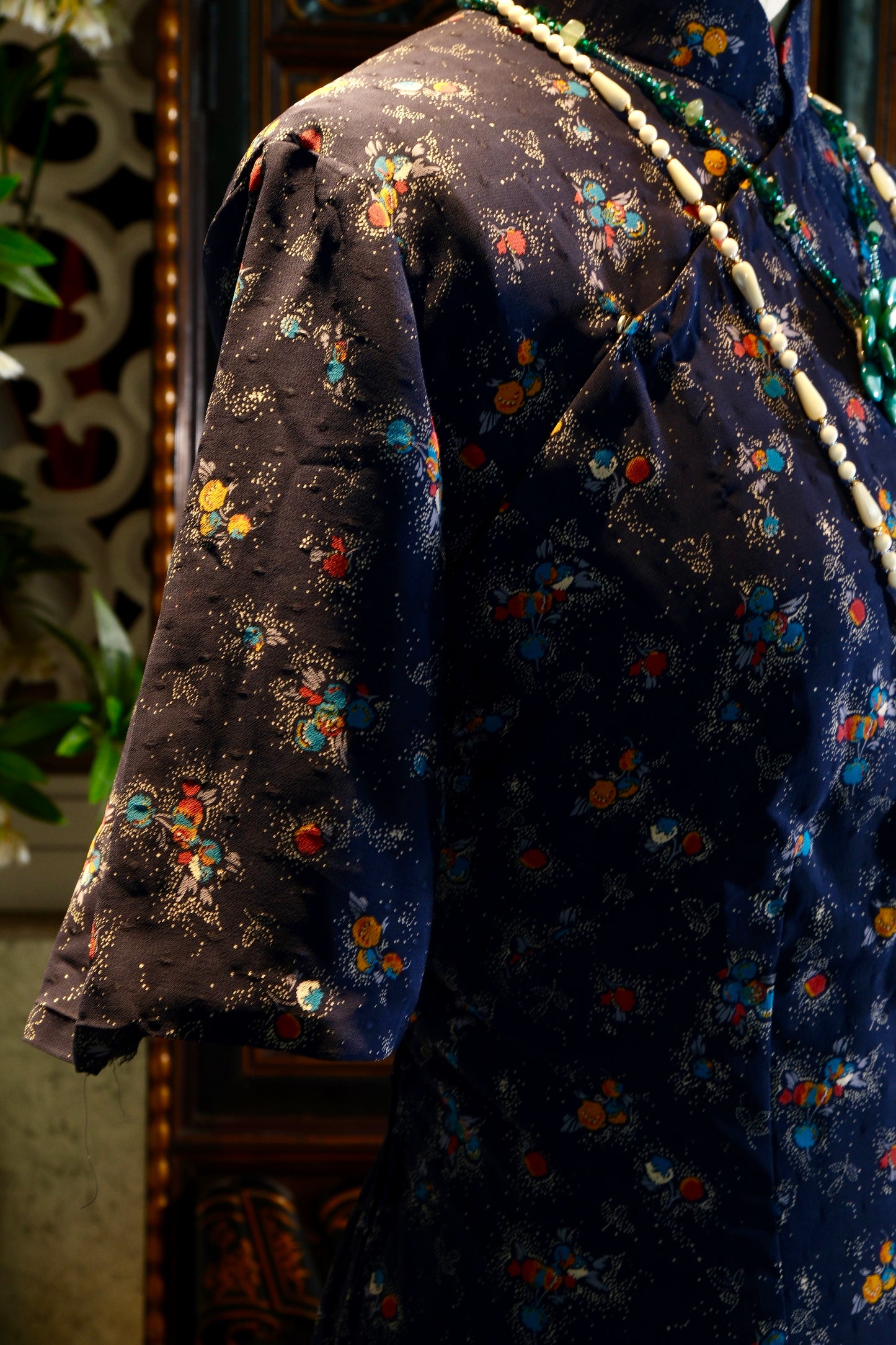
一、图案:碎花如星,织就东方诗境
这件旗袍的图案,是上世纪六十年代台湾纺织工艺与东方美学的精妙融合。底布为深邃的藏蓝,其上以浮雕肌理工艺呈现细密波点,红、橙、蓝、白等色的小花错落分布,似夜空中散落的星子,又若江南园林里“疏影横斜”的花影。这种“满地花”纹样,既承袭了明清时期“百花不露地”的传统审美,又在六十年代的台湾被赋予新意:花朵形态更趋简练,色彩搭配明快而不艳俗,恰如当时台湾社会在现代化浪潮中,对传统文化“守正创新”的态度。浮雕肌理的运用,让图案从平面走向立体,指尖抚过,能触到花瓣的起伏与枝叶的脉络,仿佛将“春江水暖鸭先知”的灵动,凝固在了织物之上。
二、故事:衣袂间的时代回响
这件旗袍诞生于1960年代的台湾,彼时的宝岛正处于经济起飞与文化自觉的双重变奏中。它或许出自台北某家老字号裁缝铺,师傅们用进口的化纤混纺面料(兼具挺括与透气),结合传统手工浮雕印花,为当时的知识女性或名媛量身定制。想象一下:穿着它的女子,可能刚从台大图书馆走出,或是赴一场茶会——旗袍的修身剪裁勾勒出东方女性的温婉曲线,立领坚守着古典礼仪,而碎花的活泼又透露出新时代的朝气。它见证过台湾“文化复兴运动”中对传统的重新诠释,也陪伴过无数女性在家庭与职场间穿梭的身影。如今,当我们在博物馆或收藏家的展柜中遇见它,那些被时光打磨的细节,都在诉说着一个时代的优雅与坚韧。
三、引经据典:从《诗经》到张爱玲的审美传承
《诗经·郑风》有云:“青青子衿,悠悠我心。”旗袍的立领,正是“子衿”之雅的现代演绎;而碎花图案,则暗合了宋代“汝窑天青釉”般的含蓄美学——以素净底色衬托繁花,正如宋人“淡妆浓抹总相宜”的审美追求。到了近现代,张爱玲在《更衣记》中写道:“旗袍的紧身直袖,把中国女人的身体线条勾勒得恰到好处。”这件六十年代的台湾旗袍,恰恰延续了这种“恰到好处的性感”:它不像民国初期的宽袍大袖那般保守,也不似七十年代后的超短款式那般张扬,而是以“中庸之美”,平衡了传统与现代、端庄与灵动。
四、艺术风格与稀缺性:不可复制的时代标本
从艺术风格看,它是“中西合璧”的典范:西式立体剪裁(收腰、省道)塑造出符合人体工学的曲线,中式浮雕印花则保留了民族符号;从稀缺性而言,六十年代的台湾旗袍本就因“手工制作+特殊面料”而产量有限,加之岁月流逝,保存完好的更是凤毛麟角。这件旗袍的浮雕肌理至今清晰,色彩未褪,堪称“活着的文物”——它不仅是一件衣服,更是研究二十世纪中叶东亚时尚史、女性史的珍贵实物。当我们凝视它时,看到的不仅是一朵花、一粒珠,更是一个时代的文化密码,等待着被更多人读懂、珍藏。
Measurements / Size Guide:
Bust / Waist / Hips: 106/92/108 cm
Total Length: 118 cm
Detailed Description:
The visual pattern of this qipao represents a subtle, masterful synthesis of 1960s Taiwanese textile engineering and Eastern aesthetic philosophy. The grounding base textile utilizes a deep, intense navy blue, upon which a fine, dense polka-dot structure is manifested via a specialized raised relief tactile technique. Across this landscape, miniature blossoms of red, orange, blue, and white are scattered in a meticulously balanced, organic composition—resembling a shower of stars flung across a midnight sky, or the delicate, sloping flower shadows (Shuying Hengxie) found within classical Jiangnan gardens.
This "all-over floral" (Mandihua) arrangement directly inherits the heritage aesthetics of the Ming and Qing Dynasties’ "teeming blossoms concealing the ground" (Baihua Buludi) tradition. However, it was granted an entirely new conceptual language in 1960s Taiwan: the floral forms became significantly more streamlined, and the color composition shifted to a crisp, bright palette completely stripped of vulgar flamboyance. This precisely mirrors how contemporary Taiwanese society navigated its mid-century modernization wave—maintaining an attitude of "preserving the orthodox core while pioneering new frontiers" (Shouzheng Chuangxin). The implementation of the raised relief texture coaxes the motif from a flat surface layout into a three-dimensional plane. As fingertips brush across the textile, one can physically trace the undulating curve of the petals and the precise anatomy of the stems, effectively freezing the raw, dynamic vitality of a shifting season directly into the structural fibers of the garment.
This qipao materialized during the 1960s in Taiwan, a unique temporal window when the island was navigating the dual musical variations of a sweeping economic takeoff and a powerful awakening of cultural self-awareness. It likely originated within one of Taipei’s heritage老字号 master tailor establishments, where senior artisans utilized premium imported synthetic-blend matrices—which brilliantly bridged crisp structural uprightness with excellent breathability—and combined them with traditional manual relief printing to build a bespoke garment tailored exclusively for an intellectual woman or an elite socialite.
One can easily envision the woman who once occupied this garment: perhaps stepping gracefully out from the National Taiwan University library, or gliding into an elegant tea assembly. The form-fitting, reduced silhouette contours flawlessly to the gentle curves of the Eastern female form; the standing collar unyieldingly safeguards classical ritual propriety, while the lively playfulness of the micro-florals declares the vibrant morning breath of a new era. This piece stood as a material witness to the re-interpretation of heritage during Taiwan’s "Cultural Renaissance Movement," just as it accompanied countless women as they navigated between the domestic sphere and the professional workplace. Today, encountering this specimen within a museum vault or a private curator’s showcase, every single detail burnished by the decades articulates a narrative of epochal elegance and quiet resilience.
The canonical text The Classic of Poetry · Zheng Feng (Shijing) beautifully notes: "Green, green is the collar of your robe; deep, deep is the longing in my heart." The standing collar of the qipao operates precisely as the modern, evolved manifestation of that elegant "robe collar" (Zijin) refinement. Concurrently, the micro-floral motif subtly aligns with the restrained, inward aesthetic characteristic of Song Dynasty "Ru ware sky-blue glaze"—utilizing an impeccably clean, serene background color chassis to offset a profusion of blossoms, a flawless realization of the classical pursuit where "both light makeup and heavy adornment remain completely fitting."
Moving into the modern era, the celebrated author Eileen Chang famously penned in her essay Chronicle of Changing Clothes: "The tight silhouette and straight sleeves of the qipao contour the body lines of the Chinese woman to absolute perfection." This 1960s Taiwanese qipao impeccably extends that philosophy of "perfectly measured sensuality." It rejects the conservative, expansive, wide robes and massive sleeves of the early Republic era, yet refuses the loud, ostentatious ultra-short hemlines that emerged after the 1970s. Instead, it anchors itself within the "Aesthetics of the Golden Mean" (Zhongyong Zhi Mei), striking a flawless balance between the traditional and the modern, the端庄 dignified and the dynamic.
Appraised through the prism of art history, this garment stands as a textbook paradigm of "East-West synthesis." Western three-dimensional pattern drafting methodologies (such as precise waist reduction and targeted darting) sculpt an ergonomic, body-contouring curve, while the Chinese relief printing technique rigorously preserves traditional cultural symbols.
Viewed from the perspective of absolute scarcity, 1960s Taiwanese qipaos were inherently limited in global production volume due to their reliance on "manual artisan fabrication paired with highly specialized textile matrices." Following the natural erosion of time, physical specimens that have bypassed decay to remain flawlessly intact are exceptionally rare—true phoenix feathers and unicorn horns. The fact that this qipao’s raised relief texture remains impeccably crisp and its color saturation completely unfaded renders it a genuine "living artifact." It transcends its definition as an article of clothing to operate as an invaluable primary physical resource for researching mid-twentieth-century East Asian fashion history and women's studies. When we closely observe it, we are looking far beyond a single blossom or an isolated bead; we are decoding the cultural matrix of an entire era, permanently preserved and waiting to be deeply understood and treasured.