深圳溯源
无法加载取货服务可用情况
当上世纪六十年代的香港真丝面料,遇上同年代港工旗袍的经典版型,一件样衣便成了穿梭时空的艺术载体——这是溯源绸缎有限公司对“复古美学”与“匠心工艺”的双重致敬。
【面料:岁月沉淀的真丝诗篇】
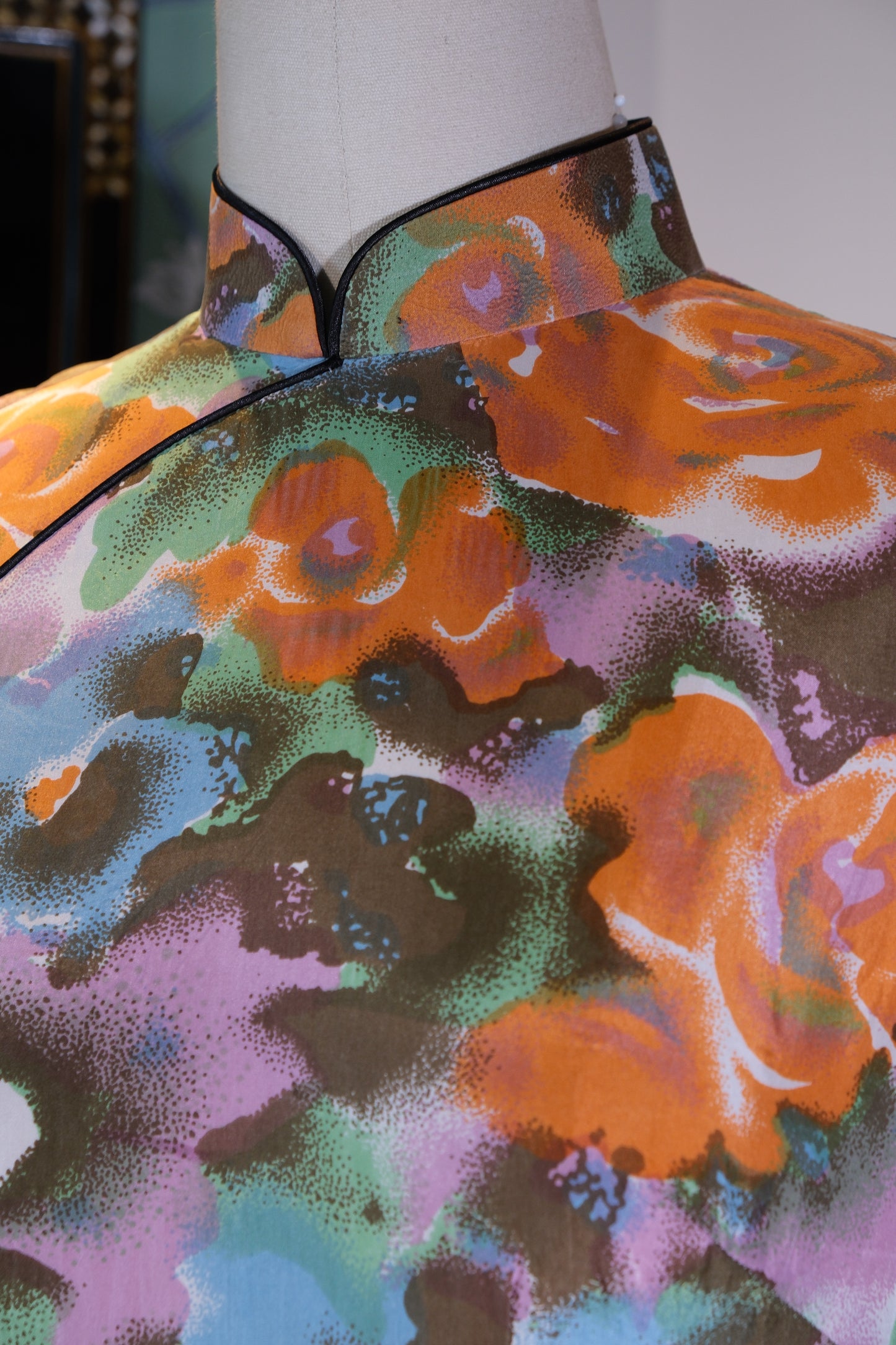
甄选60年代香港产真丝面料,历经半世纪光阴淬炼,丝缕间仍流淌着温润光泽。彼时香港的纺织工艺以“精、柔、韧”著称,真丝经特殊处理后,既保留天然蚕丝的亲肤透气性,又添几分复古肌理的朦胧质感。橙红玫瑰在粉紫、湖蓝、墨绿的晕染底色上绽放,色彩如老电影胶片般浓郁却不艳俗,仿佛将香江畔的繁花盛景与摩登风情,一并织进了丝线里。
【版型:港工剪裁的曲线美学】
复刻60年代港式旗袍版型,是东方女性身姿的诗意注解。立领贴合颈部线条,优雅中藏着克制;斜襟从领口蜿蜒至腋下,黑色细滚边如墨线勾勒,利落分割色块的同时,更添精致秩序感;收腰设计精准捕捉人体工学,将胸、腰、臀的自然曲线化作流动的韵律——无花扣的极简处理,让视觉焦点回归面料本身的花卉叙事,也暗合了60年代香港“去繁就简,以质取胜”的时尚哲学。
【工艺:藏在细节里的时代密码】
黑色细滚边是点睛之笔:选用与面料厚度匹配的丝质包边条,手工缝制时每一针都需对齐花纹走向,确保滚边如“隐形骨架”般支撑起旗袍的挺括与柔美。无花扣设计并非省略,而是以“留白”彰显自信——当真丝的光泽、花卉的张力、版型的流畅已足够动人,多余的装饰反而会成为束缚。这种“少即是多”的工艺逻辑,正是60年代香港裁缝对“高级感”的极致理解。
这件样衣,是溯源绸缎对“传统再造”的一次实验:它不止是一件衣裳,更是可触摸的历史切片——穿上它,仿佛能听见老上海滩的留声机与维多利亚港的汽笛共鸣,看见东方女性在时代浪潮中,以一身旗袍写就的从容与风华。
When archival 1960s Hong Kong silk textile meets the definitive silhouette of same-era bespoke tailoring, a prototype sample ceases to be an article of dress—it transforms into an artistic vehicle traveling through time. This piece stands as a dual tribute to retro aesthetics and master craftsmanship by Suyuan Silk Co., Ltd.
The foundation of this garment features authentic 1960s Hong Kong-manufactured silk. Having survived over half a century of careful preservation, a gentle, warm luster still flows through its organic fibers. During this golden era, Hong Kong textile engineering was globally celebrated for its exceptional refinement, softness, and structural resilience (jing, rou, ren).
The silk undergoes a highly specific technical finish that preserves the natural, breathable, second-skin comfort of mulberry silk while introducing a subtle, hazy retro texturing across the face. Vivid orange-red roses bloom across an impressionistic ground of blended powder-violet, lake-blue, and deep forest-green. The colorways radiate the dense saturation of an old analog film negative—rich and deeply evocative without ever falling into vulgarity—as if weaving the blooming flora and cosmopolitan glamour of Victoria Harbour directly into the structural weft.
This piece faithfully revives the iconic 1960s Hong Kong-style chassis (gang-gong banxing), offering a poetic blueprint of the female form under mid-century cross-cultural design influences:
The Disciplined Collar: The classic mandarin neckline is engineered to contour tightly against the throat, framing the face with an air of elegant, aristocratic restraint.
The Ink-Line Slash: A traditional diagonal closure (pajin) snakes gracefully from the throat down to the armscye. It is framed by an ultra-fine black silk piping that acts like a sharp ink line, partitioning the rich color blocks while anchoring the garment with absolute graphic discipline.
The Ergonomic Contour: The high-waisted pattern drafting relies on advanced three-dimensional shaping to capture the natural trajectory of the bust, waist, and hips, translating anatomical geometry into a fluid, sweeping rhythm. Concurrently, it is entirely devoid of ornamental frog closures (wu-huakou), intentionally redirecting all focus back to the rich narrative of the botanical canvas—a perfect reflection of the mid-century Hong Kong design philosophy of prioritizing material purity over surface decoration.
The minimalist black silk piping functions as the structural anchor of the entire composition. Master tailors utilize a silk bias-cut binding strip precisely calibrated to match the exact weight of the primary canvas. During the hand-stitching process, every single puncture must be hidden beneath the seam lines and aligned perfectly with the trajectory of the floral motif. This ensures that the piping behaves like an invisible skeleton, providing structural support to preserve the clean, architectural silhouette without sacrificing the liquid drape of the silk.
Bypassing traditional decorative frogs is not a structural omission; it is a deliberate use of liubai (negative space) to announce a fierce, modern self-assurance. When the internal refraction of the silk, the visual tension of the roses, and the ergonomics of the tailoring are already this commanding, further ornamentation becomes a restriction. This "less is more" manufacturing logic is precisely how the mid-century generation of Hong Kong tailors defined the absolute apex of haute luxe.
This historic prototype represents an uncompromising experiment in archival re-engineering at Suyuan Silk Co., Ltd. It operates not merely as an article of dress, but as a tactile, breathing slice of history.
To step into this silhouette is to activate a profound cultural echo—where the nostalgic phonographs of old Shanghai high society seamlessly harmonize with the distant foghorns of Victoria Harbour, celebrating the timeless composure, independence, and everlasting dignity of the modern Eastern woman.