深圳溯源
无法加载取货服务可用情况
衣服尺寸:
胸围/腰围/臀围/衣长:92/80/100/95 厘米
细节描述:
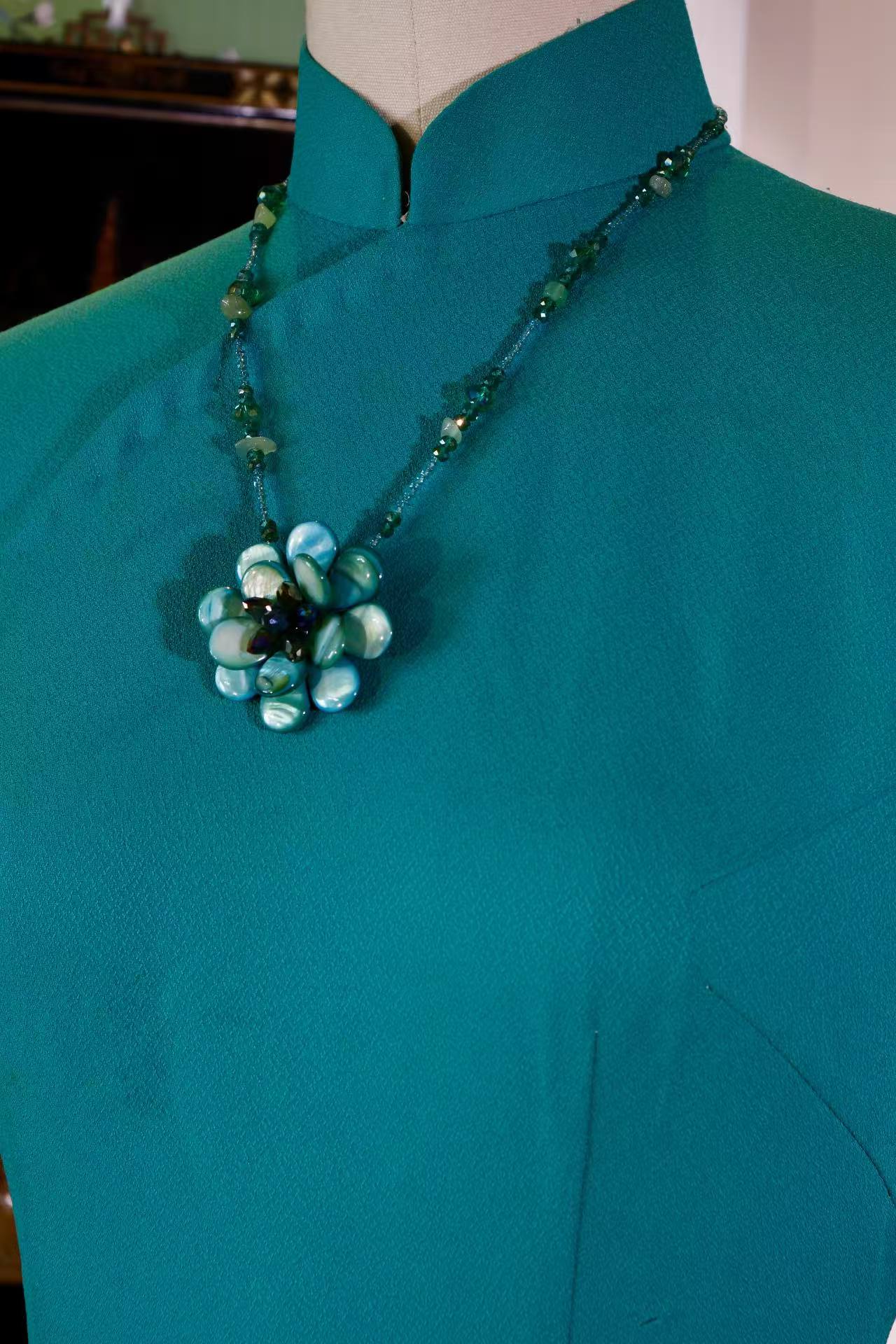
这是一件承载着时代风华的古董旗袍,其艺术价值与稀缺性不仅体现在面料与剪裁上,更在于它所凝结的六十年代香港时装工业的黄金记忆。这件旗袍以意大利进口时装面料为基底,色泽沉静如碧海青瓷,无袖设计贴合人体曲线,立领与斜襟的构造既保留传统形制,又融入现代审美,是“中西合璧”在服装史上的具象表达。
从图案上看,这件旗袍本身并无印花或刺绣,其“图案”实为面料肌理与结构线条共同构成的视觉韵律。衣身通体素色,却因省道(darts)的精准分布而形成自然的立体轮廓——胸省、腰省、臀省的巧妙收放,使布料在静态中呈现动态的流动感,宛如一幅“以针代笔、以线为墨”的立体水墨画。颈间佩戴的蓝绿色珠串花朵项链,虽非旗袍本体,却与之形成色彩与材质的对话:珠光温润,花色层叠,恰似《红楼梦》中“宝鼎茶闲烟尚绿,幽窗棋罢指犹凉”的雅致意境,为素衣点睛,赋予其文人画般的留白之美。
这件旗袍的故事,需置于1960年代香港作为“东方巴黎” 的历史语境中理解。彼时,香港裁缝业鼎盛,大量上海师傅南迁,将海派旗袍的精致工艺与本地审美融合,同时引入欧洲高级面料,形成“港式旗袍”的独特风格。意大利面料的使用,不仅体现当时香港上层社会对西方奢侈品的追捧,更折射出殖民地文化中对“异域质感”的迷恋。正如张爱玲在《更衣记》中所言:“衣服是一种言语,随身带着一种袖珍戏剧。”这件旗袍,正是那个时代女性自我表达的“戏剧道具”——它不张扬,却以剪裁的克制与面料的贵气,诉说着穿着者对身份、品味与时代的无声宣言。
从学术角度看,此类旗袍的稀缺性源于三点:其一,意大利进口面料在六十年代属奢侈品,多用于定制礼服,存世量极少;其二,手工省道工艺在现代工业化生产中已被淘汰,今日所见多为机器压褶,难以复刻其贴合度;其三,保存完好的古董旗袍多藏于博物馆或私人收藏,市面流通者凤毛麟角。正如《考工记》所言:“天有时,地有气,材有美,工有巧,合此四者,然后可以为良。”这件旗袍,正是天时(六十年代)、地利(香港)、材美(意大利面料)、工巧(手工剪裁)四者合一的典范,其价值早已超越服饰本身,成为可触摸的历史文本。
Measurements / Size Guide:
Bust / Waist / Hips / Total Length: 92/80/100/95 cm
Detailed Description:
This archival qipao captures a rare pinnacle of post-war design history, preserving the precise moment when the mid-century fashion industry of Hong Kong achieved true global integration. The structural foundation of the artifact relies entirely on imported Italian fashion yardage. The coloration is quiet, deep, and heavily saturated, evoking the reflective stillness of a monochrome Longquan celadon glaze (qingci).
The sleeveless silhouette enforces an uncompromising adherence to the natural contours of the biological form. While the high Mandarin collar and the diagonal front closure (xiejin) respect classical Chinese sartorial precedents, their clean execution reflects a thoroughly modernized aesthetic.
The garment features zero surface embellishment—no print, no embroidery, and no beadwork. Instead, its visual rhythm is generated exclusively by textile texture and structural line. The monochromatic field is given life by an incredibly precise configuration of architectural darts (shengdao). The strategic release and compression of the bust, waist, and hip darts transform the flat textile into a dynamic, shifting sculpture. It achieves the exact aesthetic economy of an elite ink-wash painting, where the needle serves as the brush and the structural seam functions as the ink.
The styling choice of a paired teal-and-blue beaded floral necklace establishes a brilliant material dialogue with the dress. The gentle luster of the beads and the layered coloration evoke the refined scholar-bureaucracy aesthetics reminiscent of the Dream of the Red Chamber: "The green smoke lingers over the tripod long after tea is brewed; the fingers remain cool after chess by the quiet window." It provides a focal punctuation mark against the austere ground, honoring the traditional Chinese painterly concept of strategic negative space (liubai).
To fully decode this artifact, it must be situated within the historical ecology of 1960s Hong Kong, an era when the city operated as the definitive fashion capital of East Asia. Following the southern migration of elite master tailors from Shanghai, the meticulous craft of the Haipai tradition fused with local cosmopolitan sensibilities, aggressively incorporating European luxury components.
The deployment of Italian textiles within a traditional Chinese form is deeply telling. It simultaneously satisfies the high-society appetite for Western luxury and mirrors the complex colonial psychology that romanticized exotic, imported textures. As Eileen Chang brilliantly observed in Reflections on Clothing: "Clothing is a language, a pocket theater carried upon the body." This minimalist qipao acted as an essential theatrical prop for the mid-century woman. It eschews overt ostentation, relying instead on disciplined restraint and material prestige to issue a silent, powerful manifesto on taste, identity, and global modernity.
From an archival and connoisseurship perspective, the historical value of this specimen is anchored by three critical criteria:
Material Provenance: Mid-century Italian textiles imported into Hong Kong were elite luxury assets, reserved strictly for high-end custom salon commissions. Their survival rate within Eastern dress formats is exceptionally low.
The Obsoletion of Custom Darting: The highly specialized artisan method of engineering hand-basted, custom-molded darts has been completely erased by modern industrialized mass production. Contemporary prêt-à-porter relies on uniform machine-pleating, which utterly fails to replicate the organic, glove-like articulation of the body achieved here.
Archival Scarcity: Pristine specimens from this specific cross-cultural matrix are predominantly locked within institutional museum collections or private holdings, leaving the commercial market almost entirely devoid of such examples.
As the ancient design treatise The Artificers’ Record (Kao Gong Ji) dictates: "When the season is aligned with heaven, when the energy is favored by earth, when the material possesses intrinsic beauty, and when the craftsman displays true skill—it is only when these four elements converge that a masterwork is born." This qipao stands as the physical incarnation of that philosophy: uniting the era (the 1960s), the location (Hong Kong), the material beauty (Italian fashion textile), and the absolute skill of the master tailor. It transcends its utilitarian origins to exist as a tactile historical document.
This garment is an intellectual exercise in textile minimalism and structural poetry. By utilizing European materiality to articulate Eastern posture, it remains an irreplaceable monument to an era when Hong Kong tailoring spoke fluently to the global stage. It represents a masterclass in cross-cultural design, waiting for a custodian who recognizes that true luxury lies not in surface ornament, but in the silent discipline of the cut.