深圳溯源
碧痕流金,织梦香江:一件六十年代港式旗袍的抽象诗学 | Flowing Green and Liquid Gold, Weaving Dreams of Hong Kong: The Abstract Poetics of a 1960s Hong Kong-Style Qipao
碧痕流金,织梦香江:一件六十年代港式旗袍的抽象诗学 | Flowing Green and Liquid Gold, Weaving Dreams of Hong Kong: The Abstract Poetics of a 1960s Hong Kong-Style Qipao
无法加载取货服务可用情况
碧痕流金,织梦香江:一件六十年代港式旗袍的抽象诗学
衣服尺寸:
胸围/腰围/臀围:92/82/100 厘米
衣长:103 厘米
细节描述:
【引言】
张爱玲曾言:“对于不会说话的人,衣服是一种言语,随身带着一种袖珍戏剧。”当我们凝视这件诞生于上世纪六十年代的香港产古董旗袍时,仿佛听到了一场关于摩登与传统的无声对话。它不仅仅是一件衣裳,更是一段被封存在织物经纬中的流金岁月,是东方美学在现代化转型期的一次华丽突围。
一、图案赏析:流动的抽象主义与“印经”幻术
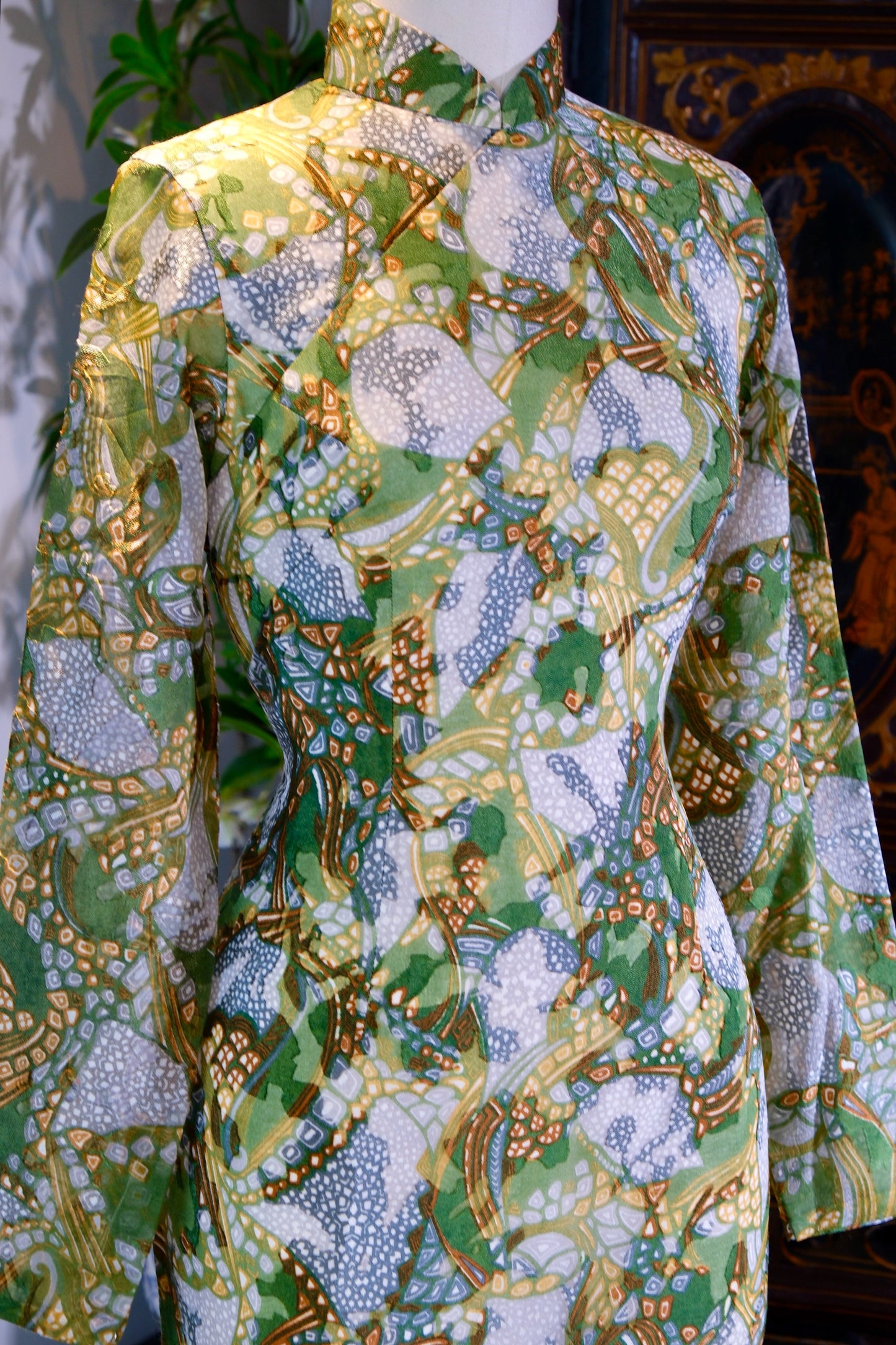
这件旗袍最引人入胜之处,在于其面料图案的大胆与前卫。不同于传统旗袍常见的具象牡丹或梅兰竹菊,它采用了一种极具现代感的抽象印花结合暗纹织花工艺。
- 色彩的交响: 主色调选取了温润而深邃的青绿(Celadon Green)作为基底,间以灰白与古铜金棕交织。这种配色既保留了中式审美的雅致含蓄,又融入了西方印象派的光影变幻,宛如雨后初晴的园林,光影斑驳。
- 肌理的韵律: 图案并非静止的平面,而是由无数流动的几何线条、点状肌理与不规则块面构成。远观如水墨晕染般朦胧写意,近看则如克里姆特(Gustav Klimt)画作般充满装饰性的节奏感。
- 工艺的奥秘: 这极有可能是当时极为精湛的“印经”工艺。工匠在织造前预先对经线进行分段印花,再织入素色纬线。这种技法使得图案边缘呈现出一种自然的模糊与错位感,仿佛色彩在织物中呼吸、游走,营造出一种“似花非花,似雾非雾”的高级视觉错觉。
二、历史回响:六十年代香江的摩登剪影
这件旗袍不仅是艺术品,更是历史的见证者。它诞生于1960年代的香港,那是“港式旗袍”的黄金时代,也是中西文化剧烈碰撞与融合的熔炉。
彼时,大量上海裁缝名师南迁香江,将海派旗袍的精致细腻与西方的立体剪裁理念完美结合。这件旗袍便是这一时期的典型代表作:
- 廓形的革命: 它摒弃了清末民初的宽大平直,采用了极度贴合人体曲线的西式省道剪裁。高耸的领口紧扣咽喉,腰身收紧至极致,下摆微微外扩后迅速收敛,勾勒出女性曼妙而独立的S型身姿。
- 时代的隐喻: 六十年代的香港女性开始走出家庭,步入职场与社交场。她们需要的不再是繁琐累赘的装饰,而是既能展现东方韵味,又便于行动、彰显干练气质的时装。这件旗袍去除了繁复的滚边与盘扣装饰,完全依靠面料本身的质感与剪裁的精准度来取胜,正是那个时代女性追求独立、自信精神的物质载体。
三、稀缺价值:不可复制的时光孤品
在古董衣收藏界,素色易得,花纹难寻,而如此高水准的抽象印花暗纹织花更是凤毛麟角。
- 工艺的失传: 随着工业化成衣的普及,这种耗时耗力、极度依赖工匠经验的“印经”与复杂提花工艺已逐渐失传。如今机器印染虽能模仿其形,却难复刻其神——那种因手工操作而产生的微妙色差与织造张力,是机器无法替代的温度。
- 保存的奇迹: 丝绸娇贵,历经六十载光阴而不褪色、不脆化,且版型依然挺括,实属罕见。它不仅是一件衣物,更是一个时代的切片。正如《诗经》所云:“岂曰无衣?与子同袍。”这件旗袍穿越半个多世纪的风尘,依然保持着当年的风华绝代,等待着懂它的人,续写这段未完的锦绣篇章。
【结语】
这不仅是一件旗袍,这是一首穿在身上的抽象诗,是一幅流动的油画。它见证了香江的繁华旧梦,也诠释了何为真正的“高级定制”。拥有它,便是拥有了一段触手可及的、优雅而倔强的历史。
Flowing Green and Liquid Gold, Weaving Dreams of Hong Kong: The Abstract Poetics of a 1960s Hong Kong-Style Qipao
Measurements / Size Guide:
Bust / Waist / Hips: 92/82/100 cm
Total Length: 103 cm
Detailed Description:
[Introduction]
Eileen Chang once wrote, "To those who cannot speak, clothing is a form of speech; it carries with it a pocket-sized drama." When we gaze upon this vintage qipao born in 1960s Hong Kong, we seem to hear a silent dialogue between modernity and tradition. It is not merely a garment, but a golden era sealed within the warp and weft of the fabric—a magnificent breakthrough of Eastern aesthetics during a period of modernization and transition.
I. Pattern Appreciation: Flowing Abstraction and the "Ikat" Illusion
The most captivating aspect of this qipao lies in the bold and avant-garde nature of its fabric pattern. Departing from the literal peonies or traditional plum, orchid, bamboo, and chrysanthemum motifs commonly found on classic qipaos, it employs a highly modern abstract print combined with a subtle jacquard-woven texture.
-
A Symphony of Colors: The primary palette features a gentle yet deep celadon green as the base, interspersed with interwoven shades of gray-white and bronze golden-brown. This color combination firmly retains the elegance and subtlety of Chinese aesthetics while integrating the interplay of light and shadow from Western Impressionism, resembling a sun-dappled garden just after a rain.
-
The Rhythm of Texture: The pattern is by no means a static, flat surface; rather, it is composed of countless flowing geometric lines, dotted textures, and irregular blocks of color. From afar, it is hazy and expressionistic like an ink wash painting, while a closer look reveals a decorative sense of rhythm reminiscent of a Gustav Klimt painting.
-
The Secret of Craftsmanship: This is highly likely a result of the extraordinarily exquisite chiné a la branche (warp printing) technique of the era. Before weaving, artisans printed patterns onto sections of the warp threads ahead of time, then wove in plain-colored weft threads. This technique gives the edges of the pattern a natural blurring and slight misalignment, as if the colors are breathing and shifting through the fabric, creating a sophisticated visual illusion of "seeming like flowers yet not flowers, seeming like mist yet not mist."
II. Historical Echoes: A Modern Silhouette of mid-century Hong Kong
This qipao is not only a work of art but also a witness to history. Born in 1960s Hong Kong, it hails from the golden age of the "Hong Kong-style qipao," an era that served as a melting pot where Eastern and Western cultures fiercely collided and integrated.
During this time, a large number of master tailors from Shanghai migrated south to Hong Kong, flawlessly combining the delicate refinement of the Shanghai style (Haipai) with Western structural tailoring principles. This qipao stands as a quintessential masterpiece of that period:
-
A Revolution of Silhouette: Abandoning the loose, flat, and straight cuts of the late Qing Dynasty and early Republican era, it utilizes Western darting techniques that fit exceptionally close to the curves of the human body. The high mandarin collar tightly fastens at the throat, the waist is cinched to the absolute limit, and the hem flares out slightly before quickly tapering back in—outlining a woman’s graceful yet independent S-curve silhouette.
-
A Metaphor of the Era: In the 1960s, Hong Kong women began stepping out of the home and entering the workplace and social circles. They no longer needed cumbersome, restrictive decorations; instead, they demanded fashionable attire that could showcase Eastern charm while allowing freedom of movement and projecting a capable, professional demeanor. This qipao strips away complex pipings and decorative frog buttons, relying entirely on the quality of the fabric itself and the precision of the cut to triumph. It stands as a physical vessel for the independent and confident spirit pursued by women of that era.
III. Rarity & Value: An Irreplicable Piece of History
In the world of vintage clothing collection, solid colors are easily found, but complex patterns are difficult to come across; high-caliber abstract prints featuring subtle jacquard-woven textures are exceptionally rare.
-
The Loss of Craftsmanship: With the popularization of industrialized ready-to-wear clothing, this time-consuming, labor-intensive warp-printing and intricate jacquard weaving process—which depends entirely on the experience of master artisans—has gradually become a lost art. Although modern digital printing can mimic its form, it can never replicate its soul: the subtle color variations and structural weaving tension produced by human hands carry a warmth that machines cannot replace.
-
A Miracle of Preservation: Silk is notoriously delicate. For it to endure sixty years of time without fading or becoming brittle, while keeping its tailored structure entirely intact, is a rare feat. It is not just a piece of clothing, but a slice of an era. As The Book of Songs (Shijing) says, "How can you say you have no clothes? I will share my robes with you." Having traveled through more than half a century of wind and dust, this qipao still retains its magnificent elegance from yesteryear, waiting for a connoisseur who understands its soul to continue writing this unfinished, splendid chapter.
[Conclusion]
This is more than just a qipao; it is an abstract poem worn on the body, a flowing oil painting. It bears witness to the bustling old dreams of Hong Kong and redefines the true meaning of "haute couture." To possess it is to possess a tangible piece of elegant and unyielding history.
分享