深圳溯源
无法加载取货服务可用情况
衣服尺寸:
胸围/腰围/臀围/衣长:100/90/110/110 厘米
细节描述:
【器物志·形制与色泽】
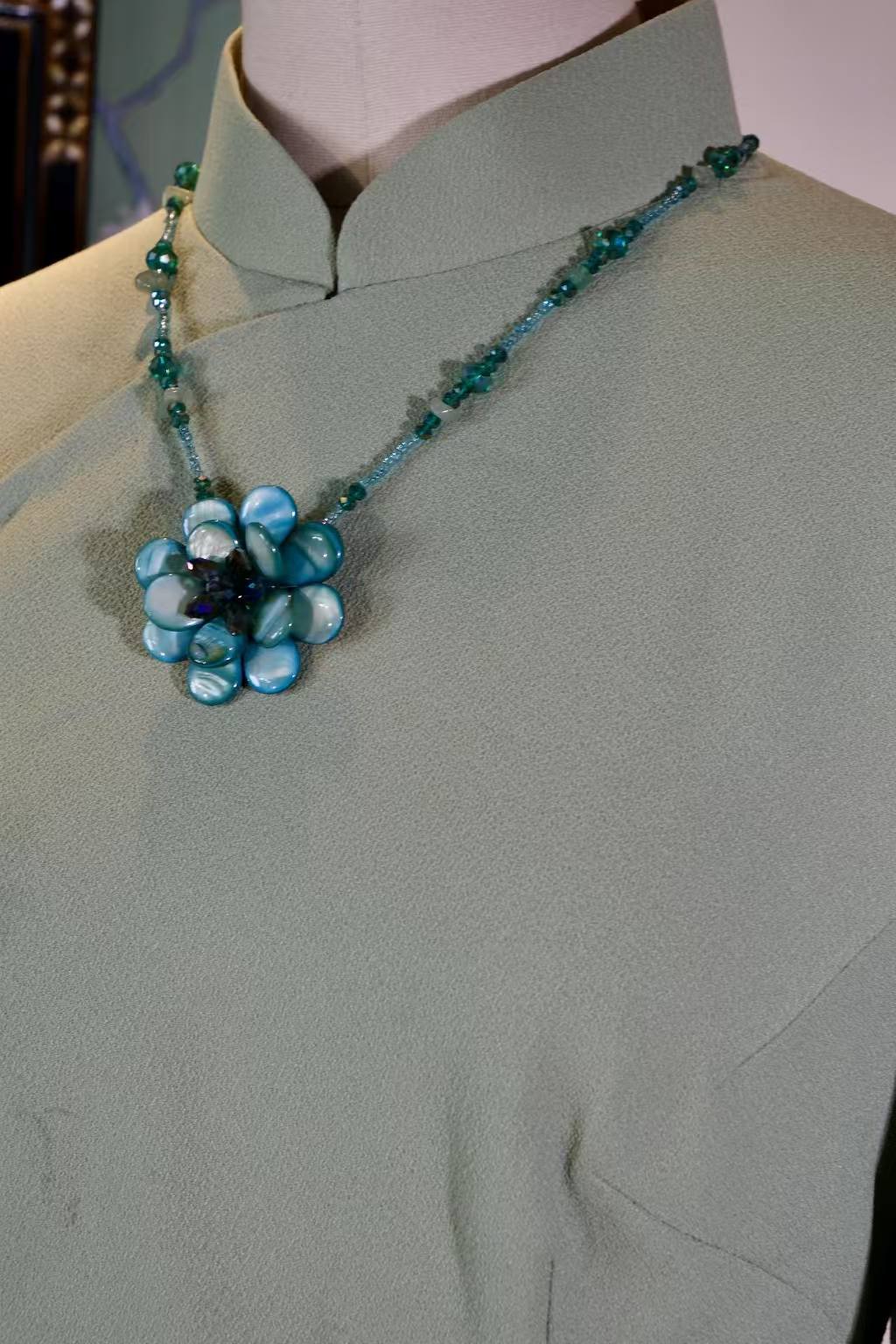
观此衣,首先映入眼帘的是一抹极具时代特征的“豆绿”或称“艾绿”。这种低饱和度的绿色,不似翠绿般张扬,也不像墨绿般深沉,它带着一种温润的玉质感,恰如《诗经》所云:“有匪君子,如切如磋,如琢如磨。”面料表面呈现出细腻的哑光质地,虽历经半个多世纪的光阴洗礼,依然挺括如初,未见丝毫松懈塌陷。这正是上世纪六十年代意大利进口精纺毛呢或混纺面料的典型特征——彼时欧洲纺织工业正处于黄金时期,其高支数纱线与精密织造工艺,赋予了织物极佳的骨架感与垂坠度。
【纹样考·无画处皆成妙境】
关于您询问的图案,这件旗袍最显著的艺术特征在于“素”。通体无印花、无刺绣、无滚边繁饰,这是一种极高明的“留白”艺术。在中国传统美学中,这叫“大音希声,大象无形”。它摒弃了清末民初旗袍常见的繁复镶滚与具象花鸟,转而追求线条本身的韵律美。唯一的装饰,乃是领口处那串蓝绿色的珠花项链(虽为配饰,却与衣身浑然一体),宛如荷塘中一点初绽的碧莲,打破了素色的宁静,起到了画龙点睛之效。这种极简主义风格,恰恰印证了六十年代受西方现代主义设计思潮影响下,海派或台式旗袍向剪裁结构回归的趋势。
【技艺论·省道与廓形】
从服装史的角度审视,这件作品是中西剪裁技法完美融合的标本。请注意观察其胸腰部的处理,采用了典型的西式立体剪裁——“省道”。传统的平面裁剪讲究“连袖”与“直身”,而这件旗袍通过精准的收省,将布料的余量巧妙隐藏,塑造出贴合人体曲线的S型轮廓。其袖型为改良后的短款喇叭袖(或称荷叶袖),既保留了中式连袖的含蓄,又增加了肢体的活动量与视觉上的轻盈感。这种剪裁对工匠的要求极高,稍有偏差便会破坏整体的平衡。作为台湾制造的古董衣,它见证了那个年代台湾作为“亚洲时装代工重镇”的精湛技艺,那是无数老裁缝用针线丈量出的黄金时代。
【岁月辞·光阴的故事】
每一件古董衣都是时间的容器。这件旗袍诞生于上世纪六十年代,那是一个东西方文化剧烈碰撞又奇妙共生的年代。或许,它曾挂在台北某家高级定制店的橱窗里,等待着一位知书达理的女士将它带回家;或许,它曾陪伴某位名媛出席过一场重要的晚宴,在觥筹交错间留下过一抹淡雅的倩影。
张爱玲曾在《更衣记》中写道:“各人住在各人的衣服里。”这件旗袍,便是一个关于优雅与克制的故事。它没有随波逐流去追逐当时流行的艳丽色彩,而是选择了一种内敛的姿态。六十年的岁月流转,曾经的时髦已成历史,但它所承载的那份从容气度,却穿越了时光的尘埃,愈发显得珍贵。
【鉴赏语·稀缺与价值】
在当今的古董衣市场上,六十年代的旗袍虽非绝迹,但像这样“意大利进口面料+台湾精工制作+保存完好+极简高级灰绿”的藏品,实属凤毛麟角。
其一,面料之稀缺:当年的进口面料存世量极少,且多为化纤混纺,能保持如此天然纤维般质感与色泽的更是罕见。
其二,审美之超前:这种极简风格完全符合当代的高级审美,即便今日穿着出席艺术展或雅集,也毫不过时,反而透着一种“老钱风”的贵气。
其三,品相之完美:古董衣最怕虫蛀与褪色,此衣色泽均匀,结构完整,堪称博物馆级的收藏佳品。
结语:
这不仅是一件衣裳,更是一段被凝固的历史,一首穿在身上的无声诗。它静默无言,却道尽了东方女性在那个特定年代的风华绝代与温婉坚韧。得之,幸甚;藏之,传世。
Measurements / Size Guide:
Bust / Waist / Hips / Total Length: 100/90/110/110 cm
Detailed Description:
The primary visual vector of this specimen is a low-saturation, refined hue historically recorded as "bean green" (doulü) or "mugwort green" (ailü). Eschewing the overt theatricality of emerald or the deep gravity of forest green, this palette projects a warm, translucent jade-like quality, embodying the classical verse from the Book of Songs (Shi Jing): "Look at that elegant gentleman—he is like bronze cut, like jade filed, like a gem chiseled, like a stone polished."
The surface of the substrate exhibits a meticulous matte topography. Across a sixty-year historical timeline, it fiercely retains its original structural stiffness (tingkuo) without showing localized fiber relaxation or structural collapse. This performance stands as definitive material proof of a premium 1960s imported Italian worsted wool or high-twist blend. During this golden age of European textile engineering, the deployment of ultra-high count yarns and precise weaving mechanics granted yardage an exceptional structural armature combined with an organic, fluid drape.
The defining art-historical signature of this qipao resides in its absolute austerity. The entire garment plane features zero surface printing, zero applied embroidery, and zero decorative piping (bianshi). This represents a highly sophisticated manifestation of strategic negative space (liubai). In classical Chinese aesthetics, this aligns with the paradigm of "the greatest sound is silent; the greatest form is shapeless" (da yin xi sheng, da xiang wu xing).
By completely casting off the heavy, additive trimming and literal floral illustration of the late Imperial and early Republican eras, the garment redirects the viewer’s eye entirely to the fluid cadence of the structural seam. The singular point of visual punctuation is the styling accompaniment of a teal-and-blue beaded floral necklace at the collar line. Operating like a singular blooming lotus breaking the stillness of a green pond, this embellishment provides a focal termination mark without violating the quietude of the monochrome ground. This strict minimalism historicizes the structural turn within mid-century Haipai and Taiwanese dress lineages, which were heavily influenced by Western architectural modernism.
From the perspective of industrial dress history, this artifact stands as an exemplary material specimen of transnational pattern engineering. The articulation of the bust and waist relies on the advanced deployment of Western three-dimensional darts (shengdao). While traditional Chinese flat pattern-cutting prioritized single-plane continuous sleeves and straight, unbifurcated torsos, this qipao implements calculated, concealed grain-reduction lines to translate flat yardage into an anatomical S-curve silhouette.
The sleeve morphology introduces a modified, short flare sleeve (lama xiu), which cleverly preserves the soft shoulder slope of traditional Chinese dress while expanding physical mobility and imparting visual lightness. This pattern execution demands extreme artisan precision; the slightest alignment error will permanently warp the grain alignment of the worsted wool. As a definitive product of Taiwanese manufacturing, the garment archives the elite technical capabilities of Taiwan during its mid-century tenure as a premier center of specialized garment production, capturing the era when master tailors measured history through individual stitches.
Every pristine antique garment operates as a physical container of chronological time. Birthed in the 1960s, this qipao was synthesized within a volatile geopolitical window defined by intense cross-cultural friction and cosmopolitan hybridization. It is highly probable that this specimen began its life-cycle within the showroom window of an elite bespoke salon in Taipei, commissioned by an independent, educated woman of the civic elite, or serving as an elegant sartorial defense for an institutional social gathering.
As Eileen Chang famously noted in Reflections on Clothing (Geng Yi Ji): "Each of us lives within our own clothing." This qipao chronicles a narrative of rigorous elegance and self-imposed restraint. Rather than capitulating to the high-chroma, saturated synthetic palettes that dominated the late 1960s, it maintains an inward-facing, disciplined composure. The passing of six decades has transformed what was once contemporary fashion into an immutable historical monument; yet the quiet confidence woven into its fibers remains entirely untouched by time.
Within the contemporary international antique apparel market, while 1960s qipaos are documented, a specimen unifying imported Italian worsted textile, elite Taiwanese artisan assembly, flawless structural preservation, and an austere, modernist sage-green color story is an absolute rarity.
Material Scarcity: Mid-century luxury imported yardage has suffered a massive attrition rate. Most surviving examples from this decade rely on early synthetic polyester blends; a textile that maintains this level of natural-fiber breathability, density, and crisp structure is a critical anomaly.
Aesthetic Longevity: The minimalist architectural lines of the garment speak directly to contemporary luxury sensibilities. It projects an inherent aristocratic poise—often categorized as the "Old Money" aesthetic—making it entirely viable for presentation within contemporary high-art spaces or formal academic symposia without appearing archaic.
Preservation Integrity: The primary hazards to vintage woolen textiles are localized insect infestation, fiber dry-rot, and atmospheric UV fading. This specimen exhibits uniform coloration, zero structural degradation, and complete seam integrity, elevating it to an institutional, museum-grade collectible.
This qipao transcends the functional utility of dress; it is a frozen archive of twentieth-century material culture—a silent poem mapped in wool. It articulates the complex historical position of the mid-century cosmopolitan woman: poised, structurally disciplined, and quietly resilient. For the dedicated archivist, it represents a non-renewable historical document worthy of permanent preservation.