深圳溯源
无法加载取货服务可用情况
衣服尺寸:
胸围/腰围/臀围/衣长:92/86/98/92 厘米
细节描述:
【器物之相:素以为绚】
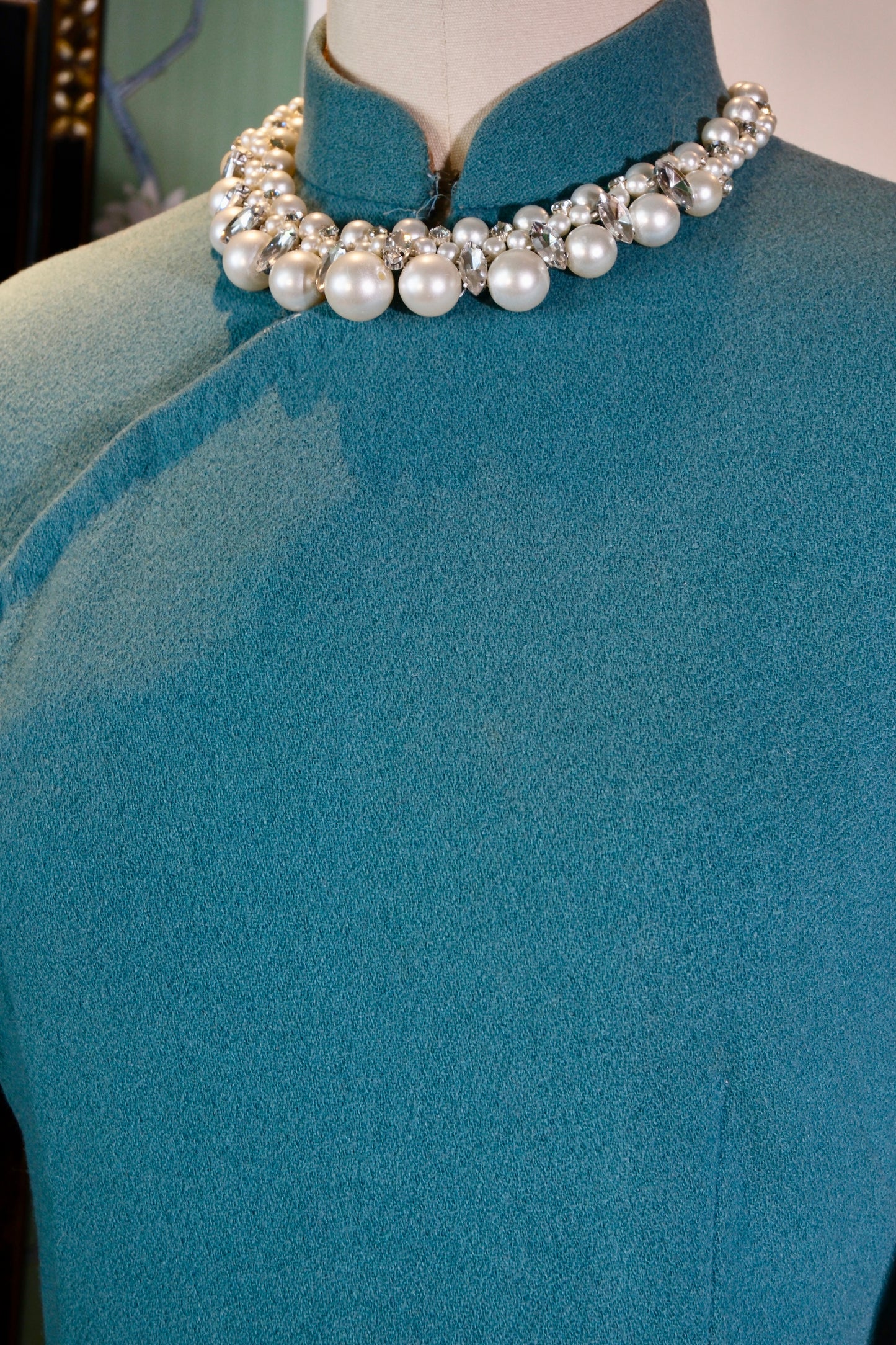
观此衣,首先映入眼帘的并非繁复的纹样,而是一抹如雨后初晴般的“碧色”。这件上世纪六十年代的香港产古董旗袍,通体无绣无绘,却深谙《论语》中“素以为绚兮”的美学真谛。它选用的是当年极为珍贵的意大利进口时装呢(Wool Crepe),这种面料自带一种哑光的高级质感,色泽沉静而深邃。
在图案设计上,它摒弃了传统旗袍常见的牡丹、凤凰等具象符号,转而以“结构”为图,以“光影”为案。请看那经典的斜襟设计,如同一道优雅的弧线划破静谧的湖面;七分袖的剪裁利落大方,露出手腕最纤细的骨节。这种极简主义的处理,恰恰是六十年代现代主义审美在东方的投射——它不靠外在的装饰喧哗,而是通过面料本身的肌理和剪裁的线条,构建出一种无声的庄严。
【史海钩沉:西风东渐的绝唱】
作为一名服装史研究者,我常将六十年代的香港旗袍视为中国近代服饰史上的一个“高光时刻”。彼时,张爱玲笔下的“万盏灯火”虽已渐行渐远,但香港作为东西方文化交汇的港口,正孕育出一种更为国际化、更具职业感的女性形象。
这件旗袍便是那个时代的缩影。它的稀缺性在于其“混血”的身份:骨子里是中式旗袍的立领灵魂,血肉里却是西式立体裁剪的精准省道(Darts)。注意看腰身两侧那道极深的收省,这是典型的意大利高级定制工艺,旨在通过物理剪裁而非松紧带,强行塑造出符合人体工学的S型曲线。这种工艺在当时造价不菲,非普通市井作坊所能为。它见证了那个时代香港名媛或高级知识分子女性的审美趣味——她们不再满足于传统的温婉,开始追求独立、干练且不失女性柔美的现代气质。
【文化互文:身体的觉醒】
林语堂曾言:“女子穿旗袍,不仅是为了美,更是为了展示一种文化的自信。”这件碧色旗袍,正是这种自信的极致表达。
它不仅仅是一件衣服,更是一段被织物封存的历史记忆。在那个胶片电影盛行的年代,这样的旗袍或许曾伴随它的主人出入于中环的写字楼或半山区的宴会厅。它没有随波逐流去追逐当时流行的艳丽印花,而是选择了一种近乎孤傲的纯色,这本身就是一种极具文人风骨的选择。
如今,当我们凝视这件近六十年前的旧物,依然能被那种穿越时光的优雅所击中。它告诉我们,真正的时尚从未过时,因为它关乎的不仅仅是衣着,更是一种关于“人”如何在这个世界上优雅存在的哲学。这不仅是一件可供收藏的古董,更是一首穿在身上的、关于东方美学与西方工艺完美联姻的无声诗歌。
Measurements / Size Guide:
Bust / Waist / Hips / Total Length: 92/86/98/92 cm
Detailed Description:
Upon viewing this specimen, one is not struck by a cacophony of ornate ornamentation, but rather by the singular, evocative "Emerald" chromaticity—reminiscent of the sky immediately following a clearing rain. This 1960s Hong Kong-manufactured antique qipao contains no embroidery or figurative surface decoration, yet it embodies the essential aesthetic truth of the Analects: "Plainness is the finest decoration." The garment is constructed from a rare, mid-century Italian import Wool Crepe, a textile that inherently projects a sophisticated matte finish, with a hue that is both composed and profound.
In its iconographic design, the garment discards the literal symbols ubiquitous in traditional qipaos—such as peonies or phoenixes—and pivots to "structure" as its pattern and "light and shadow" as its motif. Observe the classic asymmetrical front-opening (xiejin); it functions as an elegant arc slicing across a tranquil lake. The three-quarter-length sleeve cut is decisive and generous, exposing the most delicate articulation of the wrist. This minimalist treatment is a precise projection of 1960s Modernist aesthetics into the Eastern theater. It eschews the clamor of external decoration, opting instead to build a silent, formidable gravity through the textile’s intrinsic grain and the architectural rigor of its tailoring.
As a researcher in the history of dress, I frequently characterize the 1960s Hong Kong qipao as a "high-water mark" in the modern history of Chinese clothing. While the "ten thousand lamps" depicted in Eileen Chang’s prose may have begun to fade into the distance, Hong Kong—as a harbor of cultural convergence—was then incubating a female image that was increasingly internationalized and professionalized.
This qipao acts as a microcosm of that era. Its rarity lies in its "hybrid" identity: structurally, it retains the Mandarin collar soul of the Chinese qipao; biologically, it is infused with the mechanical precision of Western three-dimensional pattern-cutting—specifically, the darts. Note the deep, sculpted darts at the waistline. This is characteristic of Italian high-couture engineering, designed to bypass elastic tension in favor of physical tailoring to force an ergonomic "S-curve." At the time, such an intervention represented a significant capital investment, inaccessible to common workshops. It stands as a testament to the aesthetic orientation of the era’s Hong Kong elite and female intellectuals—women who were no longer satisfied with traditional gentleness and had begun to pursue an independent, capable, and modern temperament that did not compromise on feminine elegance.
Lin Yutang once remarked: "A woman wears a qipao not merely for beauty, but to demonstrate a cultural confidence." This emerald qipao is the ultimate articulation of that confidence.
It is more than a garment; it is a historical memory encapsulated in fiber. In the era of celluloid cinema, such a qipao may have accompanied its owner through the commercial high-rises of Central or the salons of the Mid-Levels. It did not drift with the tide of the era's popular, vibrant prints; it selected an almost aloof, monochromatic palette—a choice that in itself reflects the integrity of the literati spirit.
Today, as we gaze upon this object nearly sixty years later, we are still struck by an elegance that transcends time. It imparts a foundational truth: true fashion never expires because it concerns not only the clothing itself, but a philosophy of how one exists gracefully within the world. This is not merely an antique for a private collection; it is a silent poem woven in cloth, celebrating the perfect marriage of Eastern aesthetics and Western craftsmanship.