溯源
无法加载取货服务可用情况
【引言:时光的针脚】
“衣以载道,服以传情。”在服装史的浩瀚长河中,20世纪60年代是一个极为迷人的断代。那是一个西风东渐达到顶峰,而东方美学在坚守中寻求蜕变的黄金时代。
眼前的这件时装裙,不仅是一件衣物,更是一段被缝进经纬里的历史档案。它诞生于那个被誉为“东方巴黎”的香港,却流淌着意大利面料的高贵血液。它不仅仅是一件旗袍的变体,更是中西文化在剪裁台上的一次深情拥抱。
【面料与色泽:来自亚平宁的温柔】
古人云:“罗衣何飘飘,轻裾随风还。”但这件衣裳的质感,却比传统的丝绸多了一份挺括与笃定。
据考,此裙选用的是60年代珍贵的意大利进口时装料。彼时的意大利纺织业正处于战后复兴的巅峰,其面料工艺以结构紧密、色泽纯正著称。这种淡粉色,非中国传统的大红大绿,亦非西方的艳丽桃红,而是一种含蓄的、带着灰度的“肉粉”或“藕荷”色调。它如同宋瓷中的影青,温润如玉,既保留了东方女性肌肤相亲时的柔和感,又具备了西式礼服所需的雕塑感。这种面料的垂坠性与抗皱性,完美支撑起了裙身那流畅的线条,历经半个世纪依然光洁如新。
【版型与剪裁:海派风韵与西式立体的交响】
从形制上看,这是一次大胆的“改良”。它保留了旗袍最核心的灵魂——立领与收腰,却在廓形上进行了彻底的西化重构。
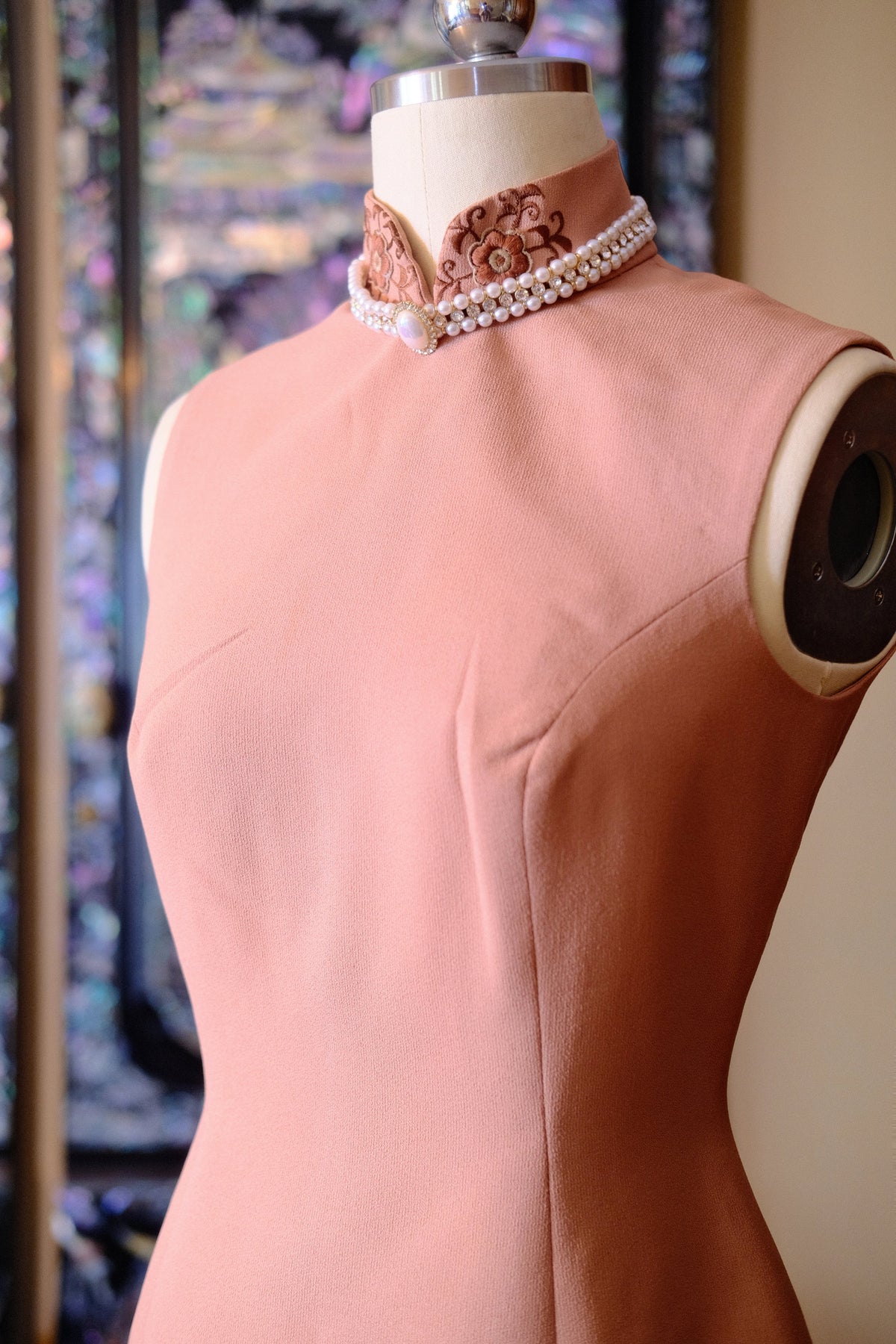
传统的旗袍讲究“平面裁剪”,顺应人体自然曲线;而这件裙子明显采用了西式立体裁剪法(Draping)。请注意看它的肩部与腋下处理,那是典型的60年代欧式连衣裙的构造,无袖设计露出了女性优美的手臂线条,胸省与腰省的巧妙转移,使得衣身如第二层肌肤般贴合,却又在臀部以下自然散开,形成优雅的A字伞摆。
这种“A字廓形”正是60年代时尚界的标志符号,它解放了女性的身体,赋予了她们行动的自由。它将东方的婉约与西方的摩登完美融合,正如张爱玲笔下那些穿梭于名利场的女性,既有旧时代的底蕴,又有新世界的锋芒。
【工艺与细节:苏绣遗风与珍珠的凝视】
最引人注目的,莫过于领口处的精湛工艺。这不仅仅是装饰,更是整件衣裳的“眼”。
领口采用了精致的机绣工艺,绣片上的花卉纹样虽为机器所制,却有着手工刺绣般的灵动与细腻。这种纹样隐约可见传统“缠枝莲”或“宝相花”的影子,寓意生生不息、富贵吉祥。但在色彩上,它选择了与衣身同色系的深一度的粉棕,低调奢华,不喧宾夺主。
【结语:博物馆级的珍藏】
《诗经》有云:“岂曰无衣?与子同袍。”这件衣裳,穿越了六十载的风霜,从繁华的香江彼岸来到我们面前。它不仅见证了那个年代香港裁缝高超的技艺——他们能用最国际化的语言,讲述最地道的中国故事;也记录了那个时代女性审美意识的觉醒。
它是一件可以穿在身上的艺术品,也是一份关于美、关于融合、关于时代的珍贵档案。穿上它,你便穿上了那段流光溢彩的岁月,步步生莲,风华绝代。
"Clothing carries ideas; attire conveys emotion." In the vast river of costume history, the 1960s stands out as a uniquely enchanting era. It was a golden age when Western influence reached its zenith, while Eastern aesthetics sought metamorphosis through steadfast resilience.
The fashion dress before us is more than a mere garment—it is a historical archive sewn into warp and weft. Born in Hong Kong, the city once celebrated as the "Paris of the East," it nevertheless carries the noble bloodline of Italian textiles. It is far more than a simple variation of the Qipao; it is a profound, affectionate embrace between Eastern and Western cultures upon the tailor’s cutting table.
An ancient verse reads: "How fluttering are the silk robes, their light hems swaying with the wind." Yet the texture of this garment possesses a structural crispness and poise that traditional silk lacks.
Records indicate that this dress was crafted from precious Italian imported fashion fabric of the 1960s. During that period, the Italian textile industry was at the peak of its post-war renaissance, renowned for tight weaves and pure coloration. This pale pink is neither the vibrant red and green of traditional Chinese weddings, nor the glaring magenta of the West; rather, it is a restrained, grey-undertoned "flesh pink" or "lotus root" shade. Resembling the shadow-blue glaze of Song Dynasty porcelain, it is warm and jade-like—retaining the gentle affinity expected against an Eastern woman’s skin while possessing the sculptural quality required of a Western evening gown. The fabric's impeccable drape and crease resistance perfectly support the dress's fluid lines, keeping it as bright and pristine as new after half a century.
In terms of form, this represents a bold "evolution." It retains the core soul of the Qipao—the stand collar and fitted waist—while fundamentally reconstructing its silhouette through Westernization.
Traditional Qipao relies on "flat-pattern cutting," conforming closely to the body’s natural curves; this dress, however, clearly adopts Western draping and three-dimensional cutting methods. Observe the treatment of the shoulders and armholes: it features the classic construction of a 1960s European dress. The sleeveless design bares the graceful lines of a woman's arms, while the clever shifting of bust and waist darts allows the bodice to fit like a second skin, only to flare out naturally below the hips to form an elegant A-line flared skirt.
This "A-line silhouette" was the iconic hallmark of 1960s fashion; it liberated the female body and endowed women with freedom of movement. It seamlessly fuses Eastern reserve with Western modernity, much like the women navigating bustling social circles in Eileen Chang’s novels—possessing the depth of the old era alongside the sharp edge of the new world.
The most eye-catching feature is unquestionably the exquisite craftsmanship at the neckline. This is not mere decoration; it is the "eye" of the entire garment.
The neckline employs refined machine-embroidery, where the floral motifs, though mechanically produced, retain the liveliness and delicacy of hand embroidery. These patterns faintly echo traditional scrolling lotus or baoxiang flower motifs, symbolizing endless vitality and auspicious prosperity. In terms of color, however, it opts for a deep dusty rose—one shade darker than the body fabric—achieving understated luxury without overshadowing the whole.
The Classic of Poetry asks: "How can it be that you have no clothes? I share my robes with you." Crossing sixty years of frost and wind, this garment has traveled from the bustling shores of Hong Kong to stand before us. It bears witness not only to the supreme mastery of Hong Kong tailors from that era—who could articulate the most authentic Chinese stories using the most international design language—but also records the awakening of women's aesthetic consciousness during that time.
It is a wearable work of art and a precious archive concerning beauty, fusion, and history. To wear it is to slip into that radiant era of yesteryear, walking with lotus steps, timeless and peerless in grace.