深圳溯源
无法加载取货服务可用情况
衣服尺寸:
胸围/腰围/臀围:82:74/92 厘米
衣长:95 厘米
细节描述:
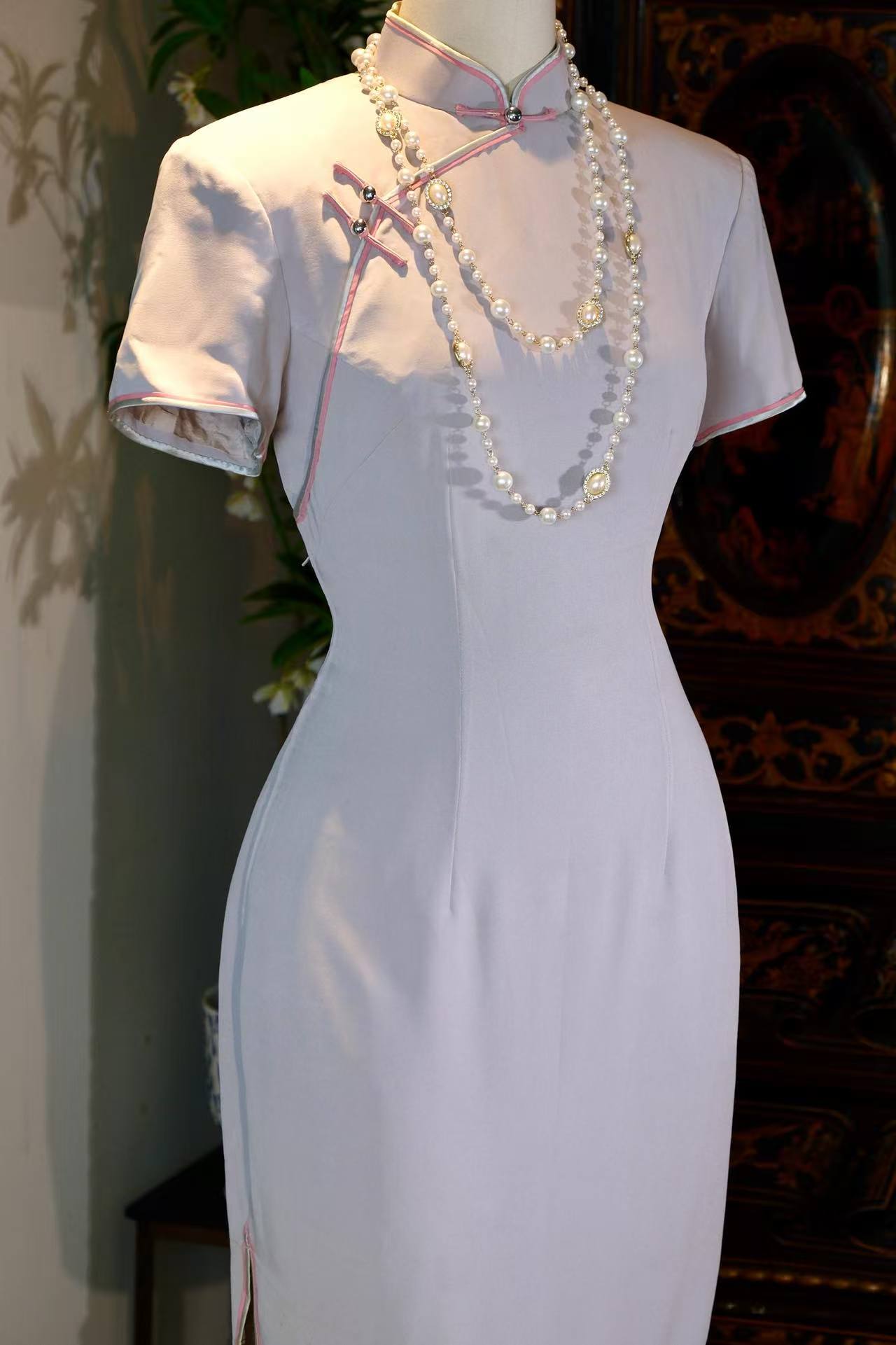
在时装史的长河中,有些衣物并非为了喧嚣的T台而生,它们是时间的容器,是静谧的独白。眼前这件上世纪六十年代的台湾产古董旗袍,便是一件典型的“无声之作”。它摒弃了彼时流行的繁复刺绣与浓烈印花,以一种近乎“计白当黑”的东方美学智慧,在服装史上留下了清丽的一笔。
衣上无花,心中有景:极简主义的东方叙事
细观此衣,最令人称奇之处在于其“无图案”。它通体呈现一种极淡的藕荷色(或称浅雪青),这是一种在色谱中极具文人气息的颜色,既非纯白的凛冽,亦非粉紫的俗艳,而是介于二者之间的一种“灰度”美学。
衣身之上,唯有几处点睛的滚边工艺。领口、大襟与袖口处,采用了粉色与灰色的双色滚条。它并非为了炫耀技法,而是如同中国山水画中的勾勒,用极细的线条勾勒出女性的身体轮廓。这种“素衣”风格,恰恰印证了明代文震亨在《长物志》中所推崇的“宁古无时,宁朴无巧”的审美格调。它不需要花鸟虫鱼来装饰,因为它本身就是那个时代台湾上层社会女性优雅与内敛的图腾。
宝岛遗珍:六十年代台湾旗袍的黄金剪影
这件旗袍的故事,要从那个特殊的年代说起。上世纪六十年代,是台湾旗袍制作的黄金时期。彼时,随国民政府迁台的大陆裁缝师傅,将海派旗袍的精髓带到了宝岛,并与当地的气候、人文相融合,形成了独特的“台式旗袍”风格。
- 剪裁的演变:不同于四十年代宽袍大袖的遗风,也不同于五十年代初期的拘谨,六十年代的台湾旗袍剪裁更为立体。请注意观察其腰身的收省(Darts),线条流畅而精准,极度贴合人体曲线,却又保留了活动的余地。这种剪裁深受当时西方迪奥“新风貌”(New Look)的影响,是东西方剪裁技艺完美融合的产物。
- 岁月的痕迹:作为一件流传半世纪的古董衣,它身上或许带着些许岁月的痕迹,但这正是其稀缺性所在。在那个成衣工业尚未完全普及的年代,每一件旗袍都是裁缝师傅“度身定做”的孤品。它可能曾属于一位台北的官太太,或是一位书香门第的千金,在某个夏日的午后,穿着它赴一场茶会,或在窗边读一封家书。
艺术风格与稀缺性考据
在艺术风格上,这件旗袍展现了“少即是多”的高级感。其领口的设计采用了经典的水滴领(或称凤仙领变体),领口较低,展现了颈部修长的线条,这在保守的六十年代是一种大胆的时尚突破。盘扣的设计简洁素雅,与滚边颜色呼应,细节之处见真章。
其稀缺性体现在以下几个方面:
- 存世量:六十年代的古董旗袍因面料娇贵,极难保存。能完好留存至今且版型未变者,寥若晨星。
- 工艺失传:现代工业流水线生产的旗袍,往往忽视了传统手工归拔(通过熨烫改变面料经纬度以贴合人体)的工艺。而这件古董衣的立体剪裁,正是老派裁缝手工技艺的见证。
- 审美价值:在当今浮躁的时尚圈,这种沉静、典雅、不张扬的“大家闺秀”风格,已成为绝响。
这件淡紫色旗袍,不仅是一件衣物,更是一段凝固的历史,一种逝去的优雅,值得每一位懂得欣赏东方之美的藏家细细品味。
Measurements / Size Guide:
Bust / Waist / Hips: 82:74/92 cm
Total Length: 95 cm
Detailed Description:
In the long river of fashion history, certain garments are never born for the clamor of the runway. They are vessels of time, whispered monologues. This antique Qipao, crafted in 1960s Taiwan, is a quintessential "silent masterpiece." Eschewing the complex embroideries and intense prints popular during its era, it embraces the Eastern aesthetic wisdom of "utilizing emptiness as form," leaving a pure and elegant mark on fashion history.
[I. No Motifs on Fabric, Infinite Scenery in Heart: The Eastern Narrative of Minimalism] Upon close inspection, the most astonishing feature of this garment is its absolute lack of patterns. The entire piece presents a very faint lotus-root purple (or pale snow-cyan)—a hue deeply charged with literary and intellectual aura in the color spectrum. It avoids both the chilling starkness of pure white and the vulgar opulence of bright pink-purple, residing beautifully within a "muted gray" aesthetic balance.
Upon the plain body of the dress, the only focal points are the exquisite pipings. The mandarin collar, diagonal opening (Xiejin), and cuffs feature a dual-color piping of pastel pink and soft gray. This design does not boast technique; rather, like the fine brushstrokes outlining silhouettes in traditional Chinese shanshui paintings, it traces the fluid contours of the female form. This minimalist "plain attire" style perfectly substantiates the aesthetic standard championed by Wen Zhenheng in the Ming Dynasty text Treatise on Superfluous Things (Chang Wu Zhi): "Better antique than contemporary; better simple than ingenious." It requires no floral or faunal decorations, for the garment itself is a totem of elegance and restraint for upper-class women in mid-century Taiwan.
[II. Treasure of the Island: The Golden Silhouette of 1960s Taiwanese Tailoring] The story of this Qipao originates from a unique historical epoch. The 1960s marked the golden age of Qipao tailoring in Taiwan. During this period, master tailors from the Shanghainese (Haipai) school migrated to the island, grafting the essence of Shanghai high-fashion onto the subtropical climate and local culture, thus forming a distinct "Taiwanese-style Qipao."
Evolution of the Silhouette: Departing from the oversized, sweeping sleeves of the 1940s and the rigid constraints of the early 1950s, 1960s Taiwanese Qipao tailoring became far more three-dimensional. Notice the precision of its waist darts—the lines flow flawlessly and contour the human body with exactitude, while preserving comfortable room for movement. Deeply influenced by the global wave of Christian Dior’s "New Look," this tailoring stands as the perfect marriage of Eastern and Western pattern-making.
Traces of Time: As an antique garment that has traversed half a century, it may bear faint traces of time, yet this is precisely where its irreplaceable rarity resides. In an era before the complete mechanization of the garment industry, every single Qipao was a bespoke, one-of-a-kind creation meticulously measured and draped by a master tailor. It might have belonged to a socialite or a daughter of a scholarly lineage in Taipei, who wore it on a summer afternoon to attend a tea gathering or read a family letter by the window.
[III. Artistic Style & Textual Rarity] Artistically, this Qipao demonstrates the high-end allure of "less is more." The neckline adopts a classic teardrop cutout—a creative variation of the Fengxian collar. The lower collar height elongates the neck elegantly, representing a daring fashion breakthrough in the conservative 1960s. The frog closures (Pankou) are kept sleek and understated, matching the colors of the piping—a testament to true luxury being hidden in the details.
Its rarity is substantiated through three critical dimensions:
Survival Rate: Due to the delicate nature of mid-century textiles, 1960s antique Qipaos are incredibly difficult to preserve. Specimens that remain flawlessly intact with their original structure unaltered are as rare as morning stars.
Lost Craftsmanship: Modern industrial assembly lines completely overlook the traditional manual iron-shaping technique (Gui-Ba), which manipulates the warp and weft of the fabric to fit the natural curves of the torso. The structural, three-dimensional fit of this antique garment stands as a living witness to the manual genius of old-school masters.
Aesthetic Value: In today’s fast-paced fashion world, this serene, aristocratic, and unpretentious "grand dame" style has truly become a lost echo.
This pale purple long dress is more than a garment; it is a frozen fragment of history, a departed elegance, awaiting a connoisseur who truly understands the pinnacle of Eastern understated luxury.