深圳溯源
素纱凝香,旧梦流光——记一件六十年代港制羊毛混纺线香绲古董旗袍 | Fragrance Congealed in Muted Textures, Glances of Vanished Dreams: A 1960s Hong Kong-Made Wool-Blend Qipao with Incense-Stick Piping
素纱凝香,旧梦流光——记一件六十年代港制羊毛混纺线香绲古董旗袍 | Fragrance Congealed in Muted Textures, Glances of Vanished Dreams: A 1960s Hong Kong-Made Wool-Blend Qipao with Incense-Stick Piping
无法加载取货服务可用情况
素纱凝香,旧梦流光——记一件六十年代港制羊毛混纺线香绲古董旗袍
衣服尺寸:
胸围/腰围/臀围:96/84/100 厘米
衣长:102 厘米
细节描述:
衣上无纹,自有文章
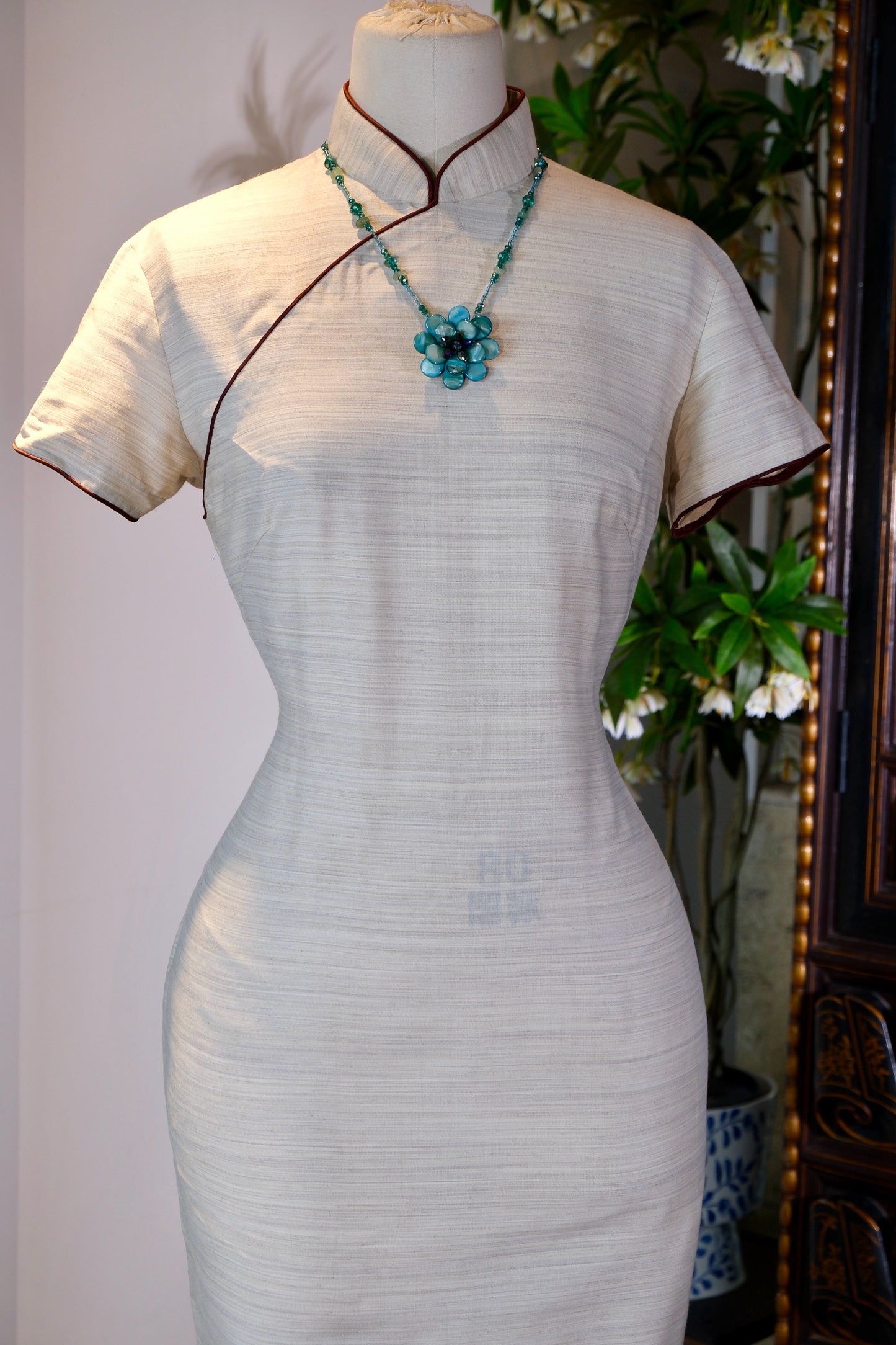
若论此件旗袍之图案,观者初见或以为素净无饰。实则不然,其妙处正在于“无图之图”。衣料本身,便是最大的纹理。这是一件米白色的羊毛混纺旗袍,其表面并非光滑如镜,而是布满了极其细密、如同丝线般平行的横向暗纹。这种纹理,在光线下流转,仿若微风拂过平静的湖面,泛起层层涟漪,又似古琴上被岁月抚平的弦痕,低调而富有韵律。
它并非印花或提花,而是织造工艺本身所形成的肌理,这在当时是一种高级面料的处理方式,旨在通过材质本身来彰显质感,而非依赖外在的繁复装饰。正如古人所言“大音希声,大象无形”,这件旗袍以极简的“素面”示人,却以其独特的肌理,诉说着一种内敛而高级的审美情趣。其领口、大襟、袖口及下摆处,均以深褐色细线香绲边,这一抹深色,如同水墨画中的勾勒,不仅勾勒出旗袍流畅的轮廓,更在素雅的底色上点睛,使其不至于单调,反添几分沉稳与精致。
香云旧梦,港岛风华
这件旗袍,诞生于上世纪六十年代的香港。彼时的香港,正处在一个东西方文化交融的特殊时期,旗袍作为东方女性的经典服饰,在此地也迎来了其最后的辉煌与变革。它不再是旧上海时期那种极度繁复、缀满珠翠的样式,而是逐渐向着更为简洁、实用、现代化的方向演变,以适应都市女性的新生活节奏。
这件旗袍的剪裁,正是这一时代精神的完美体现。它贴合身形,曲线玲珑,既保留了传统旗袍的优雅韵味,又通过更为科学的剪裁,使其穿着更为舒适自如。羊毛混纺的面料,在当时亦是一种新潮的选择。它既有羊毛的保暖与挺括,又因混纺而更具韧性与垂坠感,非常适合香港微凉的季节,也体现了当时香港作为国际贸易港口,在面料选择上的开放与多元。
我们可以想象,在半个多世纪前,它或许曾被一位优雅的香港名媛或知识女性所珍爱。她可能穿着它,漫步于中环的石板路,或是在浅水湾的沙滩上留下倩影,又或是在某个重要的社交场合,以其不张扬的华贵,赢得众人的瞩目。这件旗袍,不仅是一件衣物,更是一段凝固的时光,一个关于那个年代、那座城市的鲜活注脚。
线香绲边,匠心独运
“线香绲”,是这件旗袍工艺上的一大亮点,也是其稀缺性与艺术价值的集中体现。绲边,是中国传统服饰中一种重要的装饰与加固工艺,而“线香绲”则是其中最为精细、难度最高的一种。它要求用极细的布条,包裹着一根如同线香般粗细的棉纱或细绳,再以极细密的针脚,手工缝制于衣物的边缘。
此件旗袍的绲边,细如发丝,却饱满圆润,线条流畅,毫无滞涩之感。这不仅需要裁缝拥有极高的技艺,更需要极大的耐心与专注。在六十年代,这样的工艺已属难得,而在如今,能够掌握并愿意投入如此多工时进行手工制作的匠人,更是凤毛麟角。这细密的绲边,不仅起到了装饰作用,更使得旗袍的边缘更为耐磨,不易变形,体现了“实用与美观并重”的匠心精神。
从艺术风格而言,这件旗袍属于典型的“海派”旗袍在港岛的延续与演变。它摒弃了过多的装饰,追求线条的流畅与材质的质感,体现了“少即是多”的现代美学理念。其素雅的色彩与精致的细节,共同营造出一种“清水出芙蓉,天然去雕饰”的艺术境界。
稀世之珍,可遇不可求
时至今日,一件保存完好、工艺精湛、且带有明确时代印记的六十年代香港产古董旗袍,其稀缺性不言而喻。岁月的侵蚀、穿着的磨损、以及现代生活方式的改变,使得这类衣物存世量极少。而这件旗袍,从其面料的完整度、绲边的清晰度、以及整体的保存状态来看,堪称上品。
它不仅仅是一件可供穿着的衣物,更是一件值得收藏与研究的艺术品。它承载着特定历史时期的文化信息、工艺水平与审美风尚。对于服装史研究者而言,它是研究六十年代香港服饰变迁的珍贵实物;对于收藏家而言,它是可遇不可求的稀世之珍;而对于每一位欣赏它的人而言,它都是一扇通往那个优雅年代的窗口,让人得以窥见旧日风华,感受那份穿越时空的宁静与美好。
素纱凝香,旧梦流光。这件六十年代的羊毛混纺线香绲古董旗袍,以其独特的魅力,静静地诉说着一个关于美、关于时光、关于匠心的故事。
Fragrance Congealed in Muted Textures, Glances of Vanished Dreams: A 1960s Hong Kong-Made Wool-Blend Qipao with Incense-Stick Piping
Measurements / Size Guide:
Bust / Waist / Hips: 96/84/100 cm
Total Length: 102 cm
Detailed Description:
[I. Textures of the Cloth: Artistry Within the Absence of Motif] When observing this Qipao for the first time, one might easily mistake it for a plain, unornamented garment. Yet, its true genius resides precisely in this "canvas of no motifs." The textile itself functions as the primary visual architecture. Crafted from a premium cream-white wool blend, its surface rejects slippery smoothness; instead, it is densely blanketed by micro-linear, parallel horizontal ribbings running across the weave. This physical topography catches the light dynamically, mimicking a sudden breeze rippling across a quiescent lake, or the weathered string-marks left upon an ancient zither—deeply reserved, geometric, and rich with internal rhythm.
This layout bypasses surface printing or standard jacquard decoration, emerging entirely from the structural engineering of the loom itself. In 1960s haute couture, this served as the definitive methodology for positioning high-tier textiles—weaponizing raw material variables to project tactile substance rather than relying upon superficial, loud ornamentations. As ancestral aesthetics dictate: "Greatest music approaches silence; grandest form embraces formlessness." This Qipao meets the gaze in an unadorned, minimalist posture, yet utilizes its structural micro-shadows to articulate a deeply intellectual aesthetic. Along the mandarin collar, the asymmetrical opening, the cuffs, and the hem, the silhouette is framed by a microscopic, dark brown piping. This sharp contour acts as a single, masterfully delivered ink line in a Shanshui wash painting—defining the fluid boundaries of the garment, ensuring the cream foundation never slips into visual flat选ness, and grounding the piece in an ethos of quiet dignity.
[II. Memories of Victoria Harbour: Mid-Century Hong Kong Elegance] This Qipao was birthed during the 1960s in Hong Kong—a profound historical epoch defined by the fierce, poetic crossroads of East and West. Here, the Qipao, operating as the classic armor of Eastern women, achieved its magnificent twilight and its most progressive modern evolutions to negotiate the accelerating velocity of urban metropolis life. It deliberately shed the exhausting weight and hyper-ornamentation of its early Republican-era Shanghai precedents, pivoting instead toward a streamlined, functional, and highly modernist design linguistic.
The pattern-making of this piece stands as a pristine material manifestation of that mid-century zeitgeist. It hugs the body with architectural precision, sculpting an elegant silhouette while leveraging scientific dart configurations to guarantee ergonomic freedom of movement. The selection of a tailored wool blend was, for its time, a vanguard statement. It synthesized the crisp, structural memory of wool with the resilient drape of modern blends—negotiating the damp, chill sea winds of the Hong Kong winter basin perfectly, while archiving the free-market openness of Hong Kong operating as a premier global maritime trading hub.
To step backward half a century is to imagine this masterpiece cherished by a high-society matriarch or a university intellectual. She would have stepped through the historic cobblestone alleys of Central, captured the sunset along Repulse Bay, or anchored the room at a prestigious gala—commanding absolute focus through her non-demonstrative, understated opulence. This garment is far more than vintage apparel; it is a frozen capsule of time, a vital material footnote to a vanished golden age.
[III. Incense-Stick Piping: The Virtuoso Matrix of Manual Devotion] The execution of the Xian-Xiang Gun (Incense-Stick Piping) serves as the ultimate technical crowning achievement of this garment, concentrating its archival rarity and museum-grade value into a single detail. Fabric piping (Gunbian) has eternally functioned as a vital structural reinforcement and decorative anchor in ancestral Chinese tailoring; yet Xian-Xiang Gun represents the absolute peak difficulty within this discipline. It demands that an artisan utilize a microscopically sheared strip of bias fabric to tightly encase a cotton core no thicker than a single strand of traditional incense, subsequently stitching this cord onto the garment’s raw edges using near-invisible hand-needling.
The piping framing this specific Qipao measures thin as a strand of silk, yet remains flawlessly rounded, structurally full, and fluidly uniform without a single millimeter of tension or fabric distortion. This level of execution requires not merely virtuoso mastery from a tailor, but an almost meditative capacity for sustained focus. Even within the high-production context of the 1960s, this craftsmanship was reserved for premier commissions; in the contemporary world, masters possessive of the generational muscle memory required to commit hundred-plus hours to manual piping of this caliber are a near-extinct vanguard. This microscopic border does more than decorate; it structurally armors the garment’s high-friction margins against deformation, encapsulating the true couture ideal of "utility married to absolute grace."
Sartorially, this garment represents the definitive continuation and localized modernization of the Haipai (Shanghainese-style) legacy on the shores of Hong Kong. By executing a clean breakout from superficial decoration, it privileges clean lines and raw tactile topography—aligning flawlessly with the international modernist mantra of "Less is More." Its quiet palette and razor-sharp detailing coalesce to materialize the classical artistic ideal: "A lotus rising naturally from clear waters, entirely untouched by artificial carving."
Epilogue: A Rare Relic Devoured by Time In the contemporary market, an original 1960s Hong Kong-made Qipao preserving this tier of craftsmanship and clean historical provenance is an exceptionally rare curatorial anomaly. The chemical degradation of environmental moisture, the friction of physical wear, and the sweeping tides of fast fashion have systematically wiped out global inventories of mid-century daywear. Yet this specific piece—evaluated by its textile integrity, the crisp definitions of its manual piping, and its immaculate structural state—stands proud as a museum-grade asset.
It transcends the utility of dress to operate as a historical text worthy of elite curation and academic archiving. It houses the precise socio-cultural codes, technical limitations, and evolutions of taste defining a specific cold-war crossroads. For the clothing historian, it is an invaluable material witness; for the discerning collector, it represents an unrepeatable asset; and for the observer, it functions as a clear window looking backward into an elegant era—allowing one to catch the quiet cadence of historical craftsmanship and feel a tranquility that echoes across the currents of time.
分享