深圳溯源
无法加载取货服务可用情况
衣服尺寸:
胸围/腰围/臀围/衣长:98/86/106/108 厘米
细节描述:
一、 衣上繁花:流动的莫奈花园
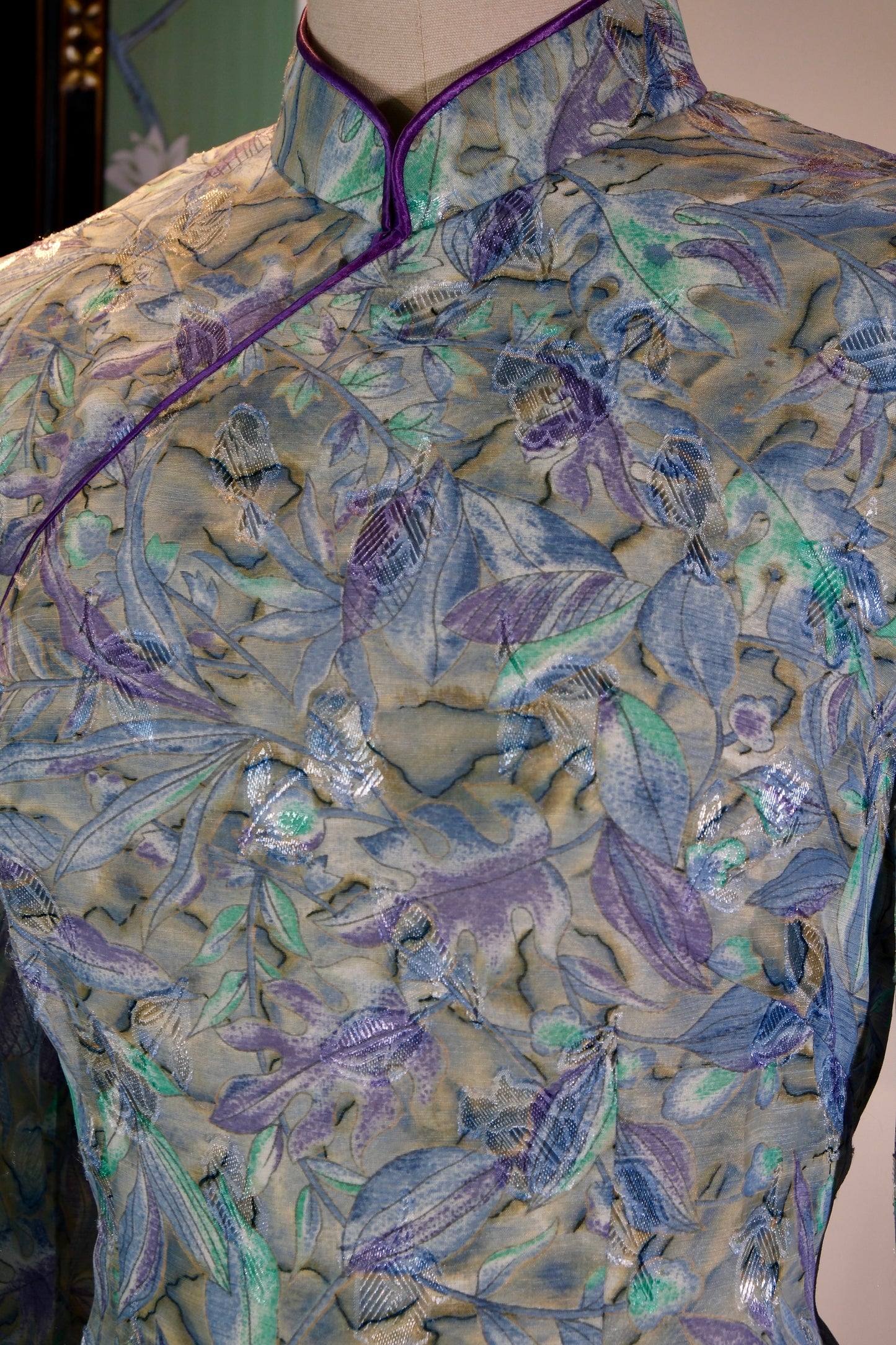
凝视这件旗袍,仿佛误入了一场关于光影与色彩的迷梦。这并非寻常的印染,而是一场面料上的“绘画”。
底料选用的是上世纪六十年代极为罕见的意大利进口暗纹提花绸,其肌理本身便如波光粼粼的水面。在此基础上,匠人运用了极高难度的手绘晕染工艺。你看那图案,并非具象的折枝花鸟,而是抽象写意的草木丛林。
色彩在蓝紫与翠绿之间游走,宛如印象派大师莫奈笔下的睡莲池,又似宋代词人贺铸笔下“一川烟草,满城风絮,梅子黄时雨”的迷离意境。紫色的叶片如梦似幻,带着金属光泽的银线穿插其间,随着光线的流转,整件衣服仿佛在呼吸。这种“色不碍墨,墨不碍色”的晕染技法,让每一片叶子都拥有了独立的灵魂,既有西画的立体光影,又有国画的气韵生动。
领口与袖口的深紫色滚边( piping),如一道精致的边框,将这满园春色稳稳收束,尽显克制的高级感。
二、 岁月针脚:黄金时代的混血美学
这件旗袍,是二十世纪六十年代香港时装界“中西合璧”巅峰时期的实物见证。
那是一个特殊的年代,张爱玲笔下的“乱世佳人”们已老去,新一代的香港名媛开始拥抱世界。彼时的香港,作为远东时尚之都,汇聚了来自欧洲的顶级面料与上海南迁的顶尖裁缝。
这件衣裳,便是那个时代的缩影。意大利的工业文明(提花面料)遇到了东方的传统手艺(立领、斜襟、归拔工艺)。请注意观察它的剪裁,这是典型的六十年代改良风格:海派裁剪的立体感被发挥得淋漓尽致。它不再像清末旗装那样宽大平直,而是极度强调女性的S型曲线。腰身的收省极其精准,那是老裁缝用熨斗和汗水“烫”出来的线条,也就是行话里的“归拔”。这种工艺如今已基本失传,机器无法替代人手对布料温度的感知。
三、 稀缺孤品:穿在身上的博物馆
《诗经·卫风》云:“绿兮衣兮,绿衣黄里。”古人常以衣寄情,而这件旗袍,寄托的是一个时代对美的极致追求。
在古董衣收藏界,六十年代的旗袍虽非最古老,却往往是最难寻觅的精品。原因在于:
1. 面料的不可再生性: 这种带有强捻丝光感且经过特殊后处理的意大利进口提花料,当年产量极少,存世至今完好无损者更是凤毛麟角。
2. 工艺的断层: 这种大面积的手绘晕染极易褪色或晕开,能保存六十余年依然色泽鲜亮、花纹清晰,说明当年的固色工艺达到了极高的水准,且保存环境极佳。
3. 审美的高度: 它脱离了俗艳的大红大绿,呈现出一种现代主义的艺术格调,即便放在今天的米兰或巴黎时装周秀场上,也毫不过时。
这不仅是一件衣服,更是一段被封存的时光。它见证了维多利亚港的霓虹初上,见证了那个东西方文化剧烈碰撞又完美融合的流金岁月。
结语:
所谓“锦衣夜行”,实乃暴殄天物。这件集意大利奢华面料、香港精湛剪裁与东方水墨意境于一身的古董旗袍,是值得被珍藏、被凝视的艺术品。它静默无言,却道尽了半个世纪前的风华绝代。
Measurements / Size Guide:
Bust / Waist / Hips / Total Length: 98/86/106/108 cm
Detailed Description:
Gazing upon this qipao feels akin to wandering into a shifting dream of light, shadow, and coloration. This layout is entirely distinct from standard industrial textile printing, operating instead as a magnificent piece of "painting" executed directly upon fabric.
The primary substrate utilizes an exceptionally rare 1960s Italian imported damask jacquard silk, boasting an inherent structural texture that mimics the shifting ripples of a water surface. Atop this luxurious base, master artisans executed a highly demanding manual hand-painted ombré bleeding technique. Observing the pattern reveals that it eschews representational, crisply delineated flora and fauna, opting instead for an abstract, expressive rendering of dense foliage and wild woodlands.
The color palette shifts dynamically between deep blues, structural purples, and vibrant emerald greens, invoking the ethereal atmosphere of Impressionist master Claude Monet’s water lily ponds, while concurrently channeling the misty, poetic melancholy written of by Song Dynasty lyricist He Zhu: "A river of misty grass, a city filled with wind-blown catkins, and the ceaseless rain when plums turn yellow." The violet leaf motifs appear dreamlike and illusory, interspersed with metallic silver threads that catch directed light. As illumination angles alter, the entire garment appears to breathe. This masterful bleeding technique—where "color does not obstruct the ink alignment, and ink does not muddy the color definition"—endows each abstract leaf with an independent spiritual resonance, perfectly synthesizing the three-dimensional light play of Western painting with the lifelike vitality (qiyun shendong) of traditional Chinese art.
Along the neckline and cuffs, a deep violet edge-piping (piping) introduces a crisp, disciplined framework. It securely anchors the sprawling seasonal colors of the surface layout, manifesting a masterclass in calculated restraint and premium distinction.
This specific qipao stands as a primary physical document of the absolute pinnacle of cross-cultural "East meets West" design trends within the 1960s Hong Kong fashion industry.
It was a highly unique historical window. The legendary "beauties of a chaotic era" written of by Eileen Chang had gradually aged, and a rising generation of Hong Kong socialites began actively embracing global cosmopolitanism. During this decade, Hong Kong stood as the definitive fashion capital of the Far East, operating as a magnetic nexus that gathered top-tier luxury textiles imported from Europe and master tailors who had migrated southward from Shanghai.
This garment functions as a perfect microcosm of that exact societal intersection: Western industrial civilization (manifested in the mechanical jacquard textile) met traditional Eastern manual craft (expressed through the high standing collar, diagonal asymmetric closure, and rigorous structural molding).
Observing its pattern drafting reveals the textbook attributes of modified 1960s tailoring, where the three-dimensional anatomical precision of the Shanghai style (Haipai) was executed to its absolute limit. Completely discarding the wide, flat, and straight silhouettes of late Qing Dynasty banner gowns, it places an intense premium on showcasing the female S-curve contour. The precision darting across the waistline is flawlessly calculated—a structural silhouette literally forced into the fabric fibers through a master tailor’s heavy iron and labor, known within the trade guild as the Gui-Ba (stretching and shrinking) technique. This highly specialized artisan skill has practically become a lost art in contemporary apparel production, as modern machinery can never replicate a master's intuitive sensory perception of textile temperature and moisture behavior.
As the ancient Book of Odes (Shijing: Odes of Wei) poetically notes: "Green is the upper robe, green is the robe with a yellow lining." Since antiquity, the literati have routinely projected profound internal emotions onto material costume, and this qipao preserves an era's ultimate pursuit of material beauty.
Within the elite circles of antique clothing connoisseurship, qipaos from the 1960s—though chronologically closer to the modern era than their pre-war counterparts—are frequently recognized as the most elusive, difficult-to-source masterworks. This acute curation premium is driven by three definitive factors:
Chronological Discontinuity of the Substrate: This imported Italian jacquard material, characterized by a highly twisted, mercerized luster and subjected to specialized vintage finishing treatments, was manufactured in exceptionally limited absolute volumes during mid-century. Physical specimens surviving to this day in pristine, unblemished archival condition are truly one in a million.
Discontinuity of the Craft Fabrications: Large-scale manual hand-painted pigment bleeding is inherently fragile and highly susceptible to severe color fading or uncontrolled bleeding over time. That this piece has journeyed across more than six decades while retaining such highly saturated coloration and crisp motif definition indicates that the original color-fixation technology reached an extraordinary level of mastery, and that the garment has benefited from exemplary archival preservation stewardship.
Elevated Aesthetic Framework: The surface composition entirely breaks away from loud, commercially vulgar reds and bright greens, embracing instead a highly sophisticated Modernist art style. Even if positioned onto a contemporary runway at Milan or Paris Fashion Week, its visual grammar remains completely timeless.
This piece is far more than an article of luxury apparel; it is a sealed time capsule of material culture. It stands as a physical witness to the neon lights first flickering over Victoria Harbour, archiving a golden era when Eastern and Western civilizations intensely collided yet achieved a flawless, harmonious synthesis.
To allow such a masterpiece to remain hidden in darkness would be a profound aesthetic tragedy. Synthesizing the heights of premium Italian fabric, the absolute precision of Hong Kong bespoke tailoring, and the poetic spiritual resonance of Eastern ink wash art, this antique qipao exists as a fine art object to be fiercely preserved, studied, and deeply revered. It hangs in magnificent silence, yet effortlessly narrates the absolute pinnacle of refinement from half a century ago.