深圳溯源
无法加载取货服务可用情况
一、衣上山河:图案里的东方美学密码
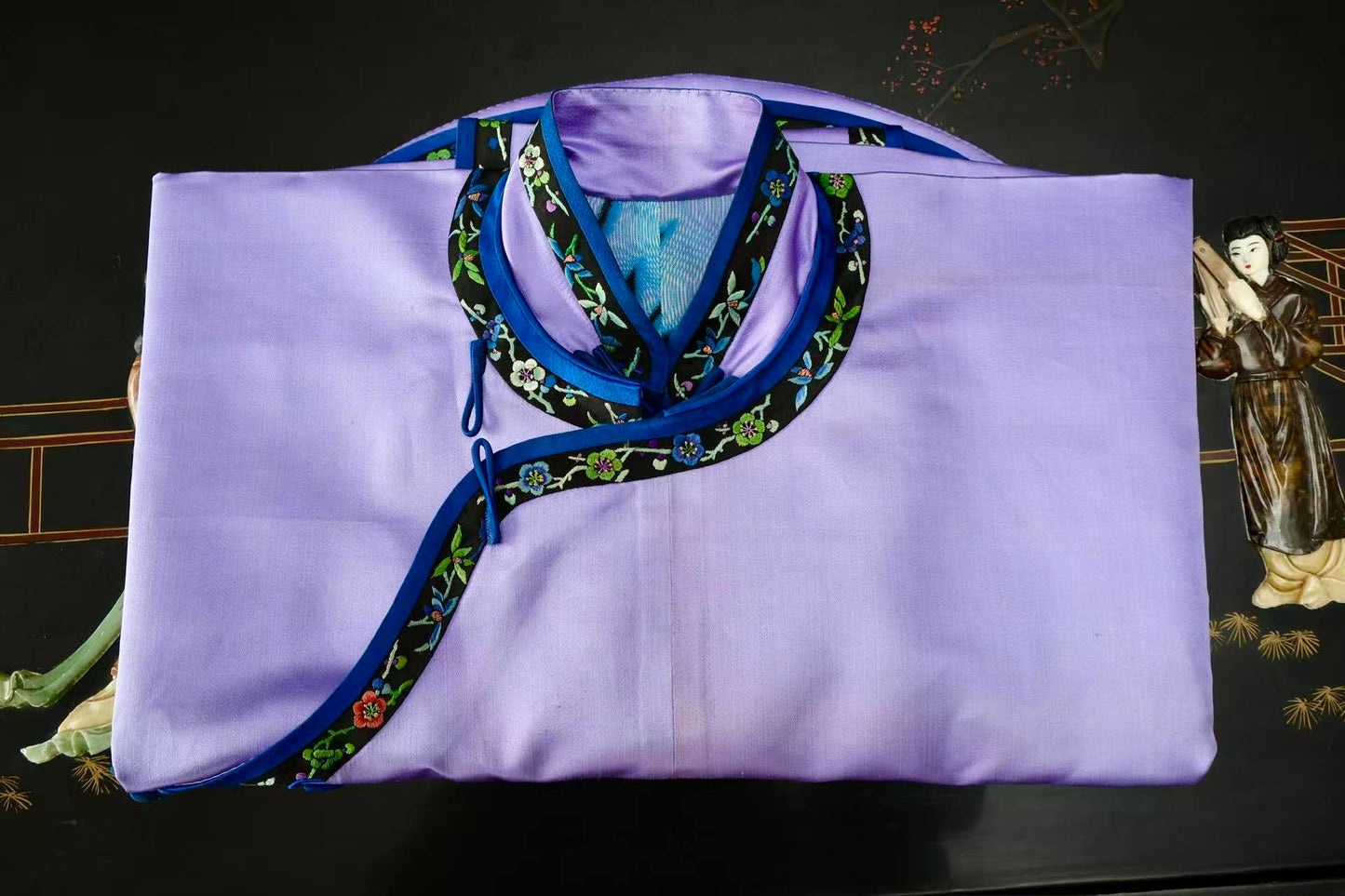
这件民国二十年代真丝素缎倒大袖上衣,以淡紫为底,
倒大袖的设计更是点睛之笔:袖口宽大如喇叭,
二、时光针脚:古董衣里的百年故事
这件上衣诞生于1920年代的上海滩,
据说,这件上衣的主人是一位留洋归来的女学生。
三、经典回响:艺术风格与稀缺性考据
从艺术风格而言,这件上衣完美体现了“海派服饰”的精髓。《
稀缺性更不容小觑:真丝素缎在民国时期已是奢侈品,需经“炼染、
四、结语:穿在身上的文化史诗
这件倒大袖上衣,不仅是一件衣服,更是一部穿在身上的文化史诗。
正如沈从文先生在《中国古代服饰研究》中所言:“
This silk plain satin wide-sleeved (Dao Da Xiu) top from the 1920s of the Republic of China utilizes a light purple base. Resembling lilacs in a springtime twilight, it exudes a noble grace within its refined elegance. Its most ingenious feature lies in the Qing Dynasty embroidered ruyi cloud-head borders inlaid along the neckline, lapel edges, and hem. Upon a black satin ground, trailing flowers are embroidered with blue, green, red, and white silk threads: the blue blossoms resemble iris bearing dew, the green leaves evoke newly unfurled fresh lotuses, the red flowers look like crabapples bursting with pistils, and the white blossoms seem like jasmines condensing frost. The stitching is as fine as strands of hair, and the color transitions are incredibly natural, as if the spring scenery of a Jiangnan garden has been embroidered directly into the warp and weft.
The wide-sleeved design is the crowning touch: the cuffs are wide like trumpets, naturally shaping a smooth curve when draping down, while the sleeves billow gracefully with every step. It at once retains the stateliness of Han women's attire from the Qing Dynasty, yet subtly carries the agility of Republic of China women pursuing liberation. The neckline features a traditional standing collar finished with a sapphire-blue satin piped trim, creating a sophisticated layer against the black embroidered border. The inner lining of the collar reveals a light blue patterned silk jacquard—resembling a secret from a secluded chamber, showcasing low-key luxury.
This top was born in the 1920s on the Shanghai Bund, a golden age where the old and the new interwove. At that time, the ripples of the May Fourth Movement had not yet settled; women of the new era bobbed their hair and walked out of their secluded chambers, yet they still retained a deep affection for the gentle tenderness of traditional attire. The wide-sleeved top was precisely a product of this era—it evolved from the robes of Han women in the Qing Dynasty, yet boldly innovated in sleeve shape and garment length: the cuffs were widened to over a foot, and the length was shortened to below the knee. It simultaneously preserved the old custom that "garments must be embroidered" while echoing the modern trend of "unbinding feet and cutting hair."
It is said that the owner of this top was a female student who had returned from studying abroad. Her father, the proprietor of a Suzhou silk house, specifically removed the embroidered borders handed down from the Qing Dynasty from an old cloak (changyi) and spliced them with imported silk plain satin. This was both a tribute to family tradition and a silent interpretation of the philosophy: "Chinese learning for fundamental principles, Western learning for practical application." Those trailing flowers might have once witnessed the tea parties of noblewomen in the late Qing Dynasty, while the light purple plain satin carried a Republic of China maiden's yearning for freedom—textiles from two different dimensions met here, with half of modern Chinese history hidden within the stitches.
In terms of artistic style, this top perfectly embodies the essence of "Shanghai-style (Haipai) fashion." The Shun Pao (Shen Bao) recorded in 1925: "The fashion of Shanghai women favors wide sleeves; the collar must be high, the sleeves must be wide, and the borders must be embroidered." Its design subtly aligns with the concept of "the real and unreal generating one another" (xushi xiangsheng) in traditional Chinese aesthetics: the plain satin represents the "unreal," while the embroidery represents the "real"; the wide sleeves represent "release," while the standing collar represents "restraint"—achieving a perfect balance amid contradictions. Furthermore, the application of the ruyi cloud-head border stems from the "auspicious motif" system of Qing Dynasty court costume—The Qing Miscellaneous Records (Qing Bai Lei Chao) states: "Garment motifs must take an auspicious meaning; motifs like cloud-heads, ruyi, and trailing branches all imply longevity and boundless blessings."
Its rarity can by no means be underestimated: silk plain satin was already a luxury product during the Republic of China era, requiring twelve specialized processes including scouring, dyeing, and calendering. Meanwhile, the Qing Dynasty embroidered borders were mostly crafted by hand, requiring a needlewoman to spend three months just to complete the borders of a single cloak. Today, to find both plain satin and embroidered borders perfectly preserved together is exceptionally rare—especially given that this top is in near-mint condition, with not a single broken line in the stitching and not a shade of fading in the colors, making it a true "living fossil" of Republic of China fashion.
This wide-sleeved top is not merely a garment, but a cultural epic worn on the body. It witnessed the turbulent transition from the imperial system to the republic, carried the breakthrough of women from the inner chambers into society, and condensed the transition from manual handicraft to industrialization. When we gaze at those trailing flowers, what we see is not only the luster of silk threads, but the breath of an era—it is the spring of blooming lilacs, the dawn of the transition between the old and the new, and the very first footprint of Chinese women walking toward the world.
Just as Mr. Shen Congwen wrote in Researches on Ancient Chinese Costumes: "Clothing is the mirror of history; every single stitch and thread reflects the countenance of an era." This top is precisely the gentlest shimmer of light and shadow within that mirror.