深圳溯源
无法加载取货服务可用情况
衣服尺寸:
胸围/腰围/臀围:96/80/98 厘米
衣长:103 厘米
细节描述:
一、物之形制:当东方剪裁遇上西式面料
这件诞生于上世纪六十年代的香港产古董旗袍,是“海派”与“港风”交融的黄金见证。不同于传统丝绸的冷冽光泽,它选用了极为罕见的针织羊绒(Knitted Cashmere)面料。在服装史的研究视野中,六十年代正是旗袍从繁复走向实用、从礼服走向日常的转型期。
- 廓形之美: 采用了经典的归拔工艺,即便是在柔软的针织面料上,依然塑造出了极其贴合女性曲线的立体剪裁。这种“软雕塑”般的质感,既保留了传统旗袍的立领与斜襟,又融入了西式连衣裙的省道设计,是那个时代中西合璧美学的极致体现。
- 色彩之韵: 整体色调呈现出一种低饱和度的烟熏玫瑰紫(Dusty Rose/Mauve)。这种颜色在色谱中极具高级感,不似正红的张扬,也不像纯黑的沉闷,它带着一种经过时间沉淀后的温婉与克制,如同张爱玲笔下那抹“葱绿配桃红”之外的另一种雅致——它是属于成熟女性的内敛风情。
二、纹样考据:繁花深处的隐喻
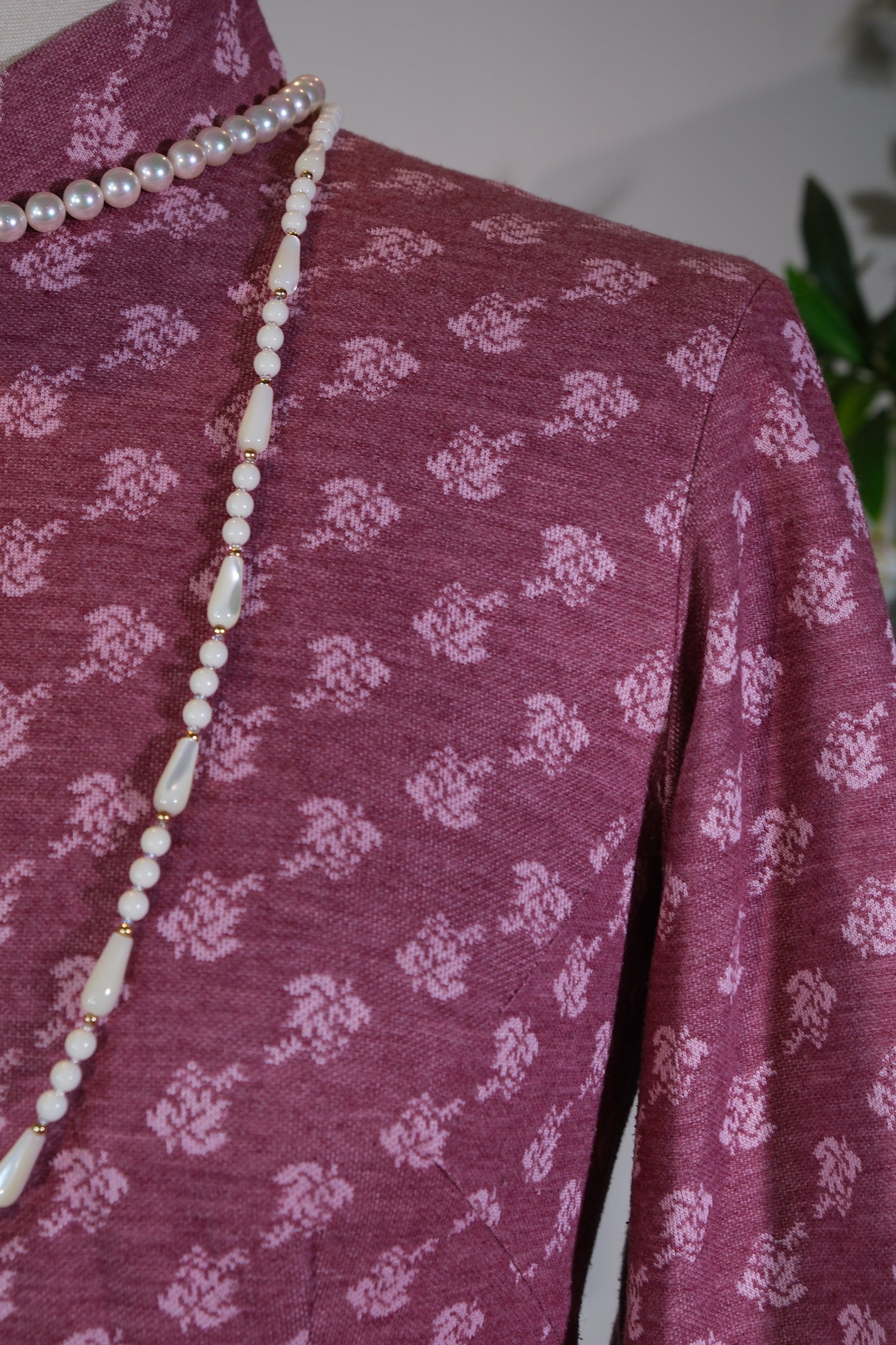
仔细观察衣身上的图案,这并非普通的印花,而是一种具有肌理感的提花或烂花工艺。
- 图案描述: 满布衣身的是一种抽象化的缠枝莲纹变体。花朵并非写实描绘,而是通过像素化或几何化的处理,呈现出一种朦胧的视觉效果。浅粉色的花簇在深紫色的底色上若隐若现,宛如雾里看花。
- 文化互文: 这种纹样设计深受当时西方波普艺术(Pop Art)与前卫时装的影响,试图打破传统旗袍大花大朵的俗套。它让人联想到《诗经·郑风》中的“有美一人,婉如清扬”,花纹的细碎与密集,恰似女子心中细腻绵长的心事。这种“乱花渐欲迷人眼”的视觉张力,正是六十年代摩登女郎追求个性解放的符号表达。
三、衣之故事:香江岁月的温柔抵抗
每一件古董衣都是历史的切片。这件旗袍产自六十年代的香港,那是一个东西方文化剧烈碰撞、传统与现代激烈博弈的年代。
我们可以想象,它或许曾属于一位在湾仔写字楼里工作的职业女性,或是中环某家洋行经理的太太。在那个年代,羊绒是昂贵的奢侈品,而将其制成贴身的旗袍,更是一种对生活品质的坚持。
“衣服是一种语言,随身带着的是袖珍戏剧。” ——张爱玲
这件旗袍不仅是一件御寒的衣物,它是那个时代女性在动荡社会中寻找自我身份的铠甲。针织羊绒的柔软,消解了传统旗袍的束缚感,让穿着者在举手投足间既有东方的端庄,又有西方的自由。它见证了维多利亚港的霓虹初上,也记录了那些在茶餐厅里摇曳生姿的午后时光。如今,当我们再次抚摸它,指尖传来的不仅是羊绒的温热,更是半个世纪前那段流金岁月的余温。
四、稀缺性与艺术价值:不可复制的孤品
从学术研究的角度来看,这件藏品的稀缺性体现在以下三点:
1. 材质的脆弱与存世量: 羊绒蛋白纤维极难保存,历经六十载光阴,若无极好的恒温恒湿环境,极易虫蛀或脆化。能如此完好地保留至今,且色泽未褪、版型未塌,实属凤毛麟角。
2. 工艺的断代: 这种老式的针织定型技术与手工归拔工艺,在现代工业化成衣生产中已基本失传。现在的机器无法复刻出那种随着人体呼吸而起伏的“第二层肌肤”感。
3. 审美标本: 它是研究六十年代香港服饰文化演变的活化石。它证明了旗袍不仅仅是博物馆里的陈列品,它曾经鲜活地存在于街头巷尾,是那个时代最具生命力的时尚宣言。
结语:
这不仅是一件衣服,这是一首穿在身上的散文诗。它等待着另一位懂它的女子,续写这段关于美、关于时间、关于东方韵味的未完故事。
Measurements / Size Guide:
Bust / Waist / Hips:96/80/98 cm
Total Length: 103 cm
Detailed Description:
This antique qipao, engineered in Hong Kong during the 1960s of the last century, stands as a golden material witness to the structural reconciliation between the Shanghai Style (Haipai) and the Hong Kong Aesthetic (Gangfeng). Deviating entirely from the cold, liquid luster of conventional silks, it uniquely implements a highly rare knit cashmere matrix. Within the analytical horizon of costume history, the 1960s represents the definitive transitional epoch where the qipao mutated from complex ornamentation toward pragmatic utility, shifting from formal regalia to the rhythms of daily lifestyle.
The Beauty of the Silhouette: The drafting pattern implements the classical Guiba ("shaping through ironing and stretching") methodology; even across the supple, elastic topology of a knit textile, it flawlessly sculpts a three-dimensional fit that aligns with the organic curves of the female anatomy. This "soft sculpture" texture simultaneously preserves the heritage high standing collar and asymmetrical closure (Xiajin) while seamlessly absorbing Western bodice darting—operating as the supreme materialization of mid-century East-West design synthesis.
The Cadence of the Palette: The overarching colorway presents a low-saturation smoked roseate purple (dusty rose/mauve). Within the textile color spectrum, this hue commands an exceptionally elevated prestige; it shuns the loud bravado of true reds while rejecting the heavy monotony of pure black. It exudes a disciplined, warm restraint precipitated through the passage of time—evoking an alternative elegance far beyond the famous "scallion-green paired with peach-pink" documented by Eileen Chang. This is the interiorized, sovereign poise belonging exclusively to mature womanhood.
Close inspection of the textile surface reveals that this layout rejects basic flat printing. Instead, it relies on a structural jacquard or devoré (Lanhua) methodology that injects an intense tactile texture into the chassis.
Pattern Layout: The entire surface is densely populated by an abstract mutation of the heritage interlocking lotus motif (Chanzhanlian). The blossoms relinquish realistic rendering, undergoing a pixelated or geometric distortion to project a dreamy, soft visual effect. Clusters of pale roseate blossoms emerge and recede across the deep purple grounding chassis, perfectly mimicking the experience of viewing flowers through a dense mist.
Cultural Intertextuality: This specific pattern layout was profoundly influenced by the contemporary global rise of Western Pop Art and avant-garde fashion movements, deliberately shattering the cliché of large, literal floral displays common to traditional qipaos. It beautifully mirrors the verse from the ancient Classic of Poetry · Odes of Zheng (Shijing): "There is a lady of peerless grace, with features delicate and clear." The dense, intricate clustering of the motifs replicates the microscopic, lingering complexities of a woman’s internal thoughts. This visual tension—where "scattered blossoms threaten to bewilder the eye"—serves as the definitive semiotic expression of 1960s modern women pursuing personal liberation.
Every antique garment serves as a live physical slice of history. Birthed within 1960s Hong Kong, this piece archives an era defined by a fierce collision and ultimate dialectic between Eastern heritage and Western modernity.
One can easily imagine this silhouette navigating the executive office spaces of Wan Chai or gracing the private residences of a foreign trade firm director in Central. During that specific timeline, high-tier cashmere operated as an elite luxury commodity; commissioning it to be molded into a form-fitting, custom qipao represents an unyielding devotion to the absolute quality of life.
"To those who cannot speak, clothes are a language; what one carries with them is a pocket drama." — Eileen Chang
This qipao functioned far beyond its utility as a thermal layer against winter drafts; it served as sartorial armor for women seeking their independent identities within a shifting society. The inherent softness of the knit cashmere completely dissolves the restrictive, binding nature of traditional qipaos, allowing the wearer to project Eastern poise and Western physical freedom simultaneously in every gesture. It bore witness to the neon illuminations rising over Victoria Harbour and archived those lingering afternoons spent within vintage diners. Today, when we handle this matrix, our fingertips harvest not merely the organic warmth of the cashmere fibers, but the residual heat of a golden epoch half a century past.
Appraised through the prism of academic material culture, the absolute scarcity of this curated specimen is anchored by three diagnostic criteria:
Fiber Volatility and Global Survival Yield: Cashmere comprises delicate protein fibers that are intensely difficult to preserve across multiple generations. Traversing six decades of timeline, without the strict intervention of a museum-grade climate-controlled environment, these textiles routinely succumb to organic infestation or chemical embrittlement. Encountering a specimen today that balances an absolute structural completeness with immaculate color saturation and zero sagging of the knit block is an extreme rarity—a true phoenix feather.
Lineage Discontinuity of Craftsmanship: This vintage methodology of knit shape-fixing coupled with manual, three-dimensional Guiba manipulation has effectively vanished from contemporary industrialized apparel lines. Modern automated machinery is fundamentally incapable of replicating that "second skin" sensation that expands and contracts in perfect synchronicity with the wearer's respiration.
The Ultimate Aesthetic Specimen: The garment functions as a live fossil for mapping the mid-century evolution of Hong Kong costume culture. It provides irrefutable physical proof that the qipao was never merely a static exhibit restricted to glass display cases; it was a breathing, vibrant entity commanding the metropolitan streets—the most vital fashion manifesto of its era.
This masterpiece transcends its definition as an article of clothing; it stands as a wearable piece of prose poetry. It waits for its next sovereign custodian to step into its matrix and continue this uncompleted narrative centered on beauty, temporal lineage, and the absolute refinement of Eastern aesthetics.