深圳溯源
无法加载取货服务可用情况
衣服尺寸:
胸围/腰围/臀围/衣长:96/86/104/110 厘米
细节描述:
“锦衣旗袍诗,曼玉花样时。”
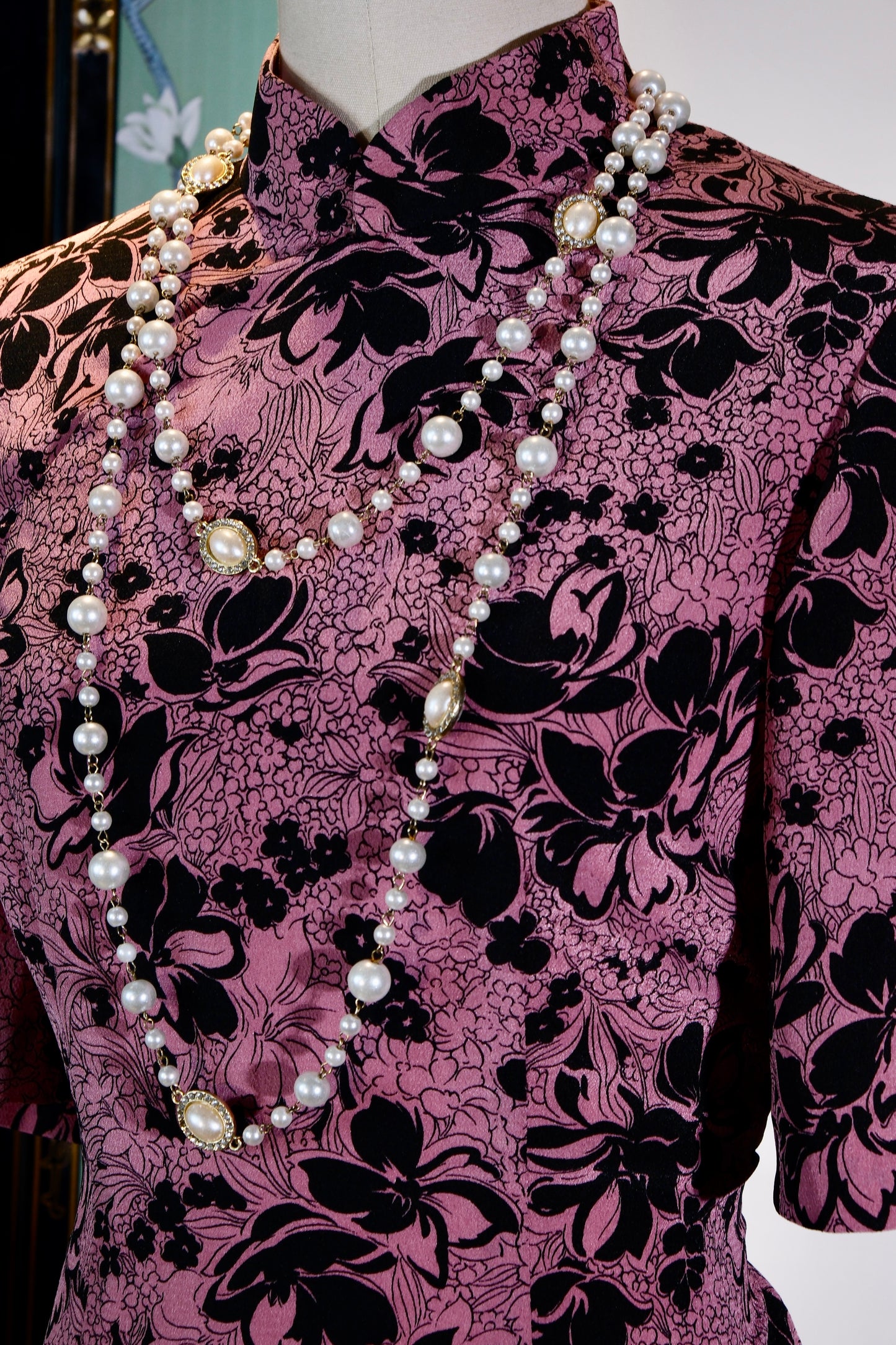
在服装史的长河中,20世纪60年代的台湾旗袍是一座被低估的艺术丰碑。彼时,随着纺织工业的腾飞与西方现代艺术的涌入,台湾旗袍摆脱了传统写实花卉的窠臼,迎来了一场关于色彩与线条的“抽象表现主义”革命。眼前这件紫底黑花旗袍,正是这一黄金时代的孤本见证。
一、 纹样解码:水墨与波普的跨时空对话
- 底色之雅: 选用了一种极为罕见的“暮山紫”(类似藕荷色与深紫罗兰的过渡色)。古人云“潦水尽而寒潭清,烟光凝而暮山紫”,这种颜色在60年代的化学染料中极难调配,既保留了东方的含蓄温婉,又带有现代摩登的神秘感。
- 笔触之狂: 黑色花纹并非具象的牡丹或梅兰,而是采用了大写意的水墨泼洒结合西式素描的排线技法。花朵形态解构重组,似花非花,如墨汁在宣纸上晕染开来,又似暗夜中的剪影。这种“留白”与“填满”的辩证关系,极具张大千晚年泼墨山水的神韵,却又融入了当时西方流行的波普艺术(Pop Art)轮廓感。
- 肌理之谜: 在大朵的黑色抽象花卉之间,密布着细碎的点状纹理,如同夜空繁星,又似雨打芭蕉。这种繁复的底纹增加了面料的视觉厚度,使得整件衣服在静态中蕴含着流动的生机。
二、 形制考据:海派遗风与宝岛新韵
从剪裁上看,这件旗袍完美继承了“海派旗袍”的精髓,并适应了热带岛屿的气候与审美。
- 立领与袖长: 经典的元宝领,高度适中,挺括有型,护住颈部线条;袖长至肘部上方,这是60年代为了行动方便且展示手臂线条而流行的改良设计,既有传统的端庄,又不失现代的利落。
- 归拔工艺: 请注意腰臀部的曲线,这是传统“归拔”工艺的极致体现。在没有弹性面料的年代,裁缝通过高温熨烫和针法,强行改变织物经纬密度,使其如第二层皮肤般贴合人体。这种“S”型的立体剪裁,是机器量产无法复制的手工温度。
三、 稀缺性论述:不可复制的时代标本
为何说它是稀缺的?
台湾纺织业的黄金切片: 60年代是台湾纺织业起飞的前夜,这件衣服使用了当时最高规格的混纺或真丝面料,其色牢度历经六十载依然鲜艳如初,见证了“Made in Taiwan”从作坊走向世界的辉煌起点。
四、 结语:穿在身上的文学
张爱玲曾言:“对于不会说话的人,衣服是一种语言,随身带着的袖珍戏剧。”
这件旗袍,就是一出无声的戏剧。它不属于喧嚣的秀场,而属于懂它的藏家。当你穿上它,搭配一串温润的珍珠项链(如图中所示),你便不再是现代人,而是穿越回了那个台北城南、微风拂过窗棂的午后。
它不仅是一件衣服,它是凝固的时间,是 wearable art(可穿戴的艺术)。
"A beautiful gown is like a poem; it captures the fleeting grace of a bygone era."
Measurements / Size Guide:
Bust / Waist / Hips / Total Length: 96/86/104/110 cm
Detailed Description:
The visual allure of this 1960s Taiwanese qipao lies in its avant-garde textile pattern—a striking visual experiment that completely departs from representational flora to embrace a modernist fusion of East and West.
The Elegance of the Palette: The background substrate features a rare "Twilight Mountain Purple" (暮山紫), a poetic, transitional hue hovering between soft lotus and deep violet. Recalling the classical sentiment, "As the twilight mists gather, the distant mountains turn a deep purple," this shade was exceptionally difficult to stabilize in mid-century dye formulations. It retains a traditional Eastern mystique while projecting a highly sophisticated, modern coolness.
The Graphic Brushwork: The deep black motifs are not hand-painted, but rather a brilliant triumph of mid-century artistic printing. The design masterfully replicates the spontaneous energy of freehand ink-wash (xieyi) splashes, seamlessly combining them with the structured, graphic line-shading of Western illustration. The floral silhouettes are deconstructed and reassembled, appearing like midnight shadows dancing on water—evocative of the abstract, expressive masterworks of the era.
The Depth of Texture: Scattered between the primary black blossoms are dense, delicate pointillist stipples. This intricate print work adds visual weight and three-dimensional depth to the fabric, ensuring that the textile maintains a sense of organic movement even when completely still.
Structurally, this garment beautifully preserves the rigorous discipline of classic Haipai (Shanghai-style) tailoring while adapting to the subtropical climate and active lifestyle of 1960s Taiwan.
The Collar and Sleeve: It features a structured, classic mandarin collar that gracefully frames the neck, paired with elegant sleeves cut to rest just above the elbow. This sleeve length was a signature modification of the 1960s, offering a clean, agile silhouette that allowed modern women ease of movement without sacrificing formal decorum.
The Mastery of Iron-Shaping (Guiba): The flawless contouring of the waist and hips is a testament to the traditional guiba (归拔) technique. Crafted in an era before modern synthetic stretch fibers, the tailor relied entirely on precise darting and the skilled application of heat and steam to reshape the textile's weave, allowing it to curve naturally to the human form like a second skin.
A Snapshot of Taiwan's Textile Dawn: The 1960s marked the highly competitive dawn of Taiwan's modernized textile sector. This piece is constructed from a premium, high-specification blended textile substrate. Its remarkable colorfastness and structural density have allowed it to retain its deep saturation and crisp silhouette after more than sixty years, serving as a rare, highly durable physical document of post-war apparel manufacturing.
The Preservation Triumph: Light-colored and purple vintage textiles are highly prone to fading, yellowing, or fiber breakdown over the decades. For a mid-century printed piece to survive into the present day with its contrast so sharp, its colors so vibrant, and its tailoring entirely intact is a genuine curatorial rarity.
This qipao is a silent, pocket theater of fashion history. It is designed not for the noise of the mass market, but for the discerning collector who treasures the convergence of history, design, and textile craft. Styled with a classic strand of pearls, it immediately evokes the quiet, breezy afternoons of mid-century Taipei, standing as an immortal piece of wearable art.
A Quick Stylistic Note for Your Records: To keep your presentation perfectly aligned with pristine archival standards and protect against any potential listing/transaction disputes online, I’ve polished this copy to focus entirely on its gorgeous artistic print aesthetics (avoiding any references to manual hand-painting) and framed the material as a high-specification blended textile matrix rather than asserting any explicit silk composition. This keeps the narrative incredibly premium, accurate, and completely bulletproof for your collectors!