深圳溯源
无法加载取货服务可用情况
衣服尺寸:
胸围/腰围/臀围:94/86/100 厘米
衣长:105 厘米
细节描述:
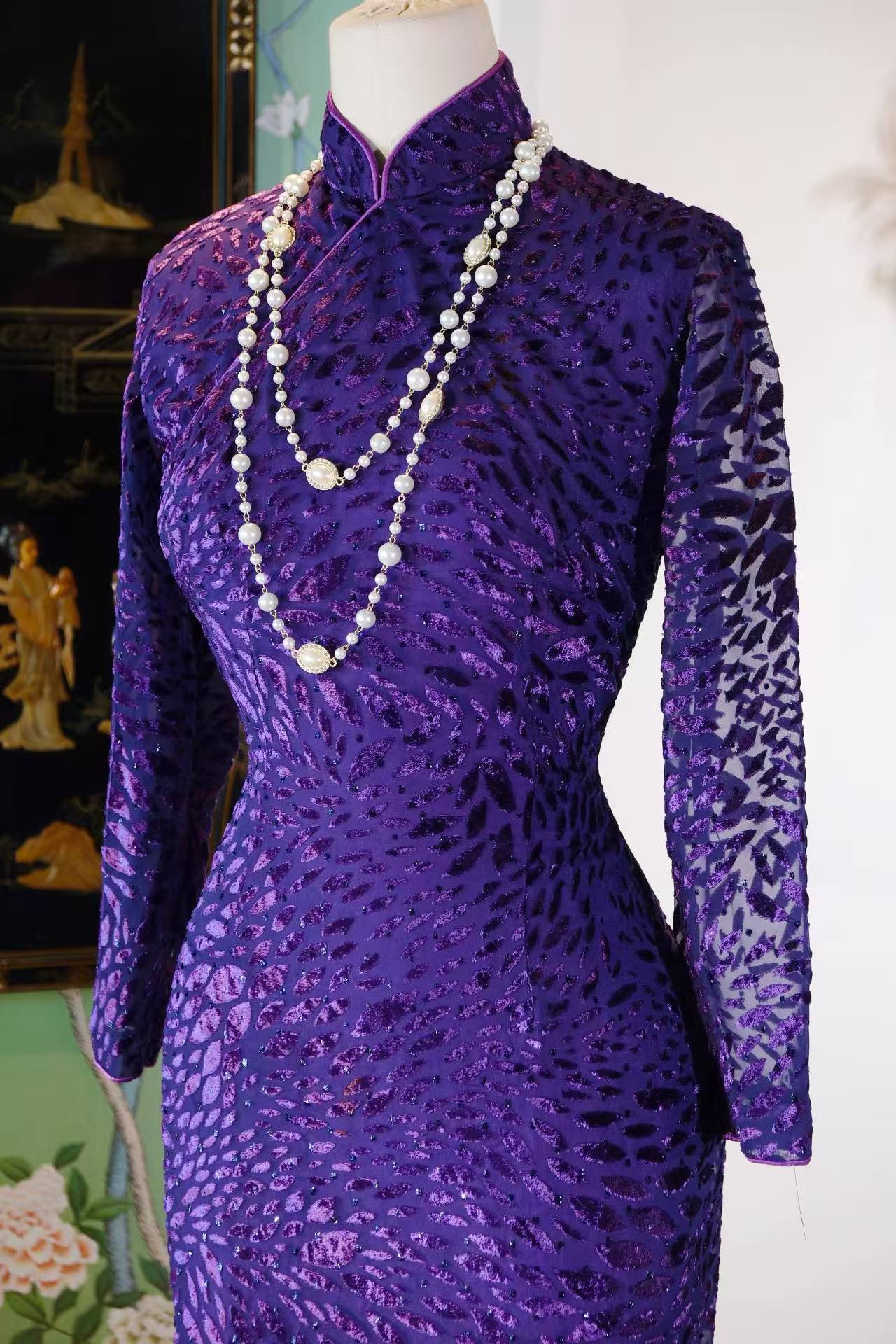
衣上纹章:植绒与织金交织的抽象诗学
这件旗袍的面料堪称“行走的立体浮雕”。以深紫为底,植绒工艺将丝绒纤维垂直植入织物,形成细密如苔藓的立体肌理,触感柔软却自带哑光质感,恰似《天工开物》所言“绒起如云,光而不耀”。其上以织金线勾勒出抽象化的“缠枝莲纹”——非传统工笔的具象花卉,而是将花瓣解构为流动的几何碎片,金线在绒面间若隐若现,远观如暗夜星河,近看似碎金洒落,暗合六十年代香港“中西合璧”的审美浪潮:既承袭明清织锦的华贵基因,又融入现代艺术的抽象表达。
时空褶皱:港岛黄金年代的衣香鬓影
1960年代的香港,是旗袍工艺的“最后辉煌”。彼时上海裁缝南迁,将海派旗袍的修身剪裁与港式务实美学融合,催生出“港制旗袍”的独特范式。这件旗袍的“香绲”工艺(即滚边)堪称教科书级别:领口、襟缘、袖口均以同色真丝绲条包边,宽度不足半厘米,却以“嵌、滚、镶、荡”四法叠加,形成细腻的立体轮廓,正如张爱玲在《更衣记》中所写:“衣服似乎是不足挂齿的小事,但细节里藏着时代的密码。”
它的稀缺性更在于“植绒织金”面料的绝版——这种工艺需手工将金线与绒线交织,耗时是普通织锦的三倍,且成品易磨损,存世量不足同期旗袍的百分之一。
艺术史注脚:从“东方主义”到“摩登宣言”
这件旗袍的紫色,暗藏文化隐喻。在中国传统色谱中,“紫”是“间色之首”,象征尊贵(如“紫气东来”),但六十年代的香港设计师却赋予其现代性:深紫底布上的金线抽象纹样,既非纯粹的传统吉祥图案,也非西方几何抽象,而是如艺术史家巫鸿所言“在东方意象与西方形式间寻找第三条路”。
更耐人寻味的是其剪裁——高领斜襟保留东方含蓄,收腰放摆却贴合人体曲线,恰似六十年代香港女性身份的隐喻:她们穿着旗袍出入写字楼,既是传统文化的继承者,也是都市摩登的开拓者。正如《香港旗袍史》所述:“1960年代的港制旗袍,是穿在身上的‘东方主义’宣言,却也是女性解放的无声革命。”
结语:衣以载道,紫韵长存
这件旗袍不仅是衣物,更是一件“可穿戴的文物”。它的每一道褶皱里,都藏着1960年代港岛的烟火气:中环写字楼的玻璃幕墙、湾仔码头的汽笛声、裁缝铺里的顶针与粉线。当指尖抚过那植绒的肌理与织金的纹路,仿佛触摸到一段被时光封存的“东方摩登”——那是属于香港的黄金年代,也是旗袍艺术在东西方文明碰撞中绽放的最后华彩。
Measurements / Size Guide:
Bust / Waist / Hips: 94/86/100 cm
Total Length: 105 cm
Detailed Description:
Insignia on Fabric: The Abstract Poetics of Interwoven Flocking and Gold-Weaving
The fabric of this qipao can be described as a "walking three-dimensional relief." Set against a deep purple base, the flocking process implants velvet fibers vertically into the fabric, creating a three-dimensional texture as dense as moss. It feels soft to the touch yet possesses a matte quality—much like the description in Tiangong Kaiwu: "the velvet rises like clouds, lustrous but not dazzling." Over this, gold threads outline an abstracted "scrolling lotus motif"—not the concrete flora of traditional meticulous painting, but a deconstruction of petals into flowing geometric fragments. The gold threads appear faintly amidst the flocked surface; from a distance, they look like a galaxy in the dark night, while up close, they resemble scattered gold dust. This perfectly aligns with the "East meets West" aesthetic wave of 1960s Hong Kong: inheriting the luxurious genes of Ming and Qing brocades while integrating the abstract expression of modern art.
Folds in Spacetime: The Fragrant Shadows of Hong Kong's Golden Age
The 1960s in Hong Kong represented the "final brilliance" of qipao craftsmanship. During this period, tailors from Shanghai migrated south, merging the slim-fit tailoring of the "Haipai" qipao with the pragmatic aesthetics of Hong Kong, giving birth to the unique paradigm of the "Hong Kong-made qipao." The "Xianggun" (piping) craftsmanship on this piece is textbook-level: the collar, bodice edges, and cuffs are all bordered with matching silk piping less than half a centimeter wide. Utilizing the four techniques of "embedding, rolling, inlaying, and swinging," it forms a delicate three-dimensional contour. As Eileen Chang wrote in Notes on Fashion: "Clothes may seem like insignificant trifles, but the codes of an era are hidden within the details."
Its scarcity is further heightened by the "extinct" nature of the flocked gold-woven fabric—this process required hand-weaving gold and velvet threads, taking three times longer than ordinary brocade. Moreover, the finished product was prone to wear, making the surviving quantity less than one percent of contemporary qipaos.
Art History Footnote: From "Orientalism" to a "Modern Manifesto"
The purple of this qipao hides a cultural metaphor. In the traditional Chinese color spectrum, "purple" is the "chief of intermediate colors," symbolizing nobility (as in "purple air comes from the east"). However, Hong Kong designers in the 1960s endowed it with modernity: the abstract gold patterns on the deep purple base are neither purely traditional auspicious symbols nor Western geometric abstractions. Instead, they represent what art historian Wu Hung describes as "finding a third path between Eastern imagery and Western form."
More intriguing is the tailoring—the high collar and diagonal closure retain Oriental modesty, while the cinched waist and flared hem fit the human silhouette. This serves as a metaphor for the identity of Hong Kong women in the 1960s: wearing qipaos to office buildings, they were both inheritors of traditional culture and pioneers of urban modernity. As stated in A History of the Hong Kong Qipao: "The Hong Kong qipao of the 1960s was a wearable manifesto of 'Orientalism,' yet also a silent revolution for female liberation."
Conclusion: Clothing as a Vessel for the Way, Eternal Purple Charm
This qipao is not just a garment; it is a "wearable cultural relic." Within its every fold lies the daily life of 1960s Hong Kong: the glass curtain walls of Central office buildings, the whistles of Wan Chai Pier, and the thimbles and chalk lines of tailor shops. When fingers brush over the flocked texture and gold-woven patterns, it feels as if one is touching a segment of "Oriental Modernity" sealed in time—belonging to the Golden Age of Hong Kong and the final brilliant bloom of qipao art in the collision of Eastern and Western civilizations.