深圳溯源
无法加载取货服务可用情况
衣服尺寸:
胸围/腰围/臀围:94/84/102 厘米
衣长:100 厘米
细节描述:
一、纹样考释:提花波点里的东方诗学
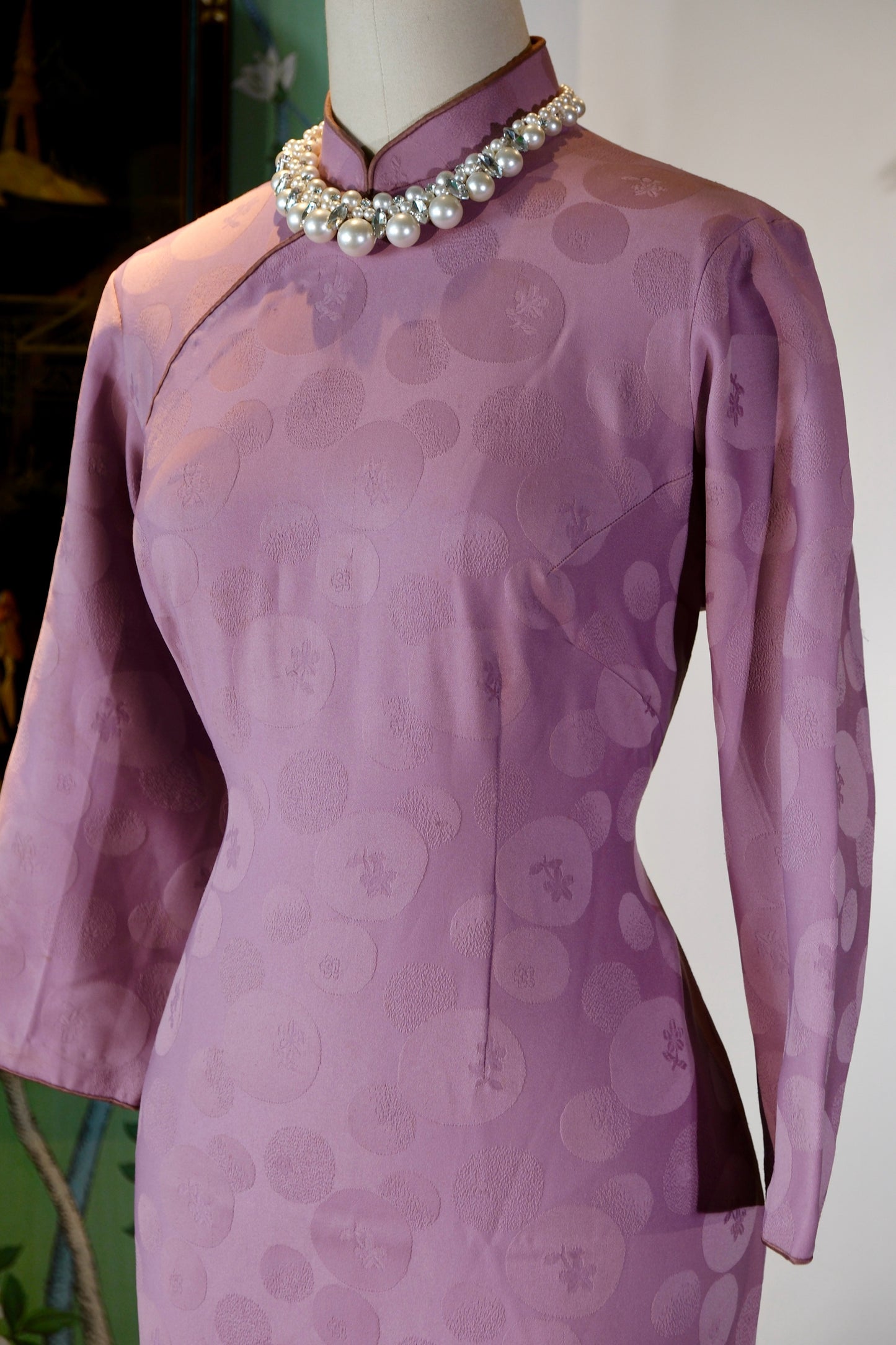
这件诞生于上世纪六十年代台湾的提花旗袍,以淡紫色为底色,通体织就“圆月缀梅”的暗纹——浅粉圆点如满月浮于烟波,每枚圆点中心皆嵌一枚梅花暗纹,花瓣以“点梅法”勾勒,疏影横斜间暗合《梅花喜神谱》“欲开”之态。提花工艺令纹样随光线流转,远观似雾中看花,近触则经纬分明,恰如《考工记》所言“天有时,地有气,材有美,工有巧”,将江南织造的温婉与台湾本土的创新熔于一炉。
二、衣以载道:海岛旗袍的黄金时代
六十年代的台湾,旗袍正经历“黄金转型期”。彼时上海裁缝南渡,将海派旗袍的立体剪裁与台湾本土面料结合,诞生“台产旗袍”这一独特品类。此件旗袍采用“改良七分袖”设计,袖口微收如兰叶,腰线内收三寸,下摆开衩至膝上三寸,既保留传统旗袍的端庄,又暗合六十年代女性追求解放的时代脉搏。据《台湾服饰史》记载,此类提花面料多由台北大稻埕织造厂生产,因工艺复杂,每匹布需织工耗时月余,现存世量不足百件。
三、稀缺之美:时光淬炼的孤品价值
在快时尚泛滥的今天,这件旗袍的稀缺性更显珍贵:
- 工艺绝唱:提花织机已于九十年代被电子提花机取代,这种“手工挑经显纬”的技艺,如今仅在苏州丝绸博物馆可见复刻;
- 文化载体:淡紫色在六十年代台湾象征“知识女性的觉醒”,宋美龄曾多次穿着同色系旗袍出席外交场合,赋予此色“优雅与力量并存”的文化隐喻。
四、穿在身上的艺术史
当指尖抚过提花波点,触到的不仅是经纬交织的肌理,更是一段流动的历史:它是《花样年华》里苏丽珍的衣橱遗珠,是张爱玲笔下“衣是随身携带的戏剧”的具象化,更是台湾服饰史上“传统与现代对话”的活化石。如今,这件旗袍静立于展柜,淡紫色的光泽里,仍跳动着六十年代的月光。
Measurements / Size Guide:
Bust / Waist / Hips: 94/84/102 cm
Total Length: 100 cm
Detailed Description:
This Jacquard Qipao, born in 1960s Taiwan, features a light purple base woven with a "Plum Blossoms within Full Moons" hidden pattern. Pale pink dots float like full moons upon misty waves, each centered with a subtle plum blossom motif. The petals are outlined using the "Plum Pointing" technique (Dianmei Fa), with sparse shadows reclining in a way that aligns with the "Budding" stage described in the Manual of Plum Blossom Portraits (Meihua Xishen Pu). The Jacquard craftsmanship allows the patterns to shift with the light; from afar, it looks like flowers seen through mist, but up close, the warp and weft are distinct. As stated in the Record of Trades (Kao Gong Ji): "Climate has its seasons, Earth has its vitality, materials have their beauty, and craftsmanship has its skill." It perfectly melts the gentleness of Jiangnan weaving with the innovation of Taiwan.
In 1960s Taiwan, the Qipao was undergoing a "Golden Transformation." At that time, Shanghainese tailors migrated south, combining the 3D tailoring of the Shanghai style with local Taiwanese fabrics to create the unique category of "Taiwan-made Qipaos." This piece features a "modified three-quarter sleeve" design, with cuffs narrowing like orchid leaves, a waistline cinched by three inches, and side slits ending three inches above the knee. It preserves the dignity of the traditional Qipao while pulsing with the era's spirit of female liberation. According to the History of Taiwanese Fashion, such Jacquard fabrics were mostly produced by weaving mills in Dadaocheng, Taipei. Due to the complexity of the craft, each bolt of cloth took a weaver over a month to complete; today, fewer than a hundred such pieces are known to exist.
In today’s era of rampant fast fashion, the scarcity of this Qipao is even more precious:
A Lost Craft: Traditional Jacquard looms were replaced by electronic ones in the 1990s. The skill of "manual warp-picking to reveal the weft" (Shougong Tiaojing Xianwei) is now only seen in replicas at the Suzhou Silk Museum.
Cultural Carrier: In 1960s Taiwan, light purple symbolized the "awakening of female intellectuals." Soong Mei-ling frequently wore similar shades during diplomatic events, endowing this color with a cultural metaphor of "elegance and power coexisting."
When fingertips brush over the Jacquard polka-dots, they touch more than just the texture of interwoven threads—they touch a flowing history. It is a missing treasure from Su Li-zhen's wardrobe in In the Mood for Love; it is the embodiment of Eileen Chang's words, "Clothing is a portable drama"; and it is a living fossil of the "dialogue between tradition and modernity" in Taiwan's fashion history. Today, as this Qipao stands silently in its display case, the moonlight of the 1960s still dances within its lavender luster.