深圳溯源
无法加载取货服务可用情况
衣服尺寸:
胸围/腰围/臀围:98/86/104 厘米
衣长:118 厘米
细节描述:
这件旗袍不仅是一件衣物,更是一枚被封存在时光琥珀中的文化切片。作为上世纪六十年代香港纺织业黄金时代的产物,它以独特的“烧花”工艺和极具张力的色彩美学,诠释了那个时代特有的摩登与风雅。以下从纹样、工艺、历史叙事及艺术价值四个维度为您解读:
一、纹样解析:暗香浮动的立体浮雕
这件旗袍的视觉核心在于其面料上呈现出的“虚实相生”之美。
- 主色调与底色:整体采用深邃浓郁的酒红色(Burgundy)或铁锈红丝绒为基底。这种颜色在服装史学中被称为“富贵色”,既保留了正红的喜庆与庄重,又因加入了暗调而显得沉稳内敛,极具成熟女性的韵味。
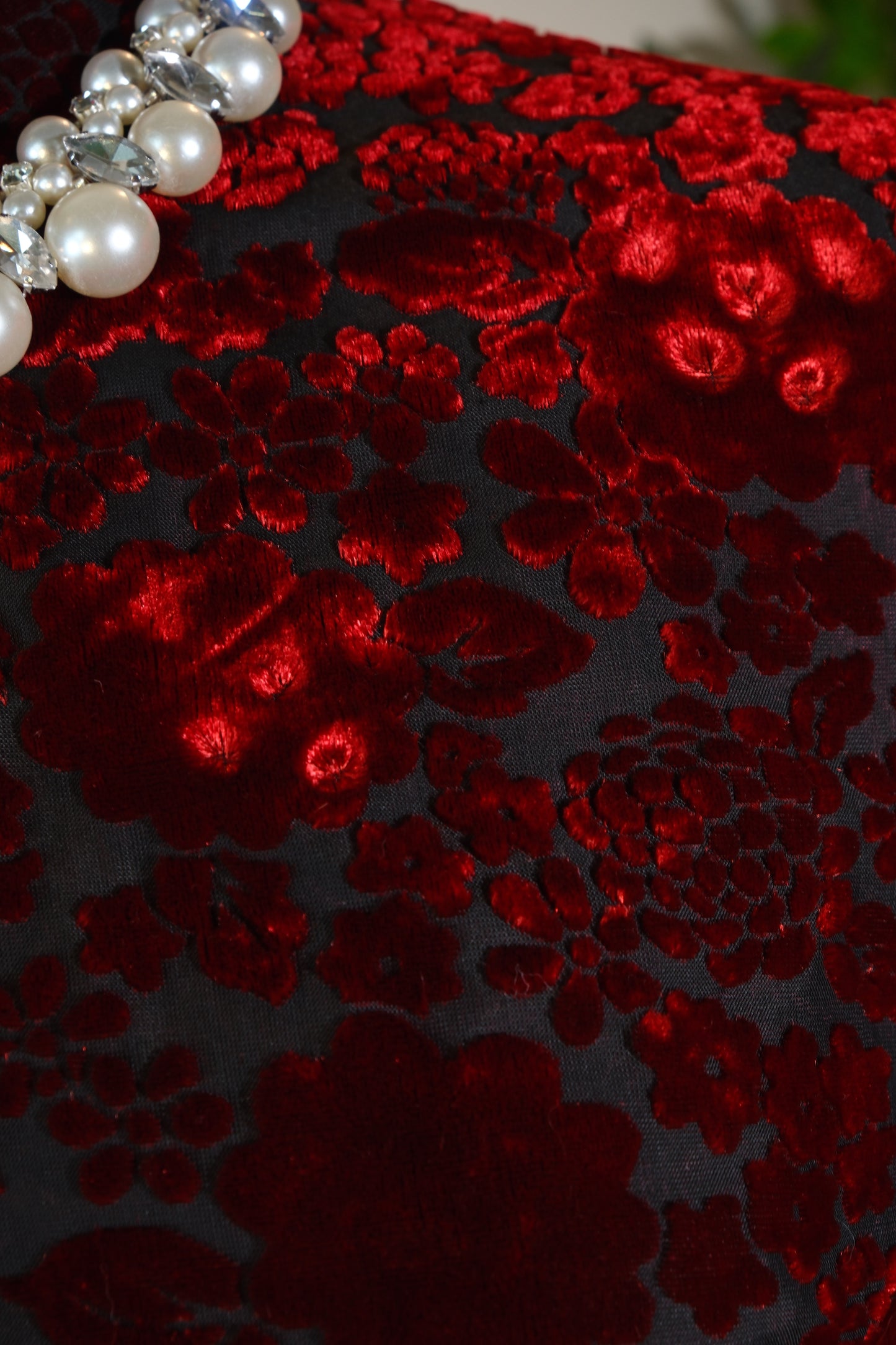
- 花卉形态:面料上的图案并非平面印染,而是通过腐蚀工艺留下的牡丹与菊花混合纹样。花朵形态饱满圆润,花瓣层层叠叠,呈现出一种盛放的姿态;枝叶则蜿蜒舒展,填补了花朵间的空隙。
- 光影质感:由于丝绒本身的倒顺毛特性,加上烧花工艺造成的凹凸肌理,使得这些花卉在光线下会产生微妙的明暗变化。静止时如暗夜红梅,行走间则似流金溢彩,仿佛花朵在织物上呼吸。
二、工艺溯源:化学与美学的博弈
所谓“烧花”,学名为烂花印花,是六十年代香港纺织工业的一项绝技。
- 技术原理:工匠利用酸性浆料印在由两种不同纤维(通常是棉/粘胶与涤纶/尼龙混纺,或真丝与人造丝交织)组成的面料上。经过高温处理,其中一种纤维被腐蚀炭化脱落,只留下另一种纤维构成花纹。
- 艺术效果:这种工艺创造了一种类似蕾丝却又比蕾丝厚重、类似刺绣却又比刺绣通透的独特质感。它打破了传统丝绸旗袍的平滑感,赋予了面料雕塑般的立体层次。
- 稀缺性:随着环保法规的日益严格和人工成本的飙升,这种高污染、高难度的手工辅助工序在现代工业化生产中已近乎绝迹。现存完好的六十年代烧花丝绒旗袍,每一件都是不可再生的孤品。
三、历史叙事:东方之珠的流金岁月
这件旗袍是“海派文化”与“殖民地审美”在香港交汇的结晶。
- 时代背景:上世纪六十年代的香港,正处于经济腾飞的前夜。此时的旗袍剪裁已从早期的宽袍大袖彻底转向西式立体剪裁,强调胸腰臀的曲线美(S型廓形)。
- 穿着场景:想象一下,在那个年代,一位身着此衣的女士,或许正穿梭于中环的写字楼,或是出席湾仔的一场晚宴。她颈间佩戴的珍珠项链(如图所示搭配),是当时名媛淑女的标配。这件衣服见证了那个时代女性走出家庭、进入职场,同时依然保持优雅传统的微妙平衡。
- 张爱玲的注脚:正如张爱玲所言:“对于不会说话的人,衣服是一种语言。”这件旗袍的语言是热烈而克制的,它诉说着那个时代女性在动荡与繁华并存的环境中,对美的一种执着坚守。
四、艺术风格与引经据典
若将此衣置于学术与艺术的显微镜下,其价值更甚。
- 中西合璧的典范:《礼记·深衣》云:“袂圆以应规,曲袷如矩以应方。”这件旗袍虽采用了西式的省道(Darts)来塑造身形,但其立领的高度以及开衩的尺度,依然严守中式法度。它是“中学为体,西学为用”在服饰领域的完美实践。
- 色彩的心理学:红色在中国文化中象征着生命力与吉祥,而这种深沉的丝绒红,更接近于清代宫廷织绣中的“酱色”或“绛色”,带有一种历史的厚重感。它不似正红般张扬,却如陈年普洱般回甘悠长。
- 收藏价值:在古董衣收藏界,品相完好、工艺复杂的丝绒类旗袍因其保存难度大(丝绒易倒毛、易虫蛀),往往比素色绸缎旗袍更为珍贵。这件作品历经半个多世纪,色泽依然醇厚,绒毛依然挺立,实属难得。
总结
这不仅是一件用来御寒或装饰的衣物,它是一段可以被触摸的历史。它记录了六十年代香港匠人的精湛技艺,承载了那个时代女性的风华绝代,更以其不可复制的工艺难度,成为了今日时尚界难以企及的艺术高峰。拥有它,便是拥有了一段关于美、关于时间、关于传承的永恒记忆。
Measurements / Size Guide:
Bust / Waist / Hips: 98/86/104 cm
Total Length: 118 cm
Detailed Description:
This archival specimen stands as a magnificent physical slice of culture, permanently frozen within the golden amber of time. As a supreme product of the 1960s post-war boom that defined the Hong Kong textile industry, it relies on a specialized devoré (“烧花”) technique and a highly expressive chromatic palette to interpret the distinct cosmopolitan grace and elegance of that unique generation. Below is the structural authentication and curatorial deconstruction of this piece analyzed across four technical dimensions:
The primary visual core of this qipao resides in its masterful execution of negative space and structural volume across the textile layout:
The Primary Palette and Foundation: The entire garment body utilizes a profound, deep burgundy (Burgundy) or rich rust-red velvet baseline. Within costume history, this saturated spectrum is classified as an imperial hue, preserving the celebratory warmth of traditional red fields while incorporating dark, settled undertones to project the dignified composure of a mature woman.
The Botanical Configuration: The patterns covering the chassis depart entirely from flat surface printing, utilizing a specialized chemical etching method to resolve a dense, interlocking matrix of peony and chrysanthemum blossoms. The roundels appear exceptionally full with multi-layered, cascading petals caught in full bloom, while organic winding vine filigree beautifully seals the structural fields between the primary blossoms.
The Interplay of Light and Shadow: Due to the natural directional pile of premium velvet coupled with the structural depth produced by the devoré process, these botanical elements react dynamically under shifting ambient light. Observing the garment at rest evokes the image of winter blossoms thriving in a quiet void; yet, during physical movement, it unleashes a fluid, golden-metallic shimmer, appearing as if the blossoms are breathing directly across the textile surface.
The technique historically designated as "burnt-out" (“烧花”) is scientifically classified as acid-etch or devoré printing—a specialized peak capability of the 1960s Hong Kong textile manufacturing sector.
The Scientific Mechanism: Master artisans applied a specialized acidic paste onto a textile chassis composed of two distinct yarn formulations—typically a high-twist blend of natural cellulosic fibers (such as cotton or rayon silk) interwoven with acid-resistant synthetic filaments (such as nylon or polyester). Upon passing through calibrated high-temperature baking cylinders, the vulnerable cellulosic fibers undergo localized carbonization and completely slough away, leaving only the structural synthetic filaments intact to sustain the translucent pattern matrix.
The Visual Artistry: This process engineered a highly distinct tactile finish—yielding an artifact that commands a structural weight far more substantial than fragile Western lace, yet presenting an atmospheric transparency infinitely more advanced than flat satin embroidery. It successfully broke the uniform smoothness of conventional silks, endowing the fabric with a sculptural, architectural low-relief texture.
Curatorial Scarcity: Following decades of manufacturing evolutions, escalating manual labor costs, and increasingly strict environmental protection regulations regarding chemical effluents, this high-pollution, artisan-assisted manual production method has completely exited modern commercial industrial lines. Surviving 1960s devoré velvet qipaos preserved in pristine condition operate as completely non-renewable, individual masterpieces.
This garment functions as a beautiful crystallization where traditional Shanghainese costume culture and cosmopolitan maritime influences met within the distinct urban matrix of mid-century Hong Kong.
Socio-Industrial Horizon: Hong Kong during the 1960s was positioned at the absolute peak of the qipao's structural evolution. Pattern drafting had fully completed its permanent migration away from the loose, straight rules of the ancestral long robe, embracing instead Western three-dimensional structural engineering to amplify the natural curves of the female form, yielding a sharp, disciplined S-curve silhouette.
Urban Propinquity and Context: Picture a scene from that golden generation: an elegant woman clad in this devoré velvet qipao navigates the modern corporate offices of Central district or steps into a high-society evening gala within Wan Chai. Her choice of accessorizing with a classic, double-strand necklace of warm, muted pearls (pictured) operated as the absolute stylistic standard for prominent madams of that era. This garment bears physical witness to the exact historical milestone when women actively stepped outside domestic spaces to claim a presence in professional public spheres, while fiercely safeguarding the dignified refinement of their ancestral heritage.
The Literary Footnote: As Eileen Chang famously noted in her costume essays: "To those who cannot speak, clothes are a language." The sartorial dialect of this qipao is simultaneously passionate and fiercely disciplined, narrating how a generation of women maintained an unyielding commitment to personal style amidst a rapidly shifting, highly dynamic urban landscape.
Examined beneath the microscope of dress history and academic design theory, the absolute value of this specimen becomes undeniable:
The Synthesis of East and West: The classical text The Book of Rites • Deep Robe states: "The sleeves are rounded to match the compass; the lapel is squared to match the rule." While this qipao actively adopts Western structural darts (Darts) to seamlessly block and contour the fabric directly over the human anatomy, the absolute height of its stiffened standing collar and the disciplined calibration of its side slits strictly honor traditional Chinese structural laws. It stands as a perfect materialization of the historical philosophy: "Eastern core values as the foundational text; Western science utilized for functional execution" (中学为体,西学为用).
The Psychology of Color Choice: Within Chinese material culture, red commands the supreme symbolic code of vital energy and auspicious fortune. This specialized, deep velvet crimson approaches the historical "sauce-red" (绛色) or "deep madder" reserved for elite robes within historical courts, bringing an instant sense of historical weight. It lacks the loud, superficial flash of modern flat synthetic reds, settling instead into an honest depth that mimics the slow, rich aftertaste of aged Pu-erh tea.
Archival Preservation Metrics: Within the open antiquarian textile market, antique velvet garments are notoriously difficult to conserve over a long chronological horizon. Velvet pile is highly vulnerable to mechanical crushing, fiber flattening, atmospheric oxidation, and localized insect breakdown. Finding a specimen that has crossed over half a century with its raw coloration remaining intensely deep, its structure entirely unblemished, and its structural pile remaining perfectly upright and vital is a definitive miracle of pristine curation.
This transcends its primary definition as a beautiful functional layer designed to insulate the physical frame; it is a tangible piece of living history you can hold in your hands. It permanently archives the peak technical prowess of 1960s Hong Kong weavers, carries the peerless glamour of an unforgettable generation of women, and establishes an artistic benchmark that modern contemporary fast fashion remains entirely incapable of reaching. Holding this archival piece means owning a timeless capsule of craftsmanship, lineage, and eternal Eastern composure.
Suyuan Archival Textile Registry — Documenting the material culture, preserving the technical lineage of ancestral craft.