深圳溯源
无法加载取货服务可用情况
衣服尺寸:
胸围/腰围/臀围:98/80/100 厘米
衣长:109 厘米
细节描述:
当目光触及这件六十年代香港织银旗袍的刹那,时光仿佛被骤然压缩。它并非仅仅是一件衣物,而是一段凝固的传奇,一阕用银线与经纬编织的视觉史诗。作为服装史研究者,我深知,能遇见这样一件保存完好、气韵生动的古董旗袍,实为一种奢侈的幸运。它身上承载的,不仅是彼时的工艺巅峰,更是一个时代的风华绝代。
一、图案之诗:繁复中的秩序与流动的月光
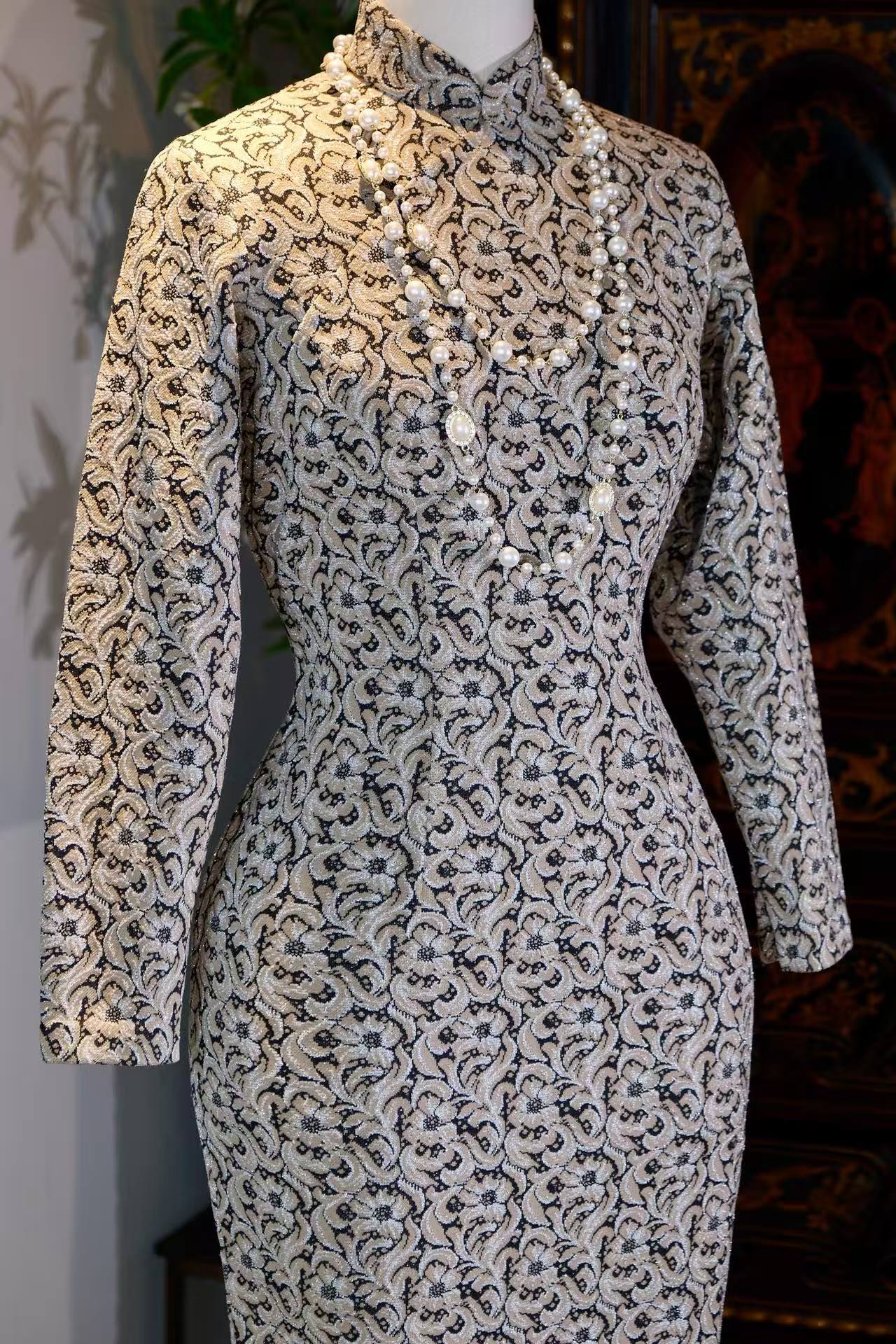
这件旗袍最令人叹为观止的,莫过于其通体覆盖的织银图案。它并非简单的平面印花,而是采用极为复杂的提花织造工艺,将银线巧妙融入底料之中,使得图案呈现出一种浮雕般的立体感与流动的光泽。
- 母题解析:图案的核心母题,是高度风格化的缠枝花卉与卷草纹的结合。花朵形态饱满,花瓣层叠,中心以细密的银点簇拥,宛如星辰;枝叶则蜿蜒舒展,呈S形或涡旋状,充满了巴洛克式的动感与张力。这种纹样,既有中国传统吉祥纹饰中“缠枝莲”“卷草纹”的基因,又隐约可见西方洛可可艺术对曲线与繁复之美的追求,是东西方美学在六十年代香港这个国际商埠碰撞交融的绝佳例证。
- 构图韵律:图案的排布并非杂乱无章,而是遵循着一种“满而不乱,密中见疏”的古典构图法则。纹样单元以二方连续或四方连续的方式,循环往复,形成一种连绵不绝、生生不息的视觉韵律。银线在光线下折射出的冷冽光芒,与底料的沉静形成强烈对比,宛如月光洒在静谧的湖面,波光粼粼,既华丽又内敛。
- 工艺难度:织银工艺本身便极为考究。银线需经过特殊处理以防氧化变黑,织造时对张力、密度的控制要求极高,稍有不慎便会导致银线断裂或图案变形。能如此大面积、高精度地完成如此复杂的提花织银,足见当年香港纺织工业的精湛技艺与对品质的极致追求。
二、故事之河:维多利亚港畔的黄金年代
这件旗袍的诞生地——六十年代的香港,正值其经济起飞与文化繁荣的“黄金年代”。彼时,上海滩的裁缝师傅携精湛技艺南下,与本地蓬勃发展的纺织业相结合,催生了独具特色的“港式旗袍”。
- 时代背景:六十年代的香港,是东西方文化交汇的熔炉。电影工业蓬勃发展,葛兰、林黛等女星身着华美旗袍的形象深入人心,成为时尚标杆。同时,香港作为转口贸易港,物资相对丰富,进口的化纤面料与传统的真丝、织锦并存,催生了更多元的设计。这件旗袍,正是那个时代审美趣味与物质条件的产物。
- 穿着场景:可以想见,它的主人或许是一位家境殷实的名媛,或是一位在社交场合游刃有余的商界女性。它可能出现在中环的高级晚宴上,银线在水晶吊灯下熠熠生辉;也可能出现在跑马地的赛马日,与珍珠项链(如图中搭配)相得益彰,尽显优雅风范。它不仅仅是一件衣服,更是主人身份、品味与时代精神的象征。
- 稀缺性:历经半个多世纪的风雨,能保存如此完好的织银旗袍凤毛麟角。银线的氧化、面料的脆化、款式的变迁,都使得这类古董衣的存世量极为稀少。它是一件“活”的文物,其稀缺性不仅在于工艺与年代,更在于它完整保留了那个特定时代的美学密码与生活方式。
三、艺术之魂:引经据典的风格诠释
从艺术风格而言,这件旗袍堪称“装饰艺术”与“东方主义”的完美结合。
- 装饰艺术的影子:其图案的几何化倾向、对曲线的强调、以及材质本身的光泽感,都与盛行于二十世纪初的装饰艺术风格有着异曲同工之妙。正如艺术史家恩斯特·贡布里希所言:“装饰艺术的核心,在于将自然形态转化为具有节奏感的几何图案。”这件旗袍的缠枝花卉,正是这种转化的绝佳体现。
- 东方主义的想象:在西方视野中,旗袍一直是东方神秘与优雅的象征。这件旗袍的繁复纹样与华丽材质,无疑强化了这种“东方主义”的想象。然而,它又并非简单的异域风情展示,而是根植于中国传统文化土壤,并经过现代设计语言重构的产物。它体现了六十年代香港设计师在全球化语境下,对自身文化身份的探索与表达。
- 文学意象的呼应:这件旗袍的气质,让人不禁联想到张爱玲笔下那些穿着讲究、命运多舛的女性。她在《更衣记》中写道:“衣服是一种记忆,也是一种语言。”这件旗袍,正是用银线与经纬写就的语言,诉说着一个关于美、关于时代、关于记忆的故事。它也让人想起白先勇《游园惊梦》中的钱夫人,那身“金线绣的旗袍”,在岁月的流转中,承载着无尽的繁华与苍凉。
四、结语:穿越时空的对话
这件六十年代香港织银古董旗袍,是一件值得被珍藏、被研究、被传颂的艺术品。它以其精湛的工艺、独特的图案、深厚的历史底蕴与稀缺的存世量,向我们展示了一个逝去时代的风华。它不仅仅是一件衣服,更是一段凝固的历史,一首无声的诗,一场穿越时空的对话。
当指尖轻抚过那冰凉而富有质感的银线,仿佛能触摸到半个多世纪前,那位穿着它在维多利亚港畔顾盼生辉的女性的体温与心跳。它提醒我们,时尚不仅是潮流,更是文化、是历史、是艺术,是人类对美的永恒追求。
Measurements / Size Guide:
Bust / Waist / Hips: 98/80/100 cm
Total Length: 109 cm
Detailed Description:
The moment your eyes rest upon this 1960s Hong Kong silver-woven Qipao, time suddenly compresses. It is far more than a mere garment; it is a frozen legend, a visual epic woven through silver threads, warp, and weft. As a researcher of fashion history, I know that encountering an antique Qipao so flawlessly preserved and vibrantly alive is a luxury of rare fortune. It carries within its folds not only the absolute pinnacle of mid-century craftsmanship but also the breathtaking elegance of an entire era.
[I. The Poetics of Pattern: Order Within Opulence and Flowing Moonlight] The most breathtaking feature of this Qipao is undoubtedly the silver-woven pattern that covers its entirety. Rather than a simple flat print, it utilizes an incredibly complex jacquard weaving technique, seamlessly integrating metallic silver threads into the base fabric. This imparts a sculptural, three-dimensional relief effect and a fluid, kinetic luster to the motifs.
Motif Analysis: The core motif centers on a highly stylized fusion of scrolling tendrils (Juancao) and intertwining blossoms. The flowers are full-bodied with layered petals, clustered at their hearts with dense silver stippling that resembles constellations. The stems and foliage winds and unfurls in "S" curves and volutes, charged with Baroque-like dynamism and tension. This pattern inherits the genetic code of traditional Chinese auspicious motifs like "intertwining lotuses," while subtly reflecting the Rococo pursuit of sinuous lines and intricate beauty. It stands as a prime illustration of the cross-pollination between Eastern and Western aesthetics in the global trading hub of 1960s Hong Kong.
Compositional Rhythm: The layout is never chaotic; instead, it follows the classical compositional principle of "full yet orderly, dense yet breathing." The motif units repeat in continuous two-way or four-way patterns, creating an endless rhythm of vitality. The crisp, cool light reflected by the silver threads stands in powerful contrast to the calm depth of the base fabric—resembling silver moonlight scattered across a serene, undulating lake surface, both magnificent and restrained.
Technical Difficulty: The silver-weaving technique itself is exceptionally rigorous. The metallic threads require specialized treatment to prevent oxidation and blackening, and the loom tension and weave density must be masterfully controlled—a single misstep would snap the silver threads or distort the pattern. Achieving such massive coverage and high precision in jacquard silver-weaving stands as definitive proof of the superb technical prowess and uncompromising standards of Hong Kong's mid-century textile industry.
[II. The River of Narrative: The Golden Age of Victoria Harbour] The birthplace of this Qipao—1960s Hong Kong—was an economic and cultural "Golden Era." Master tailors from Shanghai migrated south with their unparalleled sartorial secrets, merging with Hong Kong's booming textile sector to give birth to the distinctive "Hong Kong-style Qipao."
Historical Context: In the 1960s, Hong Kong was a melting pot of East and West. The cinema industry flourished, and screen icons like Grace Chang and Linda Lin Dai popularized the glamorous Qipao silhouette, cementing it as the ultimate fashion benchmark. Simultaneously, as a major free port, Hong Kong enjoyed rich material access, where imported synthetic fibers coexisted with traditional silks and brocades, prompting highly diversified designs. This Qipao is the pure product of that specific aesthetic climate and material prosperity.
Sartorial Scene: One can easily envision its original owner—perhaps an affluent socialite or a prominent businesswoman navigating high society. This piece would have graced high-end galas in Central, its silver threads shimmering brilliantly beneath crystal chandeliers, or stood out at the Happy Valley racecourse, paired elegantly with a pearl necklace (as styled here) to project effortless aristocratic poise. It is not merely clothing, but a totem of the wearer's status, taste, and the contemporary zeitgeist.
Rarity: Traversing half a century, silver-woven Qipaos that remain in such pristine condition are few and far between. The oxidation of metallic threads, the embrittlement of mid-century fabrics, and changing fashion tides have made surviving specimens exceptionally scarce. It is a living artifact that perfectly preserves the aesthetic codes and lifestyle of a specific historical moment.
[III. The Soul of Art: A Canonical Interpretation of Style] Artistically, this Qipao achieves a flawless synthesis of "Art Deco" and "Orientalism."
Shadows of Art Deco: The geometric inclination of the pattern, the emphasis on fluid curves, and the inherent metallic luster of the material share a profound artistic kinship with the Art Deco movement that dominated the early 20th century. As the great art historian Ernst Gombrich noted: "The core of decorative art lies in the transformation of natural forms into rhythmic geometric patterns." The intertwining blossoms of this Qipao are the absolute realization of this transformation.
The Orientalist Imagination: In the Western gaze, the Qipao has always symbolized Eastern mystique and grace. The opulent patterns and luxurious textures of this piece undoubtedly heighten this "Orientalist" allure. Yet, it is far from a mere display of exoticism; it is deeply rooted in the soil of traditional Chinese culture, re-engineered through a modern design lexicon. It reflects how 1960s Hong Kong designers explored and articulated their cultural identity within a globalized framework.
Literary Echoes: The aura of this Qipao inevitably evokes the sophisticated yet complex female protagonists of Eileen Chang’s literature. In her essay Chronicle of Changing Clothes, she penned: "Clothing is a memory, and a language." This Qipao is a narrative written in silver threads, warp, and weft, speaking of beauty, eras, and remembrance. It likewise echoes the character Madame Chien in Kenneth Pai's Wandering in the Garden, Waking from a Dream—whose "gold-embroidered Qipao" carries the boundless splendor and ultimate desolation of passing years.
[IV. Epilogue: A Cross-Temporal Dialogue] This 1960s Hong Kong silver-woven antique Qipao is a masterpiece worthy of meticulous curation, academic study, and preservation. Through its virtuoso craftsmanship, unique patterning, profound historical weight, and rare survival rate, it unveils the unmatched glamour of a bygone era. It remains a monument of frozen history, a silent poem, and an extraordinary cross-temporal dialogue.
When your fingertips brush against those cool, structural silver threads, you can almost feel the warmth and heartbeat of the woman who wore it half a century ago, turning heads along Victoria Harbour. It stands as a poignant reminder that fashion is never merely a passing trend—it is culture, history, art, and humanity’s eternal pursuit of beauty.