深圳溯源
无法加载取货服务可用情况
衣服尺寸:
胸围/腰围/臀围:100/80/114 厘米
衣长:125 厘米
细节描述:
【器物溯源:时代经纬中的工艺标本】
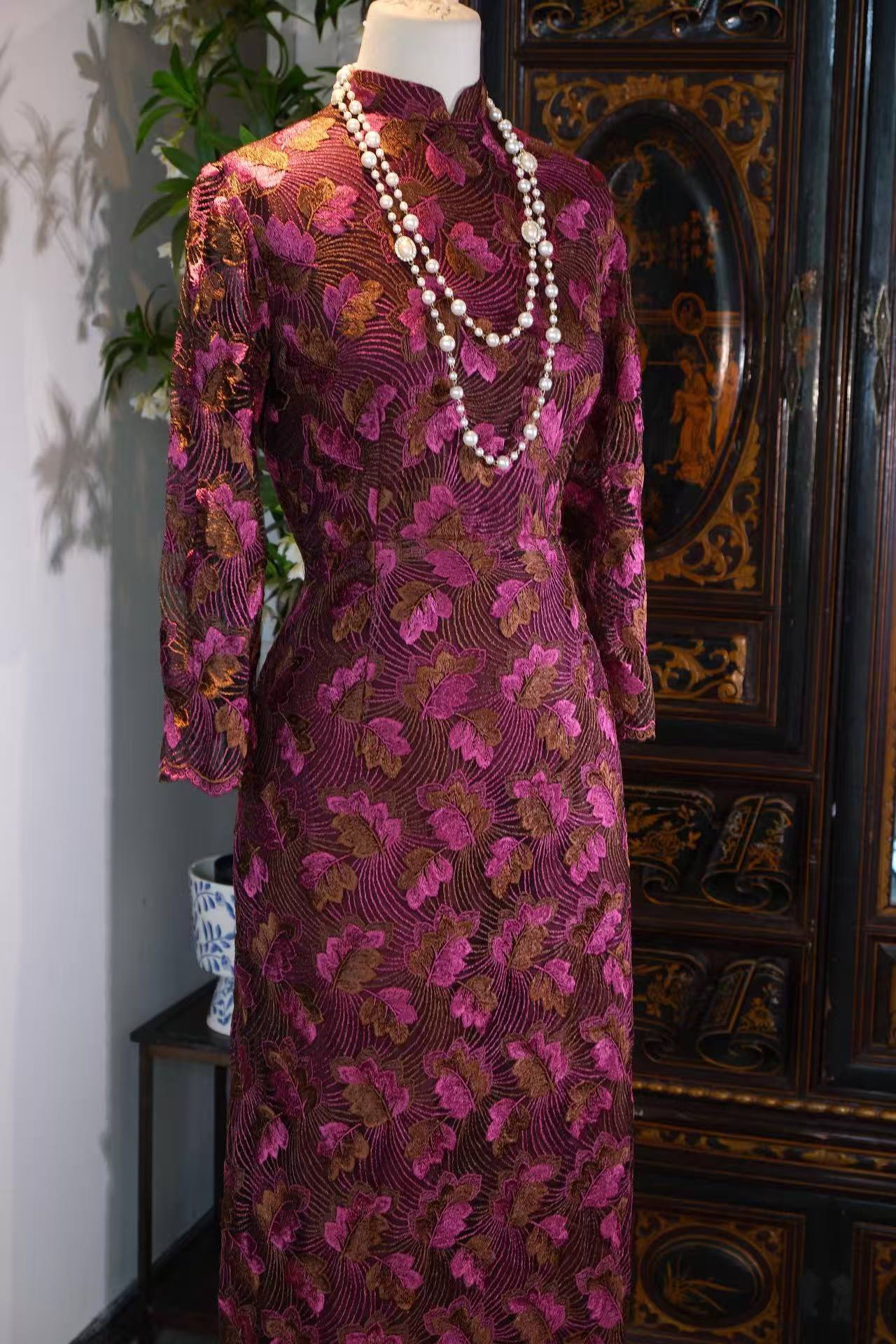
此件旗袍诞生于20世纪60年代的台湾,彼时正值东亚纺织工业的“黄金交叉期”——日本精密机绣技术随战后贸易潮涌入宝岛,与台湾本土蓬勃发展的成衣产业碰撞出独特的火花。不同于清代手工盘金绣的繁复厚重,亦异于现代数码印花的单薄直白,这种“日式机绣+台式剪裁”的组合,是冷战时期东亚时尚版图上极为罕见的“混血儿”。它见证了那个年代女性对摩登与传统的微妙平衡,是研究战后华人服饰审美变迁的活化石。
【纹样考据:紫藤垂露与流云水袖】
观其面料,乃是一件极具视觉张力的艺术品。
- 底色之喻: 通体采用深邃的茄紫色(Aubergine)为底,古称“郁金裙”之色变体。紫色在中国传统色谱中象征尊贵与神秘,而在60年代的西方语境下,又代表着迷幻与前卫。这种深沉的底色,如夜幕般衬托出刺绣的光泽。
- 纹样之构: 衣身遍布的并非具象牡丹,而是抽象化的缠枝藤蔓与阔叶花卉。叶片以古铜色丝线勾勒轮廓,花头则用艳丽的洋红与紫罗兰色填充,呈现出一种类似“浮世绘”风格的平面装饰感。
- 肌理之美: 细看之下,背景中隐约可见的波浪状线条,乃是典型的“流水纹”变体,寓意福泽绵长。这种将植物生长态势与水流动态结合的构图,暗合了《诗经》中“参差荇菜,左右流之”的自然韵律,却又通过机械刺绣的规整针法,赋予了其几何般的秩序美。袖口处的透视网纱拼接,更是神来之笔,打破了深色面料的沉闷,营造出“犹抱琵琶半遮面”的朦胧意境。
【形制解析:西风东渐下的身体解放】
从服装史角度审视,这件旗袍的剪裁具有鲜明的断代特征。
- 立领与开衩: 保留了传统的高立领,但高度较民国初期已大幅降低,更加贴合颈部曲线,体现了60年代女性追求舒适与自由的趋势。
- 西式省道: 仔细观察腰身,可见明显的西式公主线(Princess Line)剪裁痕迹。这不再是传统平面裁剪的“一片式”,而是引入了西方的立体造型观念,强调女性的胸腰臀曲线。这种“S”型廓形,正是张爱玲笔下“各人住在各人的衣服里”那种既束缚又张扬的时代注脚。
【文化互文:衣香鬓影里的旧梦】
沈从文先生在《中国古代服饰研究》中曾言:“服饰不仅是物质的产物,更是精神的载体。”这件旗袍,便是那个时代精神的载体。
想象一下,在60年代台北的某场晚宴上,或是南洋某位华侨夫人的衣橱深处,它曾被一位风姿绰约的女士穿着。她或许刚听完周璇的老歌,或许正谈论着刚刚上映的邵氏电影。那串搭配的珍珠项链(虽为配饰,却与旗袍气质浑然天成),在灯光下与衣身上的丝光交相辉映。
它不仅是一件衣服,更是一首凝固的诗。它记录了那个年代,东方女性试图在传统礼教与现代文明之间寻找自我表达的尝试。那紫红色的花叶,像是开在岁月深处的幽兰,虽经六十载光阴洗礼,依然散发着馥郁的香气。
结语:
“锦衣雪华玉颜色,回眸一笑百媚生。”这件紫韵流光的古董旗袍,不仅属于过去,更属于现在。它等待着另一位懂它的主人,续写那段关于美、关于时光、关于东方女性魅力的传奇。
Measurements / Size Guide:
Bust / Waist / Hips: 100/80/114 cm
Total Length: 125 cm
Detailed Description:
This vintage qipao was born in 1960s Taiwan, an era marking the golden intersection of East Asian textile industrialization. During this post-war period, precision Japanese machine-embroidery technology surged into Taiwan via maritime commercial trade, colliding with the island's booming domestic garment industry to spark a distinct creative energy.
Distinct from the heavy, complex opulence of Qing Dynasty hand-coiled gold embroidery (panjinxiu), and far removed from the flat, simplistic presentation of modern digital printing, this specific marriage of Japanese machine embroidery and Taiwanese three-dimensional tailoring represents an exceptionally rare "hybrid style" within the Cold War fashion landscape. It stands as physical evidence of a mid-century generation of women navigating a delicate equilibrium between cosmopolitan modernity and inherited heritage—a genuine living fossil for archiving post-war Chinese sartorial evolution.
A close study of this textile reveals a canvas of high visual tension, transforming the garment into a breathtaking piece of wearable art:
The Metaphor of the Canvas: The body of the gown is saturated in a deep, mysterious aubergine purple, a classic mid-century chromatic adaptation of the historical yujin (turmeric-dyed) robes. Within the lexicon of traditional Chinese color theory, purple represents ultimate nobility, imperial registry, and cosmic mystery; conversely, in the 1960s Western pop-culture landscape, it flirted with avant-garde psychedelia. This profound, moody ground acts as a perfect midnight sky, throwing the reflective luster of the embroidery into sharp relief.
The Architecture of the Motif: Rather than relying on standard, literal interpretations of the peony, the torso is enveloped in highly stylized, abstract winding tendrils and broad-leafed flora. The foliage is crisply outlined in an antiqued bronze silk thread, while the blossom heads are packed with concentrated infusions of vivid magenta and deep violet, projecting a flat, graphic decorative sensibility strongly reminiscent of late Ukiyo-e woodblock prints.
The Texture of Light: Beneath the main botanical structure, the background features a faint, rhythmic wave pattern—a direct variant of the classical flowing water motif (liushuiven), which symbolizes continuous, cascading fortune. This specific synthesis of botanical vitality and aquatic momentum beautifully honors the natural cadence found in The Book of Songs (Shijing): "The fluid water-greens grow long and short; we gather them left and right." Yet, here it is executed via the immaculate, unyielding tension of mechanical needles, gifting the traditional design a geometric, modern sense of order. Furthermore, the sheer mesh net splice tracing the edge of the sleeve armscye is a stroke of master design; it shatters the weight of the dark textile, introducing an alluring, translucent quality (youbao pipa ban zhe mian).
Examined through the strict lens of costume history, the pattern drafting of this qipao bears definitive, textbook characteristics of mid-century technical adaptation:
The Mandarin Collar and Closures: While the garment safeguards the iconic high mandarin collar, its absolute vertical height is significantly abbreviated compared to the restrictive, jaw-framing necklines of the early Republican era. It contours naturally against the base of the neck, mirroring the 1960s global demand for enhanced physical comfort and functional freedom of movement.
The Integration of Western Darting: A structural look at the waist configuration exposes the definitive deployment of a Western Princess Line drafting methodology. This completely moves away from the traditional, rectilinear, flat "one-piece" architecture of ancient Chinese robes. Instead, it fully embraces Western three-dimensional anatomy, prioritizing the high, sculpted geometry of the bust, waist, and hip. This hyper-cinched S-curve silhouette serves as the perfect historical footnote to Eileen Chang’s famous observation that "everyone lives inside their own clothes"—a space simultaneously restrictive and deeply self-assertive.
In Research on Ancient Chinese Costumes, the renowned scholar Shen Congwen noted: "Clothing is never a mere product of material culture; it is, first and foremost, a tangible vessel for the human spirit." This qipao is precisely such a spiritual vessel.
Picture a high-society evening gala in 1960s Taipei, or perhaps the private wardrobe of an elite Chinese matriarch residing in maritime Southeast Asia. The original wearer of this dress was a woman of immaculate presence. She might have spent her afternoon listening to the nostalgic phonograph records of Zhou Xuan, or discussing the cinematic blockbusters newly released by the Shaw Brothers studios. One can easily imagine her pairing this gown with a classic strand of saltwater pearls—a choice that would perfectly catch the ambient light, mirroring the shifting sheen of the bronze and magenta silk threads across her torso.
This dress functions as a poem frozen in time. It archives a specific moment when Eastern women began utilizing fashion to negotiate their own identity, straddling the line between traditional societal expectations and the dawn of contemporary global independence. Those deep purple leaves and brilliant magenta blossoms bloom like rare orchids in the deep corridors of history—though sixty years of environmental exposure have washed over them, their material presence still radiates a concentrated, intoxicating fragrance.
"In a splendid embroidered gown under the crisp snow, with skin like flawless jade; she turns with a single smile, birthing a hundred charms." This purple-toned, radiant vintage qipao does not merely belong to the archives of the past; it speaks directly to the present. It stands quietly in the deep recesses of time, waiting for its next true custodian—a connoisseur who will continue to write its unfolding legend of beauty, cross-cultural heritage, and everlasting Eastern elegance.