深圳溯源
无法加载取货服务可用情况
衣服尺寸:
胸围/腰围/臀围:108/102/108 厘米
衣长:106 厘米
细节描述:
【器物描述:肌理与光影的交响】
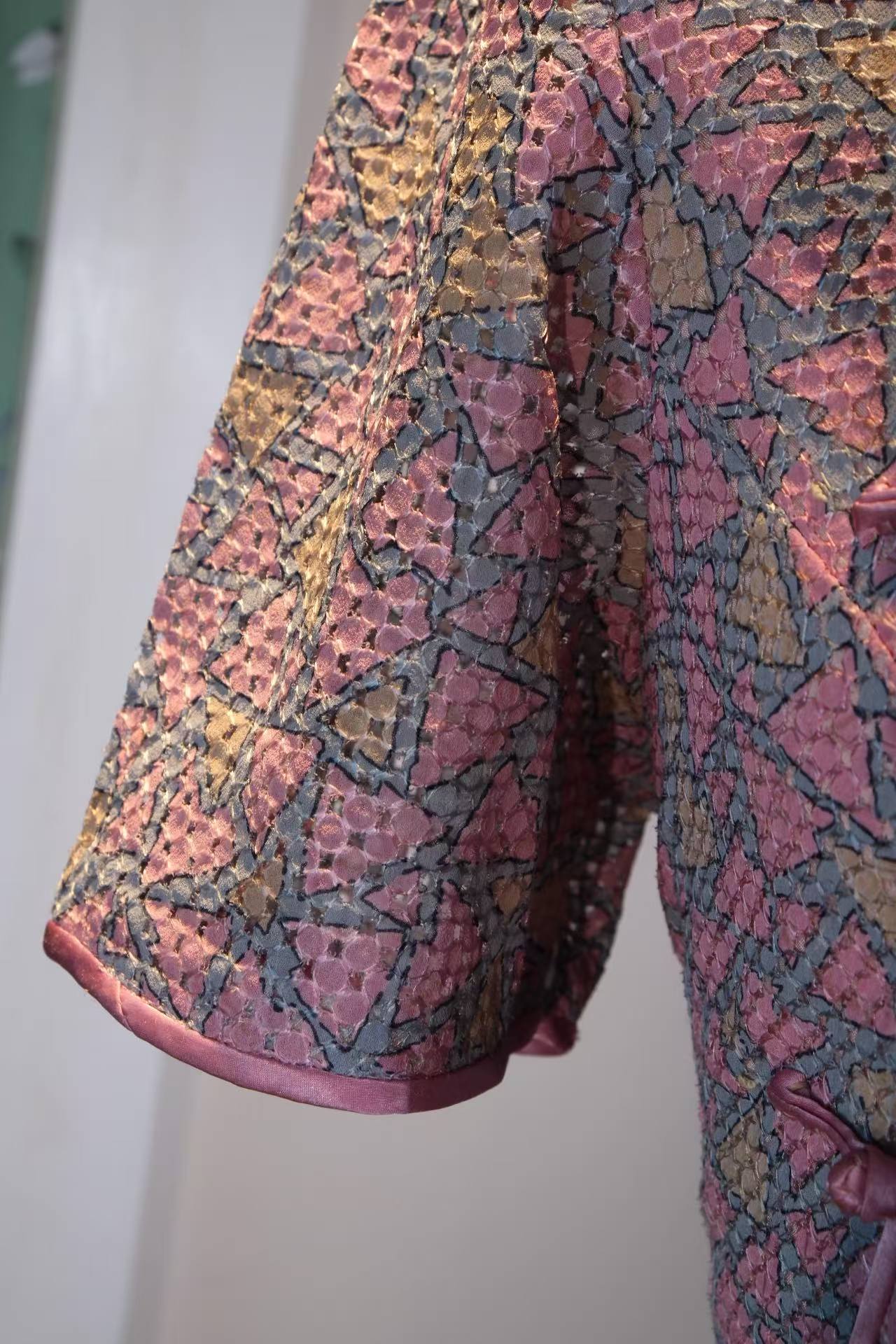
这并非一件寻常的丝绸旗袍,而是一次对织物语言的深度探索。整件衣裳最摄人心魄之处,在于其面料所呈现出的立体浮雕肌理。不同于传统平纹织物的顺滑,这件旗袍采用了特殊的提花或压褶工艺,使得布面呈现出如同古老壁画般的凹凸质感。
图案上,它大胆摒弃了传统的龙凤牡丹,转而拥抱了极具现代主义色彩的几何碎拼风格。粉紫为底,交织着灰蓝与暗金的色块,无数不规则的三角形、菱形碎片仿佛被某种无形的力量重组,既像极了破碎后重生的彩色玻璃窗(Stained Glass),又似中国传统建筑中的冰裂纹与龟背纹的现代变体。这种图案在光线下流转,随着穿着者的呼吸与走动,产生出一种迷离的动态美感,既有西方抽象表现主义的张力,又不失东方含蓄内敛的韵味。
【形制考究:复古与革新的博弈】
在形制上,这件旗袍精准地捕捉了六十年代香港时装界的审美脉搏。
- 琵琶襟的回归: 领口至腋下采用了经典的“琵琶襟”设计,这是一种源自清代服饰的偏襟样式。在六十年代西式剪裁大行其道的背景下,这种复古元素的运用显得尤为珍贵,它是对传统文化的一种温情回望,打破了单一对襟的沉闷,增添了几分婉约与灵动。
- 海派剪裁的余韵: 尽管保留了传统元素,但其整体轮廓依然是典型的“海派”改良风格。收腰极度合体,省道(Darts)运用精准,强调女性的S型曲线,袖口短小精悍,露出纤细的手臂线条。这是张爱玲笔下那个“各人住在各人的衣服里”的时代缩影,也是当时香港女性追求独立与摩登的真实写照。
【历史叙事:香江岁月的绝唱】
上世纪六十年代的香港,正处于东西方文化剧烈碰撞与融合的熔炉之中。那时的裁缝铺里,老师傅们一边听着收音机里的粤曲,一边手中的剪刀在西洋纸样与中式绸缎间游刃有余。
这件旗袍便是那个黄金时代的见证者。它可能曾穿梭于中环的写字楼,也可能出席过半岛酒店的晚宴。它身上的每一处针脚,都记录着那个时代女性对于美的极致追求——她们不再满足于仅仅作为家庭的附庸,而是渴望通过服装表达自我,展现一种既传统又前卫的复杂身份。随着时间的推移,这种重工提花面料因成本高昂、工艺繁复而逐渐退出历史舞台,使得存世的此类精品愈发凤毛麟角。
【学术注脚与收藏价值】
《诗经·卫风》有云:“硕人其颀,衣锦褧衣。”古人讲究锦衣需配罩衫,以示含蓄;而这件六十年代的旗袍,则将“锦”本身的华丽直接外化,用几何的秩序感重构了东方的奢华。
从服装史的角度来看,这件作品处于中国传统服饰向现代时装转型的关键节点。它证明了在那个年代,中国设计师(或裁缝)已经具备了极高的国际化视野,能够将西方的构成主义美学无缝植入东方的服饰载体中。
稀缺性综述:
1. 面料孤品: 这种具有强烈浮雕感的几何提花面料,属于特定历史时期的工业纺织品奇迹,现代机器难以复刻其神韵。
2. 工艺断代: 琵琶襟与西式立体剪裁的结合,需要极高超的制版与缝纫技艺,代表了老一代红帮裁缝或港式裁缝的最高水准。
3. 保存完好: 历经半个多世纪,色泽依然鲜亮,盘扣与滚边完好无损,实属博物馆级藏品。
这不仅是一件衣服,更是一首穿在身上的散文诗,等待着懂它的人,去续写下一段风华。
Measurements / Size Guide:
Bust / Waist / Hips: 108/102/108 cm
Total Length: 106 cm
Detailed Description:
This stands far apart from any ordinary silk qipao; it represents a profound exploration into the semantic language of woven textiles. The most mesmerizing attribute of the entire garment resides in the three-dimensional, high-relief texture exhibited by its fabric surface. Deviating completely from the smooth handle of conventional plain-weave textiles, this qipao implements a specialized jacquard weave or structural pleating technique, coaxing the textile plane into a tactile, high-low topography reminiscent of ancient frescoes.
In its motif layout, it boldly banishes conventional dragon, phoenix, or peony motifs to embrace a highly modernist, geometric mosaic design style. Set against a lavender-wisteria grounding chassis, blocks of slate blue and muted gold interlace. Countless irregular triangles and rhomboid fragments appear reassembled by some invisible force—strikingly evoking the broken-then-reborn splendor of stained glass windows, while simultaneously operating as a modernized mutation of the heritage ice-crackle (Bingliewen) and tortoise-shell (Guibeiwen) patterns of traditional Chinese architecture. This pattern shifts fluidly under changing illumination, generating a dreamy kinetic beauty that follows the wearer’s breath and movement. It masterfully bridges the raw tension of Western Abstract Expressionism with the disciplined, understated elegance of Eastern aesthetics.
Structurally, this qipao with high-fidelity captures the precise aesthetic pulse of the 1960s Hong Kong fashion apparatus:
The Renaissance of the Pipajin: From the neckline down to the underarm, the pattern utilizes a classical Pipajin closure—an asymmetrical, curved front lapel style derived from the costume traditions of the Qing Dynasty. Against the historical backdrop of the 1960s, where Western tailored patterns held massive hegemony, the deployment of this revivalist element is exceptionally precious. It functions as a warm, affectionate backward glance toward heritage lineage, shattering the static monotony of a standard symmetrical closure to inject a crucial element of lyrical grace and animation.
The Residual Cadence of Shanghai Tailoring: While preserving these traditional markers, the overarching profile remains a textbook manifesto of the modified Shanghai Style (Haipai). The waist reduction is mapped with extreme form-fitting precision via the rigorous deployment of darts, forcefully defining the anatomical S-curve. The sleeves are clipped short and clean, exposing the slender lines of the forearm. This stands as the ultimate material distillation of the era immortalized by Eileen Chang, where "each individual resided within their own specific garment," capturing a true portrait of mid-century Hong Kong women pursuing independence and modern refinement.
The 1960s in Hong Kong operated as an intense melting pot where Eastern and Western cultural vectors collided and reconciled with fierce vitality. Within the ateliers of that timeline, master tailors would listen to Cantonese opera over the radio while their shears navigated between Western paper patterns and Chinese silk brocades with peerless dexterity.
This qipao stands as an eyewitness to that golden epoch. It may have navigated the corporate high-rises of Central, or graced the grand evening galas at the Peninsula Hotel. Every individual stitch line anchored across its chassis archives the absolute peak of that generation's pursuit of beauty—women who were no longer content to exist merely as domestic dependents, but who actively leveraged clothing to articulate their identities, projecting a complex persona that was simultaneously traditional and avant-garde. With the passage of time, this heavy-work jacquard textile gradually vanished from commercial production lines due to its prohibitive manufacturing costs and structural complexity, rendering surviving premium specimens extraordinarily rare.
The ancient Classic of Poetry · Odes of Wei (Shijing) famously records: "A lady of majestic stature, elegant and tall... She wears a splendid embroidered robe, covered by a plain mantle." The ancients dictated that magnificent brocades must be tempered by an over-garment to safeguard modesty; conversely, this 1960s qipao directly externalizes the innate splendor of the "brocade" matrix itself, using the structural discipline of geometric order to fundamentally reconstruct Eastern luxury.
From the analytical perspective of costume history, this piece occupies a critical transition node where traditional Chinese dress was actively mutating into modern fashion apparel. It serves as physical proof that mid-century Chinese designers and tailors possessed an exceptionally sophisticated international horizon, seamlessly grafting Western Constructivist aesthetics onto an Eastern sartorial vector.
Unica Textile Matrix: This geometric jacquard fabric with its intense, relief-like textural topography represents an industrial textile miracle restricted to a highly specific historical window. Contemporary automated machinery is fundamentally incapable of replicating its unique aesthetic spirit and depth.
Lineage Discontinuity: The complex structural reconciliation of a traditional Pipajin asymmetry with Western three-dimensional ergonomic pattern drafting required superlative mastery of pattern cutting and manual tailoring—representing the absolute highest technical tier of the veteran Red-Gang (Hongbang) or Hong Kong-Style tailoring guilds.
Immaculate Preservation State: Traversing more than half a century of natural timeline, the colorway remains vividly saturated, with the hand-wound frog closures and surface binding alignments completely intact and free of degradation. It stands unequivocally as a museum-grade collectible.
This masterpiece transcends its utility as an article of clothing to operate as a wearable piece of prose poetry, waiting for its true custodian to author its next magnificent chapter.