深圳溯源
无法加载取货服务可用情况
衣服尺寸:
胸围/腰围/臀围/衣长:94/86/100/104 厘米
细节描述:
“绿叶成阴子满枝,杜牧重来鬓已丝。”
——但这件衣裳里的绿意,却从未因时光流逝而枯黄,反而在六十载的岁月沉淀中,愈发显得清雅脱俗。
一、 纹样解构:针尖上的草木呼吸
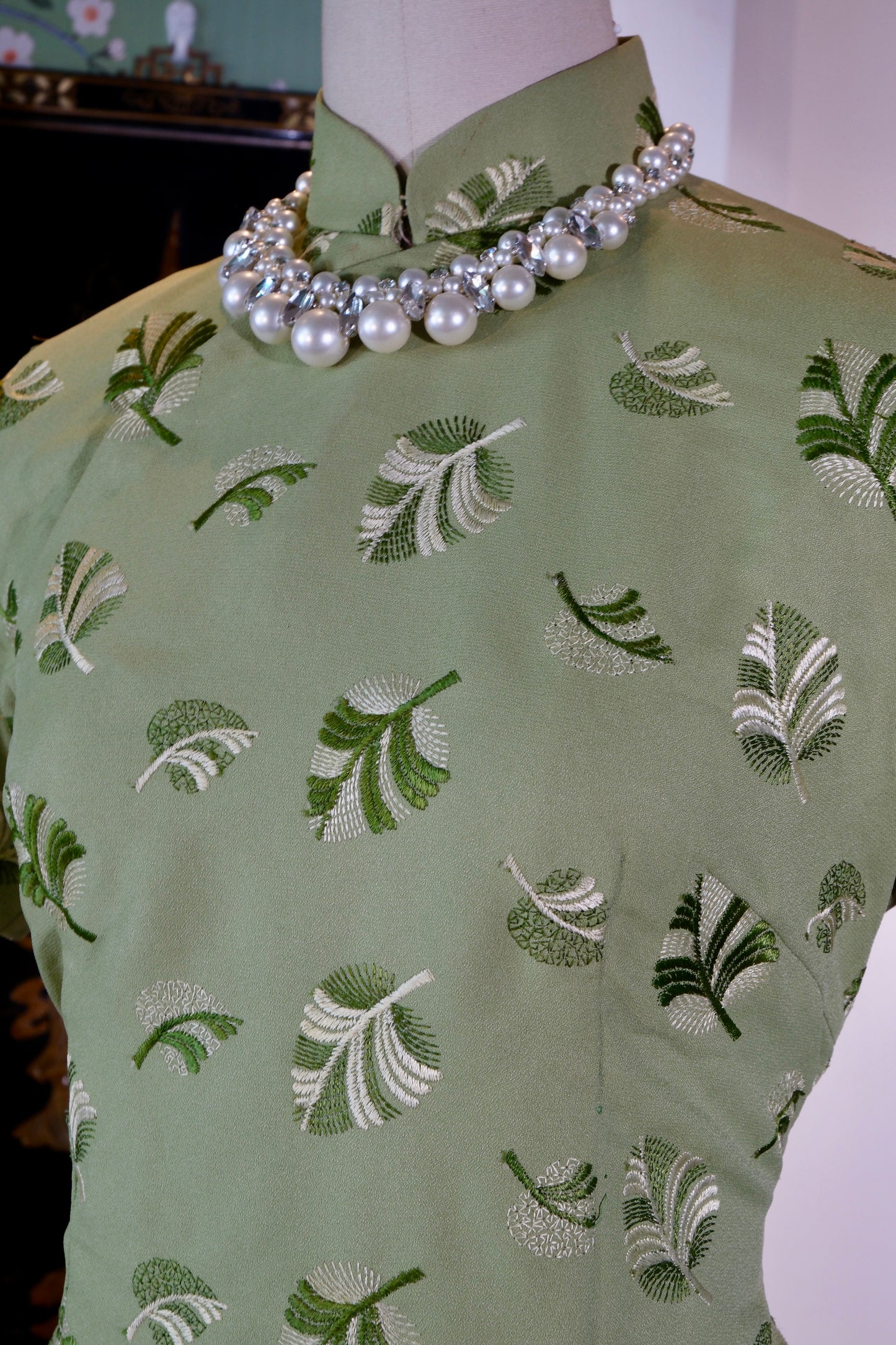
这件旗袍最引人入胜之处,在于其通体遍布的机绣叶纹图案。
不同于传统苏绣的具象花鸟,也异于西式几何纹样的冷峻,这种纹样呈现出一种极具现代感的抽象自然主义风格。
- 色彩美学: 底色选用了极为罕见的豆绿(或称艾绿),这是一种低饱和度的绿色,温润如玉,不张扬却极具生命力。绣线则采用了深绿与银白(或米白)双色交织。
- 针法技艺: 请注意观察叶片的表现手法。这是典型的六十年代台湾改良机绣工艺。工匠利用缝纫机的快速运针,模拟出类似手工“乱针绣”的质感。深绿色的线条勾勒出叶脉的骨架,刚劲有力;而白色的填充则如同阳光透过树叶洒下的斑驳光影,虚实相生。
- 布局意境: 叶片并非整齐排列,而是如风吹落叶般散落有致,大小错落。这种“散点透视”的构图,暗合了中国画论中“疏可走马,密不透风”的布局智慧,赋予了静态的面料以动态的风情。
二、 历史回响:宝岛岁月的衣香鬓影
这件旗袍诞生于上世纪六十年代的台湾。那是一个特殊的文化交融时期。
彼时,随着纺织工业的兴起,台湾成为了亚洲纺织重镇。不同于上海三十年代的手工定制巅峰期,六十年代的台湾旗袍开始尝试将工业化生产与传统审美相结合。这件衣裳便是那个时代的见证者:
- 剪裁的演变: 它的剪裁更加立体,强调女性的自然曲线,领口高度适中,既保留了东方的含蓄,又适应了当时日益活跃的现代社交生活。
- 稀缺性: 虽然名为“机绣”,但在六十年代,能够拥有如此精细配色和复杂针法程序的机器并不多见。这种带有强烈设计感的量产高定(Ready-to-wear Couture),在当时往往也是供给军官眷属或知识女性的高级成衣。如今留存完好、色泽如新的更是凤毛麟角。
三、 艺术风格:张爱玲笔下的“参差对照”
张爱玲曾言:“衣服是一种言语,随身带着的一种袖珍戏剧。”
这件旗袍所演绎的,正是一出关于“清新与怀旧”的戏剧。它没有大红大绿的俗艳,也没有黑白灰的决绝。它选择了一种中间色调,一种“哀而不伤,乐而不淫”的中庸之美。
那一串串搭配的白色珍珠项链(虽为配饰,但与衣裳浑然天成),更增添了几分民国遗风的贵气。整件衣服给人的感觉,就像是林语堂笔下那些受过良好教育、既有传统底蕴又向往自由的新女性,穿着它在台北的午后,煮一壶茶,读一卷书。
四、 结语: wearable Art(可穿戴的艺术)
收藏古董衣,不仅仅是收藏一块布料,更是收藏一段凝固的时光。
这件六十年代的台湾机绣绿叶旗袍,以其独特的植物学审美视角、精湛的早期工业化刺绣工艺以及保存完好的品相,成为了研究战后东亚服饰变迁的珍贵标本。它不仅是一件衣物,更是一首穿在身上的散文诗,等待着懂它的人,续写下一个六十年的风华。
"The green leaves have formed an abundant shade, and the branches are heavy with fruit; yet when Du Mu returns, the hair at his temples has already turned to silk."
— Yet the vibrant green infused within this garment has never withered or yellowed under the passage of time; rather, suspended through six decades of historical maturation, it emerges with an increasingly refined, transcendent composure.
Measurements / Size Guide:
Bust / Waist / Hips / Total Length: 94/86/100/104 cm
Detailed Description:
The most compelling dimension of this artifact lies in the comprehensive distribution of its machine-embroidered foliate motifs across the entire structural panels of the clothing body.
Diverging explicitly from the literal, representational bird-and-flower iconography native to traditional Suzhou embroidery (Suxiu), and equally distinct from the cold, industrial severity of Western geometric patterns, this ornamentation manifests a highly contemporary breed of abstract naturalism.
Chromatic Physics and Aesthetic Theory: The baseline textile matrix is saturated in an exceedingly rare bean-green or mugwort-green (Ailü). This represents a low-saturation, calculated green value—tempered and warm like unctuous nephrite jade—that renounces loud visual dominance while maintaining a profound, latent vitality. The embroidery filaments implement a dual-thread interweaving of deep forest green and silver-white (or cream).
Kinetic Needlework and Mechanical Execution: Closer evaluation of the leaf anatomy isolates the structural signature of 1960s Taiwanese modified machine embroidery. The artisan manipulated early mechanical sewing apparatuses through rapid, variable-velocity stitching to simulate the organic, multi-directional textures characteristic of manual "random-stitch" embroidery (Luanzhenxiu). The deep green filaments map out the structural skeleton of the leaf veins with crisp, masculine velocity, while the white thread fills the negative space to capture the optical illusion of mottled sunlight filtering through a living canopy—yielding an elastic interplay of solid and void (Xu shi xiang sheng).
Compositional Spatiotemporal Logic: The leaves deliberately reject rigid, symmetrical alignment; instead, they are scattered with calculated spontaneity, mimicking foliage cast across the wind. This mastery of asymmetrical scale shifts honors the classical Chinese painterly canon of "scattered perspective" (Sandian Toushi), which dictates that layout must be "loose enough to race a horse, yet dense enough to block the wind" (Shu ke zou ma, mi bu tou feng). It successfully instills a static fabric plane with a dynamic, kinetic atmosphere.
This garment was manufactured during the 1960s in Taiwan—a highly specific historical window characterized by intense, multi-layered cultural cross-pollination.
During this era, driven by the rapid post-war capitalization of the textile manufacturing sector, Taiwan transformed into an undisputed industrial powerhouse within the East Asian trade network. Distinct from the 1930s Shanghai golden era of pure manual haute couture, 1960s Taiwanese dressmaking began aggressively experimenting with the synthesis of early industrial mass fabrication and classical aesthetic canons. This qipao stands as a pristine material monument to that technological transition:
Evolution of the Pattern-Drafting Cut: The underlying architecture implements a more pronounced three-dimensional darting system, leaning into the natural anatomical curves of the modern female form. The height of the Mandarin collar is calculated with moderate proportion, successfully retaining traditional Eastern modesty while effortlessly adapting to the high-mobility demands of active, modern mid-century social life.
Vectors of Scarcity: Though taxonomically classified as "machine embroidery," the mechanical apparatuses capable of executing such nuanced color programming and intricate stitch-velocity variations were exceedingly rare anomalies in 1960s Taiwan. This genre of garment represents an early iteration of high-design ready-to-wear couture. In its historical context, such premium apparel was restricted almost exclusively to the households of high-ranking military officers (Juancun elite) or cosmopolitan intellectual women. To discover a specimen surviving half a century with its chromatic saturation completely intact and its structural epidermis free of degradation is a supreme archival rarity.
As Eileen Chang famously remarked in her seminal sartorial essay: "Clothes function as a sovereign vernacular; they carry a pocket drama wherever they go."
The specific narrative staged by this qipao explores the delicate psychological threshold between fresh modernism and archival nostalgia. It explicitly rejects the vulgar saturation of primary reds and greens, just as it avoids the absolute finality of a monochromatic black-and-white-grey palette. Instead, it deliberately operates within a sophisticated matrix of intermediate tones—achieving a classical Confucian aesthetic equilibrium defined as "sorrowful without devastation, joyful without excess" (Ai er bu shang, le er bu yin).
The historical inclusion of a matched, milk-white cultured pearl necklace (which, though an accessory, dissolves organically into the garment's visual field) injects an undeniable lineage of Republican-era aristocratic refinement (Minguo Yifeng). The total aesthetic impression directly evokes the progressive, highly educated "New Woman" archetype championed by Lin Yutang—individuals anchored deeply within classical literary lineages yet oriented toward personal autonomy, wearing such garments in a quiet Taipei afternoon while boiling tea and decoding a volume of modern prose.
To collect and archive antique garments extends far beyond the preservation of physical yardage; it constitutes the preservation of a frozen temporal dimension.
This 1960s Taiwanese machine-embroidered foliage qipao—with its singular botanical taxonomy, its exceptional command of early industrial needlework technology, and its pristine conservation state—stands as an invaluable material holotype for the study of post-war East Asian dress history. It operates not merely as an article of clothing, but as a piece of material poetry draped across space, waiting for those with the historical literacy to read its seams and inherit its elegance for the next sixty years.