深圳溯源
无法加载取货服务可用情况
衣服尺寸:
胸围/腰围/臀围/衣长:106/94/110/98 厘米
细节描述:
“衣裳是文化的皮肤,针脚是时间的语言。”
当我们抚摸这件上世纪五十年代的香港产古董旗袍时,指尖触碰到的不仅是丝缕经纬,更是一段被封存的香江岁月。
【观·繁花如梦】
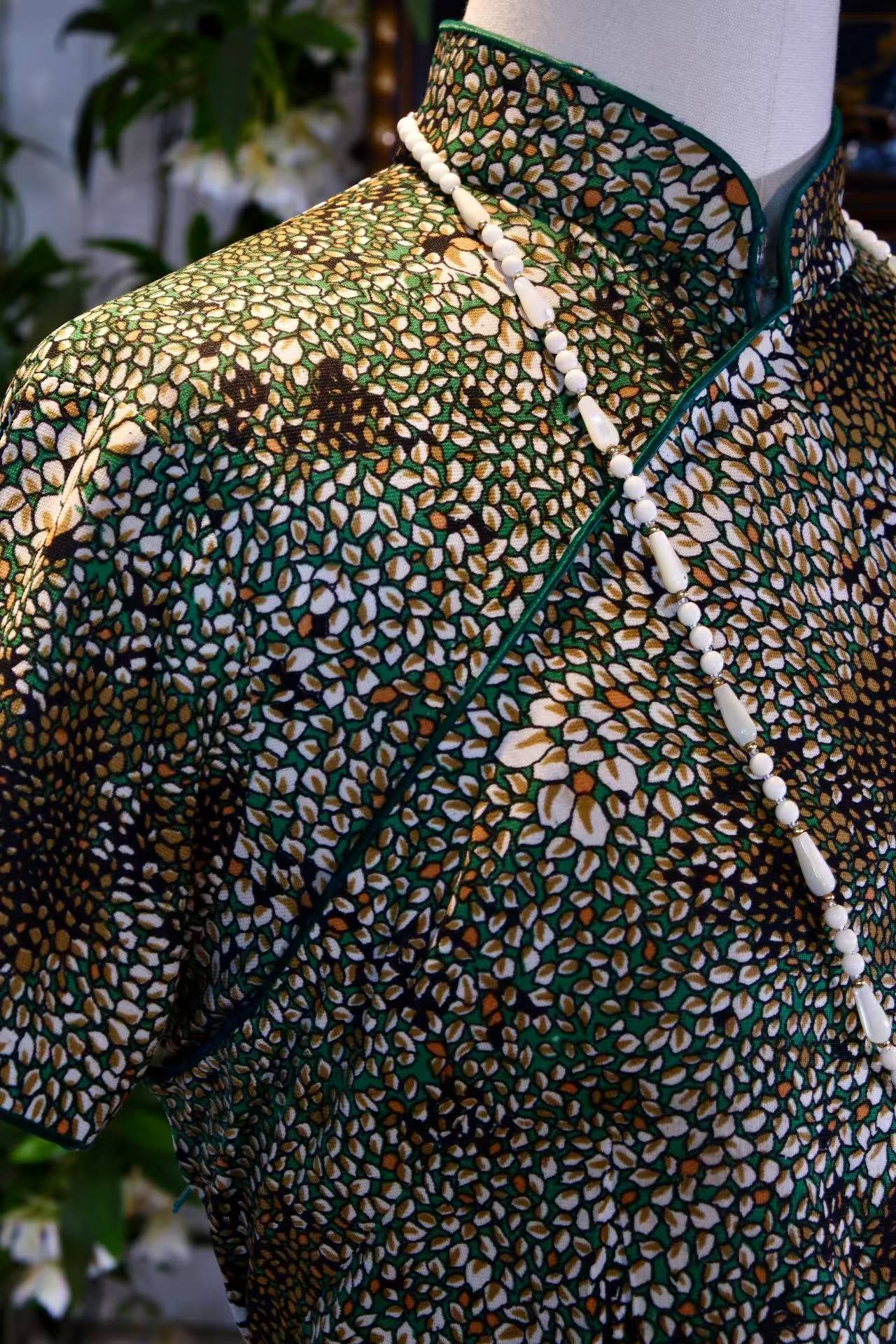
它不属于那种一眼望穿的传统工笔花鸟,而是一场关于色彩的抽象实验。墨绿为底,宛如深夜的静谧森林;赭黄与月白交织成无数细密的花簇,似点彩画笔下的光影斑驳,又若星河倾泻。这种极具现代构成感的碎花图案,在那个年代是前卫与摩登的代名词。它打破了传统纹样的对称与刻板,以一种自由、奔放的姿态,诉说着战后女性渴望挣脱束缚、拥抱新生的心理图景。
【品·匠心如发】
视线游走于领口与大襟,你会惊叹于那一道深绿色的“线香绲”。古人云:“良工苦心,细致入微。”在如此繁复缭乱的底纹之上,工匠以细如线香的滚边,勾勒出利落挺拔的线条。这不仅仅是装饰,更是一种克制的美学——以极简的线条驾驭极繁的花色,多一分则乱,少一分则弱。这是典型的“港工”骄傲,也是那个黄金时代裁缝们引以为傲的手艺勋章。
【悟·绝版风华】
张爱玲曾写道:“对于不会说话的人,衣服是一种语言,随身带着的是袖珍戏剧。”这件旗袍,就是一出无声的折子戏。七十载光阴流转,多少绫罗绸缎化为尘土,唯有它,凭借着坚韧的面料与精湛的剪裁,穿越时空而来。它不仅是一件衣物,更是五十年代香港中西文化交融、传统与现代碰撞的实物标本。
穿上它,你穿上的不仅是一份合体的优雅,更是一段不可复制的历史。在这快节奏的现代都市里,愿这份来自半个世纪前的从容与精致,能让你在举手投足间,流露出独一无二的东方韵味。
【藏品注脚】
● 年代: 1950s (Post-war Hong Kong Era)
● 产地: 香港 (Hong Kong Made)
● 工艺: 传统平面剪裁结合西式省道,极细线香绲边
● 面料: 高密度抽象印花棉/混纺(保存极佳)
● 状态: 博物馆级收藏品相
Measurements / Size Guide:
Bust / Waist / Hips / Total Length: 106/94/110/98 cm
Detailed Description:
This specimen represents a radical departure from the literal, meticulous flower-and-bird motifs characteristic of traditional Eastern brushwork, operating instead as a sophisticated mid-century experiment in abstract optical composition.
The garment plane is anchored by a deep ink-like forest green ground, evoking the dense quietude of a nocturnal forest. Superimposed upon this field is an asymmetrical scattering of ochre-yellow and moon-white floral clusters, executed with a loose, pointillist rhythm that manipulates light and shadow across the textile surface like mottled starlight filtering through a canopy. By discarding rigid symmetry and conventional decorative boundaries, this highly progressive, avant-garde layout historicizes the post-war psychological shift of the 1950s cosmopolitan woman—translating a cultural desire for structural liberation and modern autonomy into a dynamic textile movement.
The definitive technical excellence of this artifact is archived in the flawless execution of its edge-finishing and structural boundaries, a testament to the peak era of post-war Hong Kong sartorial engineering (ganggong).
Along the absolute perimeter of the high Mandarin collar and the diagonal closure (dajin), the artisan has applied an ultra-narrow, dense forest green piping. In textile taxonomy, this execution is celebrated as "incense piping" (xianxiang gun) due to its string-like fineness and unyielding linear discipline. Against a highly complex, visually active floral ground, this structural border introduces a necessary geometric calm. It acts as an aesthetic governor—using severe, minimalist lines to control and balance the sprawling energy of the multi-colored floral print. This level of manual precision requires rigorous iron-molding and grain manipulation, serving as a material signature of a master tailor's hand-craftsmanship.
Morphologically, this specimen captures the precise historical transition where traditional Chinese two-dimensional construction absorbed the anatomical physics of Western haute couture. The drafting maintains the soft, unbroken shoulder slope characteristic of traditional flat garment-cutting, preserving a classical Eastern composure.
However, the torso layout incorporates precisely calculated waist-reduction darts (shengdao). This hybrid pattern engineering eliminates excess fabric bulk beneath the bust and along the lower back, wrapping the biological form in a disciplined, elegant silhouette that directly accommodated the rapid civic mobilization of mid-century Hong Kong. Furthermore, the high-density abstract print substrate provides remarkable structural stiffness (tingkuo) and resistance to fiber degradation, allowing the deep forest green and ochre pigments to retain their original saturation over a seventy-year archival timeline.
As Eileen Chang famously noted in Reflections on Clothing (Geng Yi Ji): "For those who cannot speak, clothes are a language, a pocket theater carried upon the body." This specimen operates as an intricate cross-cultural drama. Decades have passed, reducing countless rolls of silk and brocade to dust, yet this artifact survives as a primary material witness to 1950s Hong Kong—a pivotal geopolitical window characterized by intense socio-cultural friction and cosmopolitan hybridization.
To inhabit this garment is to step into a meticulously calibrated elegance and an irreplaceable history. Amid the accelerated velocity of the contemporary metropolis, the reserved composure and structural precision of this mid-century artifact allow the wearer to project a deeply unique, immutable expression of Eastern modernism.
Era: 1950s (Post-war Hong Kong Era)
Provenance: Hong Kong (Hong Kong Made)
Workmanship: Traditional flat-pattern drafting integrated with Western structural darts; ultra-fine incense piping (xianxiang gun)
Substrate: High-density abstract-print cotton/specialty blend (exceptionally preserved)
Condition: Museum-grade archival preservation quality