深圳溯源
无法加载取货服务可用情况
衣服尺寸:
胸围/腰围/臀围/衣长:104/86/110/113 厘米
细节描述:
“锦衣旗袍诗,曼玉花样时。”
—— 这不仅仅是一句赞美,更是对上世纪六十年代香港时装黄金期最精准的注脚。
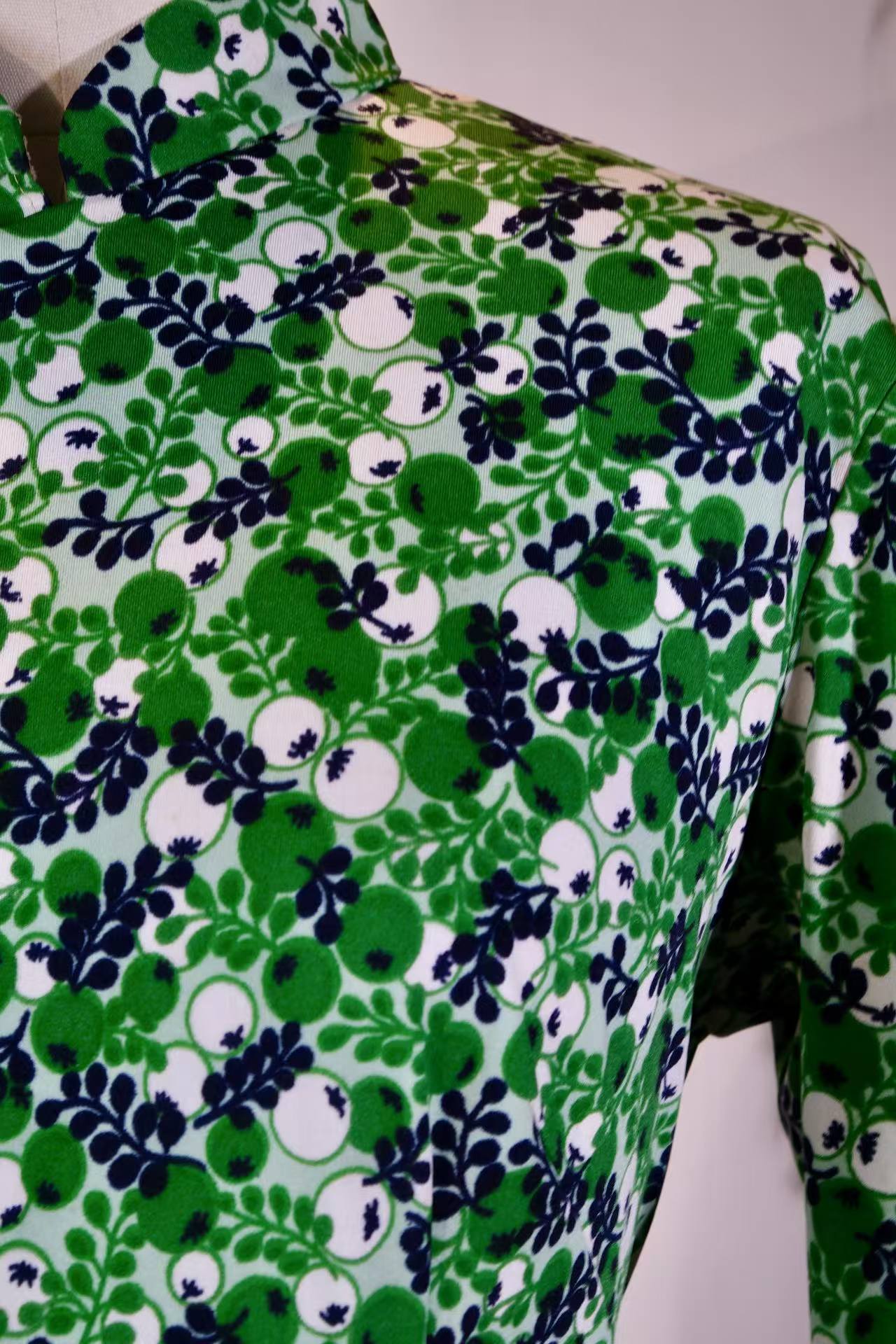
🌿 图案解码:当东方草木遇上西方波普
初见此衣,目光必被其面料上蓬勃的生命力所捕获。这并非传统中式旗袍中常见的具象牡丹或梅兰竹菊,而是一场东西方美学的奇妙碰撞。
* 视觉修辞: 图案采用了极具现代感的抽象植物纹样。深绿、草绿与藏蓝交织成繁复的枝叶网络,宛如宋代花鸟画中折枝法的变体;而那散落其间的白色圆点与圈状结构,则带有明显的六十年代欧洲Op Art(欧普艺术)与波普艺术的影子。
* 色彩心理学: 这种高饱和度的“苹果绿”底色,在当时被称为“太空时代”的色彩语言,象征着战后经济腾飞期的乐观与活力。它打破了传统旗袍沉稳内敛的色调规训,展现出一种摩登女性的自信与张扬。
🧵 物质文化史:意大利面料与香港裁缝的共谋
这件旗袍的身世,是全球化贸易早期的一段佳话。
* 海派/港式剪裁: 注意观察其肩部线条与腰身收省。这是典型的“港工”特征——受西方立体剪裁影响,强调胸腰差的极致曲线,同时保留了中式立领的含蓄。这种“西料中做”的模式,正是张爱玲笔下那个“各各不相干,又各各有一点联系”的时代的缩影。
🕰️ 古董衣的低语:穿越六十年的优雅
每一件古董衣都是有灵魂的幸存者。
想象一下,1965年的某个午后,一位身着此衣的女士,或许正走在中环的石板路上,或是出席一场在半岛酒店举办的鸡尾酒会。那时的她,耳畔或许回响着葛兰的曼波舞曲,手中摇曳着马天尼。这件旗袍见证了她从青春韶华到成熟风韵的过渡。
六十年过去了,纤维的抗老化特性让这份翠绿依然鲜亮如初,仿佛时间在这里打了个结。它不再仅仅是一件衣服,它是那个“花样年华”的实体化石。
📜 学者结语:稀缺的艺术孤本
在服装史的维度上,我们常说“一代有一代之文学,一代亦有一代之衣裳”。
这件旗袍之所以珍贵,在于它处于一个不可复制的历史交汇点:
1. 工艺的绝唱: 如今已难寻能完美驾驭这种面料的老派裁缝,那种手工归拔出的流畅线条,是机器无法替代的温度。
2. 审美的孤本: 这种结合了中式韵味与西式抽象艺术的印花设计,随着七十年代后极简主义的兴起而逐渐消逝。
收藏此衣,即是收藏了一段关于“美是如何在东西方文化夹缝中野蛮生长”的历史。它不仅适合在重要的雅集中展示,更值得被作为纺织艺术的标本,细细研读。
Measurements / Size Guide:
Bust / Waist / Hips / Total Length: 104/86/110/113 cm
Detailed Description:
The primary visual weight of this garment relies on the intense, booming vitality of its surface design. It rejects the conventional, illustrative flora of classical Chinese dress in favor of a striking cross-cultural graphic synthesis.
Visual Rhetoric: The textile employs a highly modernized, abstract botanical layout. Saturated forest green, grass green, and deep navy filaments interlace to form a dense network of branches and foliage—a mid-century abstraction of the traditional Song Dynasty "broken-branch" composition (zhezhi fa). Interspersed within this foliage are white geometric circular points and concentric rings, directly channeling the visual vernacular of 1960s European Op Art and Pop Art movements.
Chromatic Articulation: The high-chroma "apple green" ground represents a key color story of the mid-century Space Age aesthetic. Symbolizing the profound optimism and socioeconomic expansion of the post-war era, this palette completely shatters the subdued, monochromatic behavioral expectations of traditional Chinese vestments, declaring instead the confidence, autonomy, and modern presence of the period's cosmopolitan woman.
The biography of this artifact stands as primary physical evidence of early globalized textile trade routes and specialized regional craftsmanship.
The Hong Kong-Shanghai Lineage: The structural engineering of the shoulder slopes and waist-reduction darts represents the absolute peak of post-war Hong Kong execution (ganggong). Heavily influenced by Western three-dimensional haute couture, the pattern drafting accentuates an extreme anatomical differential between the bust and waist, while fiercely preserving the moral reserve of the tall Chinese Mandarin collar. This specific structural paradigm—applying traditional Eastern hand-craftsmanship to imported Western luxury textiles—perfectly historicizes the transitional era described by Eileen Chang, where distinct cultural identities operated inside a unified modern form.
Every pristine antique garment functions as a silent, physical survivor of a lost life-world.
To reconstruct its historical milieu: during an afternoon in the mid-1960s, a woman donning this emerald specimen would have navigated the stone-paved inclines of Central or attended an elite cocktail salon at the Peninsula Hotel. The garment operated as a dynamic theatrical prop within an urban soundscape defined by Grace Chang’s mambo rhythms, serving as a direct witness to the wearer's personal transition from youth into mature social elegance. Six decades later, the exceptional resistance to degradation within these premium fibers allows this vivid green matrix to retain its original chromatic intensity. It has ceased to be mere apparel, standing instead as a tangible, three-dimensional fossil of a bygone golden era.
Within the framework of dress history, every epoch articulates its socio-political reality through material form. The structural scarcity of this qipao is defined by two irreproducible historical criteria:
The Obsoletion of Artisan Production: The generational lineage of master tailors capable of perfectly manipulating this specific fabric weight has completely vanished. The fluid, organic lines achieved through manual iron-molding (guiba) possess an artisan warmth and human touch that modern industrialized mass production cannot replicate.
The Extinction of the Aesthetic Paradigm: This highly specific design intersection—fusing classical Chinese spatial layout with Western abstract geometry—disappeared entirely following the global rise of industrial minimalism in the 1970s.
To preserve this artifact is to curate a critical chapter in international design history: a record of how cross-cultural aesthetics flourished within the geopolitical margins between East and West. It transcends the functional utility of ceremonial wear to exist as an institutional-grade material specimen of twentieth-century textile art.