深圳溯源
无法加载取货服务可用情况
衣服尺寸:
胸围/腰围/臀围:94/74/100 厘米
衣长:130 厘米
细节描述:
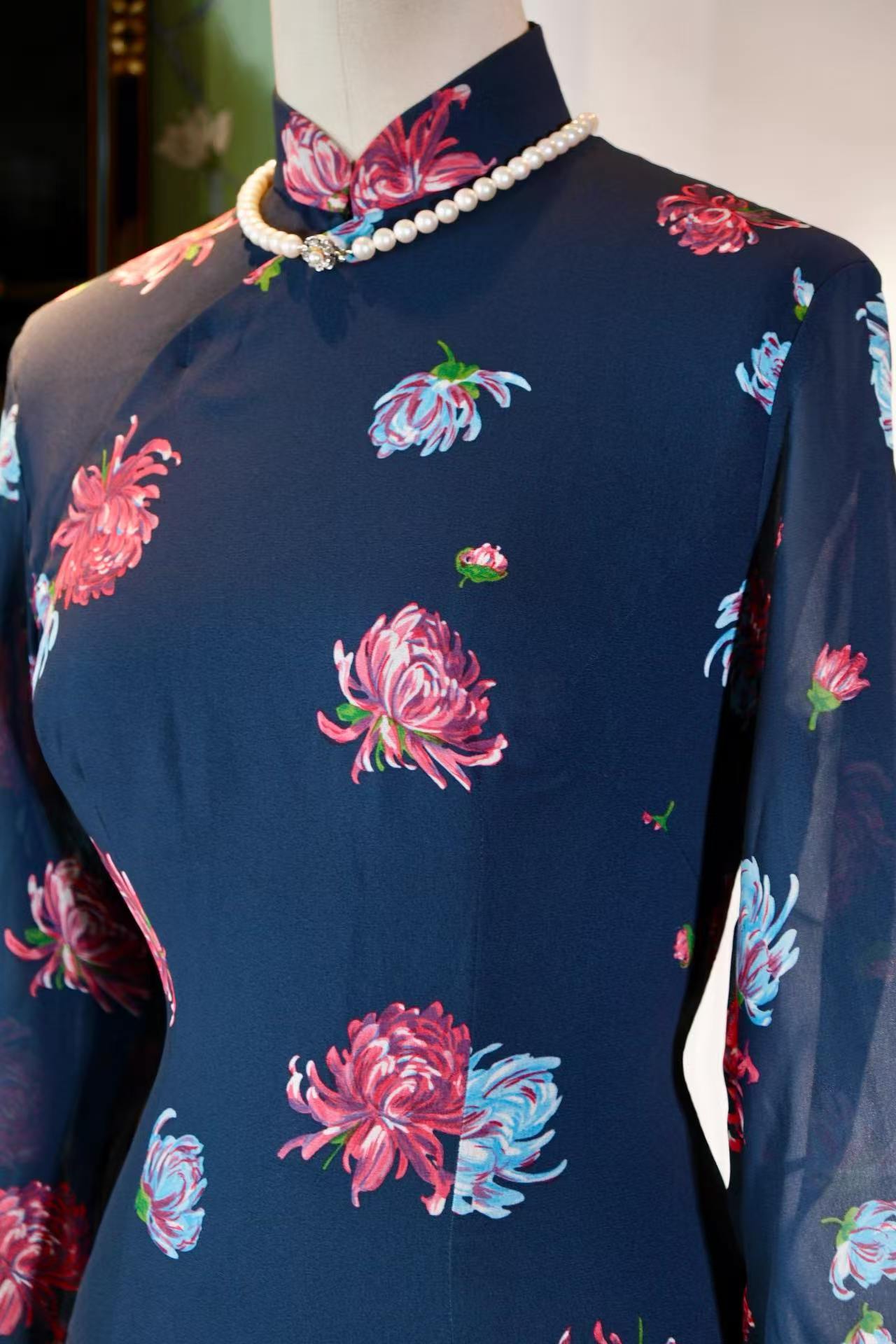
这件旗袍的图案设计,堪称一绝。它摒弃了当时市面上常见的大红大绿,而是选择了一种更为内敛、雅致的艺术表达。
- 花型选择: 图案主体为菊花。在中国传统文化中,菊花象征着隐逸、高洁与长寿。不同于牡丹的富贵逼人,菊花多了一份文人的傲骨。旗袍上的菊花并非写实风格的工笔画,而是采用了类似“没骨画法”的晕染效果。
- 色彩搭配: 底色为深邃静谧的藏青色,如同夜幕降临时的维多利亚港,深沉而包容。花朵的颜色则由胭脂红与天青色交织而成。红色的花瓣热烈而不艳俗,蓝色的花瓣清冷而不孤寂,两者在藏青色的底布上错落有致地绽放,仿佛夜空中绽放的烟火,既对比鲜明又和谐统一。
- 布局构图: 花型分布呈现出一种“散点透视”的韵律感,大小相间,疏密有致。有的含苞待放,有的肆意盛开,仿佛随风而动,极具动感。这种布局留出了大量的“气口”,使得整件旗袍在视觉上透气、灵动,不落俗套。
时代叙事:香江旧梦,黄金年代
这件旗袍诞生于上世纪六十年代的香港,那是一个新旧交替、中西合璧的黄金年代。
- 历史背景: 当时的香港,经济腾飞,电影业繁荣。葛兰、林黛等影星身着旗袍的形象深入人心。这件旗袍正是那个时代的缩影——它保留了中国传统的立领与斜襟,但在剪裁上更加贴合人体曲线,强调腰线与臀部的比例,这是受到西方立体剪裁影响的结果。
- 面料工艺: 值得注意的是,这件旗袍采用了雪纺面料。在六十年代,化纤与仿真丝技术的引入是纺织业的一大革新。相比于传统的真丝缎面,雪纺更加轻盈、飘逸,且带有微微的透视感(尤其是袖子部分),这种“露”与“藏”的艺术,展现了当时女性思想的解放与对美的重新定义。
- 稀缺性: 经过半个多世纪的岁月洗礼,能够完好保存至今的雪纺面料极为罕见。雪纺易脆、易勾丝,但这件旗袍的印花依然清晰,色泽依然鲜亮,面料依然挺括,这本身就是一个奇迹。它是那个时代香港制衣工艺巅峰的见证者,是不可再生的孤品。
艺术风格:海派余韵,港式摩登
这件旗袍的艺术风格,可以概括为“典雅中的摩登”。
- 剪裁之美: 它的线条流畅利落,经典的斜襟设计从领口蜿蜒至腋下,勾勒出东方女性含蓄的性感。七分袖的设计,既端庄得体,又露出了纤细的手腕,搭配珍珠项链,尽显名媛风范。
- 意境之美: 它不只是一块布,更是一幅流动的画。穿上它,仿佛能让人穿越回那个纸醉金迷却又充满书卷气的年代。它适合在微凉的秋夜,配上一件羊绒披肩,赴一场老友的晚宴;也适合在午后的茶室,伴着留声机里的周璇老歌,独自品味时光的馈赠。
结语
这件六十年代的香港雪纺印花旗袍,是时间的幸存者。它身上的每一朵菊花,都承载着历史的记忆;每一缕丝线,都编织着旧日的繁华。收藏它,不仅是收藏一件衣服,更是收藏一段无法复刻的东方美学传奇。
Measurements / Size Guide:
Bust / Waist / Hips: 94/74/100 cm
Total Length: 130 cm
Detailed Description:
[I. The Iconography: The Fragrant Spirit of "Mogu" Painting Aesthetics] The pictorial layout of this Qipao represents an absolute masterclass in textile design. Rejecting the aggressive, highly saturated reds and greens ubiquitous in the marketplace of that era, it opts instead for a deeply reserved, patrician artistic expression.
Choice of Motif: The primary motif centers on the chrysanthemum. Within traditional Chinese iconography, the chrysanthemum serves as a canonical emblem of hermit-like seclusion, pristine integrity, and longevity. Distinct from the overwhelming, wealthy opulence of the tree peony, the chrysanthemum projects the defiant, proud spine of the literati class. The chrysanthemums engineered across this garment bypass literal, fine-line realism (Gongbi); instead, they employ a washing and blending technique akin to the classical Mogu (boneless/contourless) painting methodology.
Palette Orchestration: The background is executed in a deep, quiescent navy blue—resembling Victoria Harbour as night falls, profound and all-enveloping. The blossoms interlace brilliant tones of crimson and azure. The crimson petals pulse with warmth without ever verging into vulgarity, while the azure petals remain crisp and cool without slipping into desolation. The two hues bloom in deliberate misalignment across the navy ground like fireworks scattering across a midnight sky, achieving a sharp visual contrast that remains flawlessly unified.
Compositional Rhythm: The floral distribution implements the rhythmic grace of traditional Chinese "scattered perspective" (Sandian Toushi), alternating in scale and balancing density against breathing space. Some emerge as tight buds awaiting dawn, while others open with wild abandon, projecting a kinetic fluidity as if swaying in a sudden breeze. This blueprint leaves ample visual "apertures" (Qikou), ensuring the entire garment feels airy, organic, and beautifully unconventional.
[II. The Temporal Narrative: Dreams of Victoria Harbour, The Golden Era] This Qipao was birthed in 1960s Hong Kong—a definitive golden age characterized by the shifting of eras and the miraculous synthesis of East and West.
Historical Context: During this epoch, Hong Kong experienced an unprecedented economic ascent alongside a booming cinema industry. Silver-screen icons like Grace Chang and Linda Lin Dai permanently cemented the glamorous Qipao silhouette into the global fashion lexicon. This garment stands as a flawless material cross-section of that era—faithfully retaining the ancestral structural mandarin collar and diagonal opening, while deploying a heavily darted, body-conscious fit to contour the waist-to-hip ratio, an absolute result of Western three-dimensional draping methodologies.
Textile Craftsmanship: Crucially, this piece utilizes a lightweight chiffon fabric. In the 1960s, the introduction of advanced synthetic fibers and early faux-silk engineering marked a monumental revolution in the global textile industry. Compared to heavy, traditional high-gloss silk satins, chiffon introduced an unprecedented weightlessness, fluidity, and a subtle, elusive sheer quality (particularly pronounced across the sleeves). This deliberate choreography of "revealing and concealing" beautifully mirrors the mid-century liberation of women's consciousness and the redefinition of modern beauty.
Rarity: Traversing half a century of environmental wear, a chiffon textile that remains flawlessly preserved is an exceptional rarity. Mid-century chiffons are notoriously prone to embrittlement and snagging; yet the print on this Qipao remains pristine, the colors hold their vivid registration, and the fabric retains its proper structural crispness. It stands as a living witness to the peak manufacturing standards of mid-century Hong Kong tailoring—an unrepeatable historical specimen.
[III. Artistic Style: The Legacy of Shanghai, Hong Kong Modernity] The overarching artistic philosophy of this Qipao can be defined as "modernity anchored within classical elegance."
The Beauty of Tailoring: The silhouette is clean, streamlined, and deliberate. The classic diagonal opening (Xiejin) winds elegantly from the throat down to the underarm, contouring the reserved sensuality of the Eastern female form. The three-quarter sleeves project an aristocratic decorum while drawing focus to a slender wrist—a layout engineered to pair seamlessly with a pearl necklace to exude effortless high-society poise.
The Beauty of Mood: This is far more than engineered yardage; it is a fluid landscape painting made wearable. To step into it is to step backward into an epoch that was simultaneously decadent yet filled with literary refinement. It belongs to a cool autumn evening, draped beneath a cashmere shawl for an intimate dinner among old friends; or inside a quiet afternoon teahouse, accompanied by the crackle of a gramophone playing Zhou Xuan's nostalgic melodies, privately savoring the gifts of passing time.
Epilogue This 1960s Hong Kong printed chiffon Qipao is a triumphant survivor of time. Every single chrysanthemum blooming across its fibers archives the memory of history; every line of thread weaves the vanished splendor of yesteryear. To curate this piece is to curate far more than apparel—it is to hold a fragment of an unrepeatable Eastern aesthetic legend.