深圳溯源
无法加载取货服务可用情况
衣服尺寸:
胸围/腰围/臀围/衣长:96/76/96/104 厘米
细节描述:
【序章:经纬间的跨洋对话】
在服装史的宏大叙事中,鲜有物件能如这件上世纪六十年代的旗袍般,将东西方的审美意志如此精妙地缝合。它并非单纯的衣物,而是一段被织物封存的时光标本。彼时,香港正处于“东方巴黎”的黄金余晖中,工匠们以针为笔,将来自亚平宁半岛的意大利进口亚麻,化作了一首关于摩登与传统的抒情诗。这不仅是一件古董衣,更是全球化早期时尚贸易与本土匠心碰撞出的璀璨火花。
【纹样:指尖上的立体星辰】
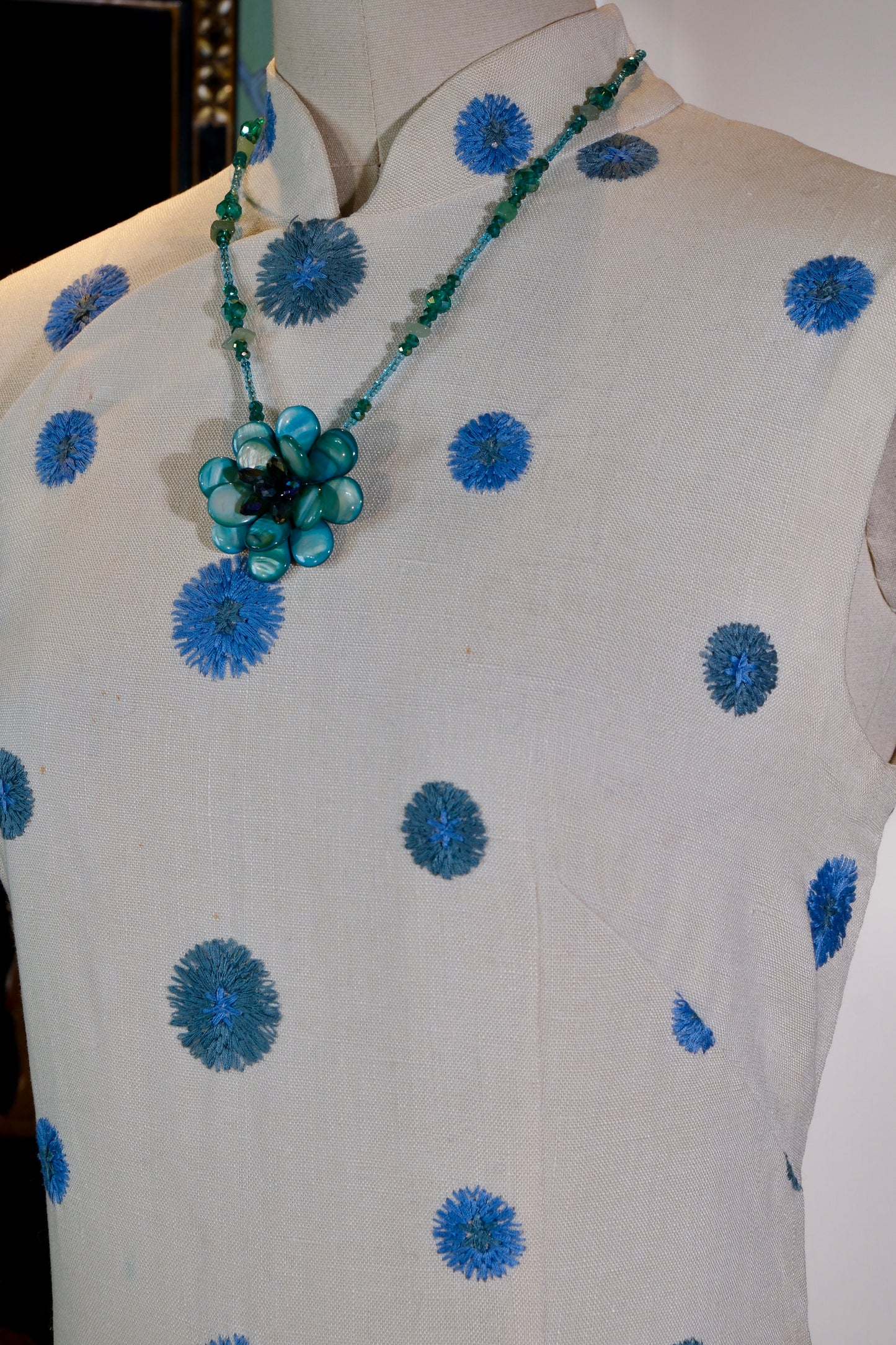
凝视其表,最摄人心魄的莫过于那散落于素白底色之上的蓝色绒球状刺绣。这并非寻常的平面印花,而是极具雕塑感的立体刺绣工艺。每一朵“花”皆由无数细密的丝线簇拥而成,宛如雨后初绽的矢车菊,又似夜空中悬浮的幽蓝星辰。它们在亚麻粗粝而质朴的肌理上跳跃,打破了传统旗袍纹样的对称与刻板,呈现出一种近乎印象派画作的光影流动感。这种设计语言,既保留了中式刺绣的细腻温婉,又吸纳了西方现代艺术对几何与质感的探索,是六十年代波普艺术风潮在东方服饰上的一次优雅回响。
【史证:亚麻上的时代宣言】
从物质文化研究的角度审视,这件旗袍的面料选择本身便是一种无声的宣言。在丝绸统治旗袍界的传统语境下,选用意大利进口亚麻,彰显了穿着者超越时代的先锋品味。亚麻,这种源自自然的纤维,带着微皱的随性与透气的自由,恰恰契合了六十年代女性追求解放、回归自然的身体意识。其剪裁摒弃了繁复的滚边与镶嵌,转而以极简的线条勾勒身形,无袖设计与高挺领口形成张力,精准地捕捉了那个时代特有的“克制性感”。正如张爱玲所言:“衣服是一种言语,随身带着一种袖珍的世界。”这件旗袍,便是那位未曾谋面的女主人向世界递出的一张精致名片——独立、知性且拥有跨越文化的视野。
【结语:稀缺的传世孤品】
岁月流转,半个多世纪的风霜并未折损它的风华,反而为其增添了一层温润的包浆。此类结合欧洲顶级面料与香港失传手工绒绣工艺的旗袍,存世量极罕。它不仅是博物馆级的收藏佳品,更是一位静默的历史讲述者。当我们抚摸那些立体的蓝色绒球,仿佛仍能触碰到六十年代那个夏夜的微风,听到缝纫机哒哒作响的韵律。这是一件可以穿在身上的艺术品,等待着下一位懂得欣赏这份“残缺之美”与“跨界之韵”的藏家,续写它的传奇。
Measurements / Size Guide:
Bust / Waist / Hips / Total Length: 96/76/96/104 cm
Detailed Description:
Within the grand narratives of dress history, few material objects sew together the aesthetic wills of East and West as exquisitely as this 1960s qipao. It is not merely a garment, but a physical specimen of time preserved in textile form. In this era, Hong Kong basked in the golden twilight of its status as the "Paris of the Far East." Artisans, using needles as brushes, transformed fine imported linen from the Italian Peninsula into a lyric poem of modernity and tradition. This piece stands not only as an antique, but as a brilliant spark struck from the collision of early globalized fashion commerce and localized master craftsmanship.
Gazing upon the surface, the most breathtaking element is the scatter of blue, tufted pom-pom-like embroidery floating across the pristine white background substrate. Eschewing standard flat printing, the artisan deployed a highly sculptural, dimensional embroidery technique. Each individual flower cluster is formed by countless dense silk threads gathered together, resembling cornflowers blooming fresh after rain, or deep blue stars suspended in the night sky.
They leap dynamically against the lightly textured, rustic grain of the linen, breaking away from the rigid symmetry of conventional qipao arrangements to project a shifting play of light and shadow reminiscent of an Impressionist canvas. This design vocabulary retains the delicate tenderness of Chinese embroidery while seamlessly absorbing Western modern art’s exploration of geometry and texture—an elegant Eastern echo of the Pop Art movement sweeping the globe in the 1960s.
From the perspective of material culture studies, the choice of textile substrate for this qipao is itself a silent manifesto. Within a historical context where silk traditionally dominated the qipao, selecting imported Italian linen reveals the original wearer's progressive, avant-garde taste.
Linen, a natural fiber carrying a relaxed, slight wrinkle and a breathable freedom, beautifully aligned with the 1960s female consciousness that chased liberation and a return to natural anatomical form. The tailoring discards complex, heavy edge-piping and surface embellishments in favor of minimalist structural lines that contour the body. The sleeveless design paired with a high standing collar creates an exquisite tension, capturing the decade's signature "restrained sensuality." As Eileen Chang famously observed: "Clothes are a language, a pocket world carried upon the body." This qipao functioned as a highly refined calling card presented to the world by its unmet owner—independent, intellectual, and possessing a deeply cross-cultural perspective.
Through more than half a century of shifting years, the passage of time has not diminished its elegance, but has instead graced it with a soft, warm vintage patina. Qipaos that successfully synthesize premium European textiles with the now-extinct hand-embroidered tufting (rongxiu) techniques of old Hong Kong are exceptionally rare archival finds.
This piece exists not only as a museum-grade collectible but as a quiet, physical narrator of history. Touching the dimensional, blue velvet stars, one can almost feel the gentle evening breeze of a 1960s summer night and hear the rhythmic hum of a treadle sewing machine. It is a wearable work of fine art, waiting for a true connoisseur who understands this perfect harmony of rustic texture and cross-cultural elegance to continue its legendary narrative.