溯源
无法加载取货服务可用情况
【引言:时光的琥珀】
张爱玲曾言:“对于不会说话的人,衣服是一种语言,随身带着的是袖珍戏剧。”这件静默于模特架上的蓝色旗袍,便是一出关于六十年代香港风华的独角戏。它不似三十年代海派旗袍那般婉约低回,也不像当代时装那般张扬外露,它恰恰处于那个新旧交替、东西交融的奇妙节点——那是香港服装史上的“黄金时代”,也是现代女性意识觉醒的衣褶之间。
【面料考据:来自亚平宁的温柔触感】
抚之如云,触之生温。此衣最珍贵之处,在于其面料的出身。据考证,这是典型的60年代意大利进口羊毛羊绒混纺面料。彼时,香港作为自由港,汇聚了全球最顶级的纺织资源。意大利毛纺业以其精湛的缩绒工艺闻名于世,这种混纺面料既保留了羊毛的挺括骨架,又融入了羊绒的软糯亲肤。
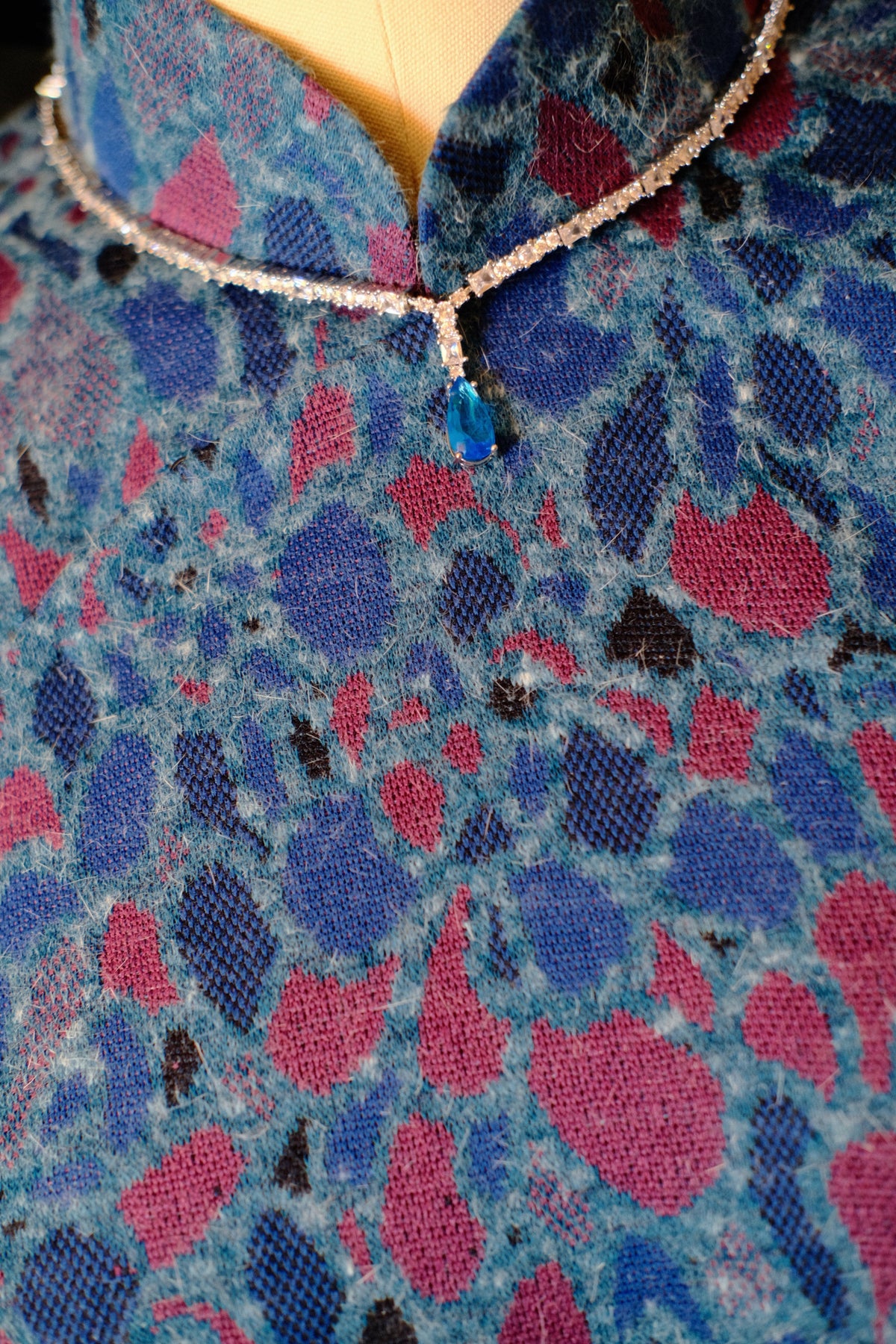
细看其表,面料表面有一层细腻的绒毛感(Napped finish),这是当时高档粗花呢(Tweed)或法兰绒(Flannel)常见的后整理工艺。这种工艺不仅增加了保暖性,更让那抹深邃的宝蓝与跳跃的玫红在光影下呈现出一种油画般的朦胧质感,宛如莫奈笔下的睡莲池,抽象而迷离。
【版型与剪裁:西风东渐的立体美学】
从服装史的角度审视,这件旗袍是“海派剪裁”向“港式立体剪裁”过渡的教科书级范例。
不同于传统平面剪裁的宽松,60年代的香港旗袍深受西方Dior“New Look”余韵及Balenciaga建筑感廓形的影响。请注意其肩部线条,采用了西式的装袖(Set-in Sleeve)工艺,肩头圆润挺立,完美修饰了东方女性较为溜肩的体态。
腰身的收省(Darts)极为精准,甚至可能使用了西式连衣裙的公主线分割逻辑,将女性的S型曲线勾勒得淋漓尽致,却又含蓄得体。这种“紧身而不紧绷”的功力,非十年以上经验的红帮裁缝或香港本土名师不能为。领口虽保留了传统立领的韵味,但高度已适度降低,更符合当时职业女性出入写字楼与社交场的实用需求。
【纹样与配色:抽象表现主义的东方转译】
衣身上的纹样,绝非传统的牡丹凤凰,而是极具现代感的抽象几何碎花。这种设计语言深受50-60年代西方抽象表现主义艺术的影响。深蓝为底,象征沉稳与理智;紫红斑点如夜空烟火,打破了沉闷。这种配色在当时被称为“太空时代”前的前卫色调,既有着维多利亚时期的复古浪漫,又预示着波普艺术的到来。它不属于任何一个具体的朝代,它只属于那个渴望突破、拥抱现代的六十年代。
【配饰点睛:网纱礼帽下的名伶梦】
与之搭配的同色系网纱礼帽,是整套造型的灵魂所在。在60年代的香港上流社会或高级职员圈层,出席正式场合必戴帽饰。这顶帽子采用了轻盈的硬网纱,点缀着细闪的亮片与羽毛装饰,不仅呼应了旗袍的色调,更在视觉上拉高了重心,增添了一份好莱坞电影般的戏剧张力。颈间那一抹蓝宝石吊坠项链,更是神来之笔,它压住了领口的空旷,如同画龙点睛,锁住了那份属于旧时代的贵气。
【结语:穿在身上的文学】
这不仅是一件御寒的衣物,更是一座微型的博物馆。它记录了意大利纺织工业的辉煌,见证了香港裁缝技艺的巅峰,也承载了一位女性在半个多世纪前对美与自由的追求。
当我们凝视这件旗袍,仿佛能听到留声机里周璇的歌声渐行渐远,取而代之的是节奏明快的爵士乐。它是流动的雕塑,是穿在身上的文学,是那段流金岁月留给后世最温柔的遗产。
【收藏建议】
鉴于羊毛羊绒混纺面料的特性,建议恒温恒湿保存,避免阳光直射导致那抹迷人的宝蓝褪色。这不仅是对文物的尊重,更是对那份跨越时空之美的呵护。
Eileen Chang once observed: "To those who cannot speak, clothes are a language—a pocket drama carried on one's person."
This blue Qipao standing quietly on the mannequin is precisely a one-act play celebrating the elegance and style of 1960s Hong Kong. Unlike the gentle, understated restraint of 1930s Shanghai-style Qipao, nor as outwardly provocative as contemporary fast fashion, it rests at that wondrous intersection of old meeting new and East meeting West—the "Golden Age" of Hong Kong costume history, folded into the rising consciousness of the modern woman.
To touch it is to feel clouds; to hold it is to feel warmth. The true luxury of this garment resides in the provenance of its material—research identifies it as a classic 1960s imported Italian wool-cashmere blend.
During that era, Hong Kong served as a free port assembling the world’s finest textile resources. The Italian wool industry was globally renowned for its exquisite fulling and finishing techniques; this blend preserves the structured framework of virgin wool while incorporating the soft, inviting tactile quality of cashmere.
Inspecting the surface reveals a fine napped finish—a finishing technique common to high-grade tweeds and flannels of the decade. Beyond adding insulation, this process allows the deep royal blue and vibrant magenta to present an oil-painting-like hazy depth under light, evoking the abstract, dreamlike quality of Monet’s water lily ponds.
Viewed through the lens of fashion history, this Qipao is a textbook example of the transition from traditional "Haipai flat cutting" to "Hong Kong-style structural tailoring."
Departing from the looser fit of traditional two-dimensional cutting, 1960s Hong Kong Qipao were deeply influenced by the lingering resonance of Dior’s "New Look" and Balenciaga’s architectural silhouettes. Note the shoulder construction: it adopts a Western set-in sleeve technique, rounding and structuring the shoulder line to perfectly refine the sloping shoulders common among Eastern women.
The waist darting is executed with extreme precision, likely borrowing the princess-line partitioning logic of Western dresses to highlight a woman's feminine S-curve while remaining entirely decorous and understated. This mastery of "fitted without being restrictive" could only come from master tailors with decades of specialized experience. While the collar retains the poise of a traditional stand collar, its height has been thoughtfully lowered to suit the practical demands of working women navigating office towers and social receptions.
The print across the body shuns traditional peonies or phoenixes in favor of highly modern, abstract geometric florals. This design language draws inspiration from 1950s and 1960s Western Abstract Expressionism.
The deep blue ground symbolizes poise and intellect, while scatterings of magenta act like fireworks in the night sky, breaking any visual monotony. Considered avant-garde colors during the dawn of the "Space Age," this palette captures both Victorian retro-romanticism and the forthcoming arrival of Pop Art. It belongs to no single historical dynasty, but rather to the 1960s—an era eager for breakthroughs and embracing modernity.
The color-matched netted fascinator hat serves as the defining soul of the ensemble. Among high society and executive circles in 1960s Hong Kong, headwear was essential for formal occasions. Crafted from lightweight stiffened netting and accented with subtle sequins and feather trims, the hat echoes the tones of the Qipao while visually elevating the wearer's height and adding a layer of Hollywood cinematic drama.
The sapphire pendant necklace resting at the throat is a masterstroke: it fills the negative space of the neckline, anchoring the quiet nobility of a bygone era.
This is far more than a garment to ward off the cold; it is a miniature museum. It records the peak of the Italian textile industry, bears witness to the golden era of Hong Kong tailoring mastery, and carries a mid-century woman's pursuit of beauty and self-expression.
Gazing upon this Qipao, one can almost hear the voices of old Shanghai gramophone songs fading into the distance, replaced by the lively rhythms of jazz. It is a fluid sculpture, wearable literature, and the most gentle legacy left behind by a golden era.
Given the nature of the wool-cashmere blend, it is recommended to store this piece in a climate-controlled environment with stable temperature and humidity, avoiding direct sunlight to prevent fading of the royal blue hue. This honors not only the garment as a historical artifact, but also preserves a timeless beauty that spans across eras.