深圳溯源
无法加载取货服务可用情况
衣服尺寸:
胸围/腰围/臀围:// 厘米
衣长: 厘米
细节描述:
【图案赏析:抽象写意与暗纹肌理的交响】
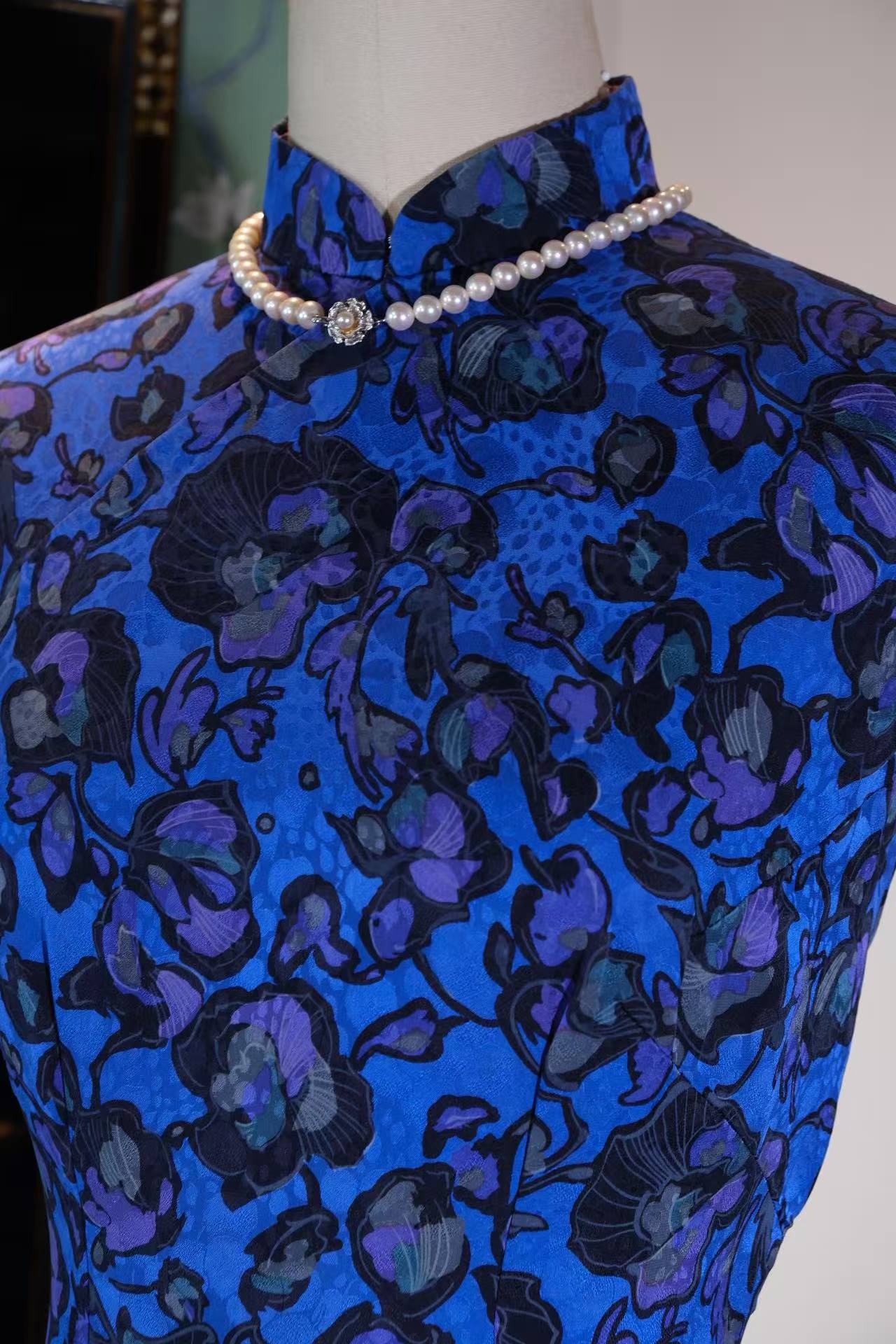
这件旗袍的面料堪称上世纪六十年代纺织工艺的“视觉诗篇”。底色选用了极具现代感的电光蓝(Electric Blue),这种高饱和度的蓝色在当时深受西方波普艺术影响,却又被东方审美巧妙驯化。
其上并非传统的具象工笔花卉,而是采用了当时极为前卫的“抽象印花”技法。紫罗兰色与深靛青色的花朵形态解构重组,似兰非兰,似荷非荷,呈现出一种印象派的光影流动感。更为精妙的是面料底层的“暗纹织花”工艺——在平视时隐约可见的几何提花纹理,如同水波下的潜流,赋予了平面印花以立体的触感与层次。这种“表里不一”的复杂工艺,正是那个年代香港纺织业追求极致奢华与创新的缩影。
【形制考证:西风东渐下的黄金剪裁】
从服装史的角度审视,这件旗袍是典型的“海派余韵,港式新风”。
- 无袖削肩设计: 不同于传统旗袍的连袖或短袖,这种完全露出肩臂线条的削肩剪裁,大胆地吸收了西方晚礼服(Evening Gown)的结构语言,旨在展示女性优美的肩颈曲线,是六十年代女性解放思潮在服饰上的直接投射。
- 立体省道与拉链: 观察其腰部的收省(Darts)极其精准,这标志着旗袍已从传统的平面裁剪彻底转向西式立体裁剪。配合侧边的隐形拉链,使得衣身如第二层肌肤般贴合,勾勒出那个时代推崇的沙漏型身材。
【历史回响:香江岁月的穿针引线】
张爱玲曾言:“对于不会说话的人,衣服是一种语言,随身带着的是袖珍戏剧。”这件旗袍,便是一出关于六十年代香港的无声戏剧。
彼时的香港,正处于东西方文化剧烈碰撞与融合的熔炉期。它既保留了老上海的精致与矜持,又吸纳了伦敦与纽约的现代与前卫。这件旗袍极有可能出自当年中环或尖沙咀某位名师裁缝之手。在那个没有流水线生产的年代,每一寸布料都经过挑选,每一道滚边都凝聚着匠人的体温。它或许曾陪伴一位名媛出席过半岛酒店的舞会,或许曾在某个微雨的黄昏,穿过熙攘的弥敦道。它是那个“流金岁月”的实物见证,记录了华人女性在现代化进程中,对自我身份与美的重新定义。
【稀缺性综述:不可复制的时代孤品】
在古董衣收藏界,六十年代的香港旗袍之所以珍贵,在于其“过渡性”与“绝版性”。
- 面料的不可再生: 这种结合了复杂暗纹提花与现代感抽象印花的人造丝或混纺面料,随着化工染料的迭代和织机的更新,早已停产。如今的数码印花虽能模仿其形,却难复刻其神韵与那种特有的岁月光泽。
- 工艺的断代: 这种极致的收腰与归拔工艺,需要极高的手工技巧。随着成衣工业的崛起,这种为单一个体量身定制的精细度已近乎失传。
正如《诗经》所云:“青青子衿,悠悠我心。”这件蓝底紫花的旗袍,不仅是一件衣物,更是一段被封存的时光。它以其独特的艺术风格和不可再生的稀缺性,静默地诉说着那个风华绝代的年代。拥有它,便是拥有了一段触手可及的历史。
Measurements / Size Guide:
Bust / Waist / Hips: / / cm
Total Length: cm
Detailed Description:
The textile of this qipao acts as a breathtaking visual poem charting the progressive heights of 1960s textile engineering. The foundational canvas is saturated in a highly contemporary electric blue. Driven by the global explosion of Western Pop Art, this hyper-saturated hue was masterfully civilized here by the disciplined restraint of an Eastern aesthetic.
Departing from literal, fine-line imperial botanical brushwork, the dress proudly embraces the avant-garde spirit of mid-century abstract printing. Violet and deep indigo-cyan floral structures are deconstructed and fluidly reassembled—resembling neither pure orchid nor literal lotus—to evoke the shifting light and shadow of an Impressionist landscape.
The definitive triumph of this yardage, however, resides in the subterranean layers of its construction: a meticulous hidden-weave jacquard base. When viewed head-on, faint geometric jacquard textures surface across the cloth like undercurrents beneath a still water plane, gifting the superficial abstract print a structural, three-dimensional tactile depth. This complex, multi-layered architecture is the ultimate material reflection of a mid-century Hong Kong textile industry fiercely obsessed with luxury and technical innovation.
Examined through the rigorous framework of costume history, this piece stands as a textbook example of Haipai (Shanghai-style) legacy cross-pollinating with modern Hong Kong design:
The Sleeveless Cut-Away Shoulder: Moving away from traditional extended grown-on caps or standard short sleeves, this silhouette introduces a dramatic cut-away sleeveless architecture. It boldly absorbs the structural vocabulary of Western mid-century evening gowns (Evening Gown), explicitly engineering a framework to showcase the natural, sweeping lines of the female shoulder and collarbone—a direct physical manifestation of the 1960s global women's liberation movement.
The Integration of Western Darting: The distribution of the structural bust and waist darts (se省) is flawlessly calculated against the body. This marks the absolute transition of the qipao away from two-dimensional, rectilinear ancestral drafting into the realm of Western three-dimensional anatomy. Working in absolute synchronization with a clean side-zipper closure, the textile functions like a second skin, contouring a highly sculpted hourglass silhouette.
As Eileen Chang famously noted in her seminal costume sociology text A Chronicle of Changing Clothes, "To those who cannot speak, clothing is a form of speech; it carries with it a pocket-sized drama." This electric-blue qipao operates as precisely that—a silent, wearable theater archiving 1960s Hong Kong.
During this mid-century chapter, Hong Kong functioned as a vibrant cultural crucible. It guarded the immaculate refinement and aristocratic poise of old Shanghai's high society while eagerly absorbing the avant-garde modernity radiating from London and New York. This specific garment was almost certainly born within the prestigious atelier of a master tailor operating in Central or Tsim Sha Tsui. In an era completely untouched by high-speed industrial mass assembly, every millimeter of textile was chosen by hand, and every seam absorbed the unique touch of the artisan.
One can easily visualize this piece drifting through an ambient evening gala at the Peninsula Hotel, or cutting through a misty twilight along the neon corridors of Nathan Road. It stands as a physical monument to a golden era, documenting a generation of Chinese women fiercely redefining their autonomy, modern identity, and personal aesthetic code.
Within the global connoisseurship community, 1960s Hong Kong-manufactured qipaos occupy a status of extreme scarcity due to their position at a critical sociopolitical and technological crossroads:
The Extinction of Mid-Century Synthetics: This specific union of complex geometric base jacquard with a bold, painterly abstract overlay was achieved using mid-century rayons and specialized industrial blends. Due to subsequent overhauls in chemical dye regulations and the total replacement of traditional low-speed looms with high-speed digital printers, textiles of this exact caliber have vanished from global production. Contemporary digital print reproductions can mechanically mimic the layout, but they completely lack the weight, internal structural refraction, and organic vintage sheen of the archival cloth.
The Loss of Bespoke Infrastructure: Achieving this extreme level of high-waisted ergonomic contouring required specialized ironwork manipulation (gui-ba stretching and shrinking techniques). Following the post-war rise of industrial ready-to-wear manufacturing, the meticulous craftsmanship required to custom-mold a textile to a single individual's anatomy has largely entered the realm of a lost art.
The Book of Songs (Shijing) beautifully muses: "Blue is the collar of your robe, deep is the longing in my heart." This electric-blue and violet-blossomed qipao is far more than an article of dress; it is a segment of history preserved in amber. With its commanding visual tension and irreplaceable scarcity, it stands as an unvoiced, tactile monument to a magnificent generation. To hold it is to look directly into the deep, unblemished history of elegance.