溯源
无法加载取货服务可用情况
一、 时代回眸:摇曳六十年代与意式美学的崛起
时光倒流至上世纪六十年代,那是一个在战后经济复苏中迎来文化大爆炸的“摇摆年代”(The Swinging Sixties)。如果说五十年代的时尚是巴黎高级定制(Haute Couture)的绝对统治,那么六十年代则是意大利制造(Made in Italy)异军突起的黄金期。
彼时,随着皮蒂宫(Palazzo Pitti)秀场的声名鹊起以及米兰时装周的成熟,意大利时尚界打破了法式的传统束缚。不同于巴黎的严苛与繁复,意大利设计师们——如艾米里奥·普奇(Emilio Pucci)等——开始将地中海的明媚色彩、古典艺术的浪漫以及现代工业的便捷相结合,推崇一种“松弛的优雅”。这种美学既保留了欧洲宫廷的华贵底蕴,又注入了战后新女性追求自由、打破阶级界限的现代精神。这件时装裙,正是那个新旧交替、东西方审美激烈碰撞与完美融合时代的绝佳见证。
二、 华服鉴古:形制、面料与剪裁的三重奏
1. 织金提花:流动的光影与贵气的肌理
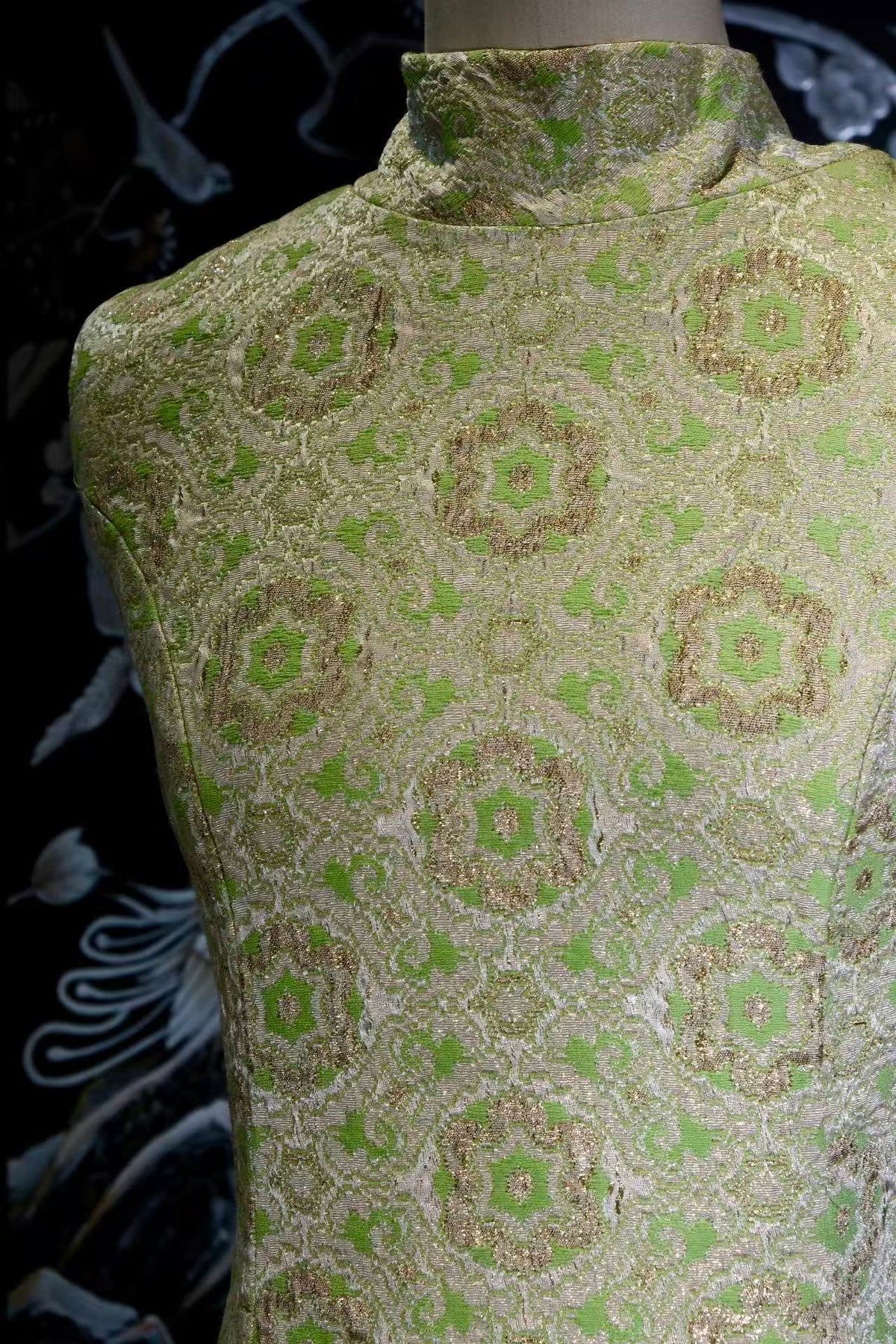
此裙最令人惊艳之处,在于其面料。这是一件典型的意大利进口织金提花(Gold Lurex Brocade)时装。在灯光下,面料表面的暗纹与织入的金属金线交相辉映,宛如水波流转。这种工艺源自欧洲古老的织锦传统,但在六十年代,意大利工坊将其与合成纤维(Lurex)创新结合,使得衣物不仅保有古典织物的挺括与奢华,更增添了现代主义的金属光泽与轻盈质感。衣身上的宝相花纹与几何图形交织,金绿相间,既有文艺复兴时期的繁复图腾感,又有波普艺术的装饰趣味,富贵而不艳俗,清新中暗藏贵气。
2. 东方气韵:中式立领与西剪裁的跨文化对话
从形制上看,这件裙子展现了一次跨越半个地球的审美交融。
裙身采用了中式旗袍中经典的小立领(Mandarin Collar)设计。领口不高不低,刚好贴合颈部,不仅起到了修饰天鹅颈的视觉效果,更赋予了穿着者一种含蓄、内敛的东方书卷气。然而,它并未采用传统旗袍的侧开衩与贴身曲线,而是结合了当时风靡西方的无袖箱型/微A字廓形。这种“去性感化”的剪裁,摒弃了紧身衣的束缚,让裙摆在行走间自然微张,既端庄得体,又充满了六十年代特有的青春与活泼。它完美诠释了当时西方设计师对“东方主义”的浪漫想象——不是简单的符号堆砌,而是对东方“气韵生动”的精准捕捉与现代化重塑。
三、 文心雕龙:穿在身上的诗意与风骨
若要用一句中国古诗词来形容此裙,非《诗经·小雅》中的“有匪君子,如金如锡,如圭如璧”莫属,亦或借用温庭筠《菩萨蛮》中“照花前后镜,花面交相映”的绮丽意象。
翠绿色,在中国传统色谱中名为“碧”或“黛”,它是“一陂春水绕花身”的灵动,也是“客舍青青柳色新”的清新。而这抹翠色之上,金色的织线如秋日暖阳洒在碧波之上,泛着粼粼波光。它不像正红那般咄咄逼人,也不似纯黑那般深沉肃穆,它带有一种“和而不同”的温润与包容。
穿上这件裙子,仿佛能看到一位从六十年代意大利社交季走出的现代女性:她受过良好的教育,或许刚看完一场歌剧,手里端着鸡尾酒,眼神里既有古典贵族的从容,又有新时代女性的独立与自信。这件衣服不仅仅是一件蔽体的织物,它是一段凝固的岁月,是那个充满活力、崇尚自由与创造力的年代的缩影。
结语:
历经半个多世纪的岁月洗礼,这件意大利织金提花时装裙依旧光彩照人。它不仅是一件高级复古时装,更是一件值得珍藏的艺术品。它以其独特的翠色与流金,在现代生活中为我们留存了一份永不褪色的优雅与诗意。
Rolling back the hands of time to the 1960s, we encounter "The Swinging Sixties"—an extraordinary era of cultural explosion born amidst post-war economic recovery. If the 1950s belonged to the absolute dominion of Parisian haute couture, the 1960s marked the golden age of the "Made in Italy" uprising.
At that time, propelled by the rising prominence of the Palazzo Pitti runways and the maturation of Milan Fashion Week, the Italian fashion sphere broke free from traditional French strictures. Eschewing the rigorous, elaborate constraints of Paris, Italian designers—such as Emilio Pucci—pioneered a "relaxed elegance" that fused Mediterranean brilliant color, classical artistic romanticism, and the pragmatic conveniences of modern industry. This aesthetic preserved the lavish heritage of European royal courts while injecting the modern ethos of post-war women striving for liberation and the dissolution of class boundaries. This gown stands as a magnificent testament to that era of transition and cross-cultural synthesis.
The most arresting attribute of this gown resides in its textile composition: a quintessential imported Italian gold-lurex brocade (Gold Lurex Brocade). Under the play of light, the understated damask patterns woven into the ground intersect with metallic gold threads to ripple like running water. This technique descends from ancient European weaving traditions, yet in the 1960s, Italian ateliers innovatively fused it with synthetic metallic fibers (Lurex), endowing the fabric with the crisp opulence of classical textiles alongside modern metallic luster and featherlight aeration. Interweaving floral roundels (Bao-xiang Hua) with geometric motifs in shimmering green and gold, the fabric balances Renaissance-inspired intricate ornamentation with Pop Art decorative verve—opulent without vulgarity, breathing freshness infused with patrician depth.
Structurally, this garment articulates an aesthetic convergence spanning half a globe. The bodice adopts the classic Chinese mandarin collar (Mandarin Collar). Resting at an optimal height against the throat, it not only refines the visual line of a swan-like neck, but imbues the wearer with an understated, introverted scholarly grace. Yet, bypassing the traditional side slits and skin-tight curvature of the conventional Qipao, it incorporates the sleeveless boxy/micro-A-line silhouette that swept the West during that decade. This "de-sexualized" cut discards the bondage of restrictive corsetry, allowing the skirt to flare gently with every stride—simultaneously decorous and vibrant with the youthful energy characteristic of the 1960s. It perfectly captures Western designers' romanticized imagination of "Orientalism": not a superficial stacking of symbols, but a precise capture and modern reimagining of the Eastern spirit of "vital breath and dynamic resonance."
If a classical Chinese verse were summoned to evoke this gown, one might invoke lines from the Classic of Poetry (Xiaoya): "Ah, that gentleman, bright as gold, lustrous as tin, pure as a scepter of jade." Alternatively, one might borrow the lush imagery from Wen Tingyun's Pu Sa Man: "Before and after the flower-matching mirrors, the flower-like face and blossoms reflect one another."
Emerald green, designated within traditional Chinese color nomenclature as bi (jasper) or dai (deep green), captures both the lively ripple of "a stretch of spring water winding around floral banks" and the vibrant clarity of "guest-house willows newly tinged with green." Across this expanse of emerald, golden woven threads scatter like autumn sunlight dancing across jade waters, casting shimmering refractions. Neither aggressively assertive like true crimson nor sombrely solemn like pure black, it projects an inclusive, gentle warmth defined by "harmony without uniformity."
Slipping into this dress evokes the image of a modern woman stepping out from a 1960s Italian social season: highly educated, perhaps fresh from an evening at the opera holding a cocktail glass, her gaze marrying the composed poise of classical aristocracy with the independent self-assurance of a new era. This creation transcends mere apparel designed for utility; it is a solidified capsule of time—an epitome of a vibrant epoch that revered freedom and creative reinvention.
Traversing over half a century of temporal tides, this Italian gold-lurex brocade dress retains its breathtaking radiance. Far more than a piece of vintage couture, it stands as a collectible work of art. Through its unique emerald hues and flowing gold, it preserves an unfading elegance and poetic resonance for our modern lives.