深圳溯源
无法加载取货服务可用情况
衣服尺寸:
胸围/腰围/臀围:86/70/100 厘米
衣长:108 厘米
细节描述:
这件上世纪四十年代末的巴黎缎大陆产古董旗袍,是海派文化鼎盛时期中西合璧审美与精湛工艺的结晶。它不仅是一件服饰,更是一段流动的历史,承载着那个时代女性的风骨与摩登精神。
图案解析:传统吉祥纹样的现代转译
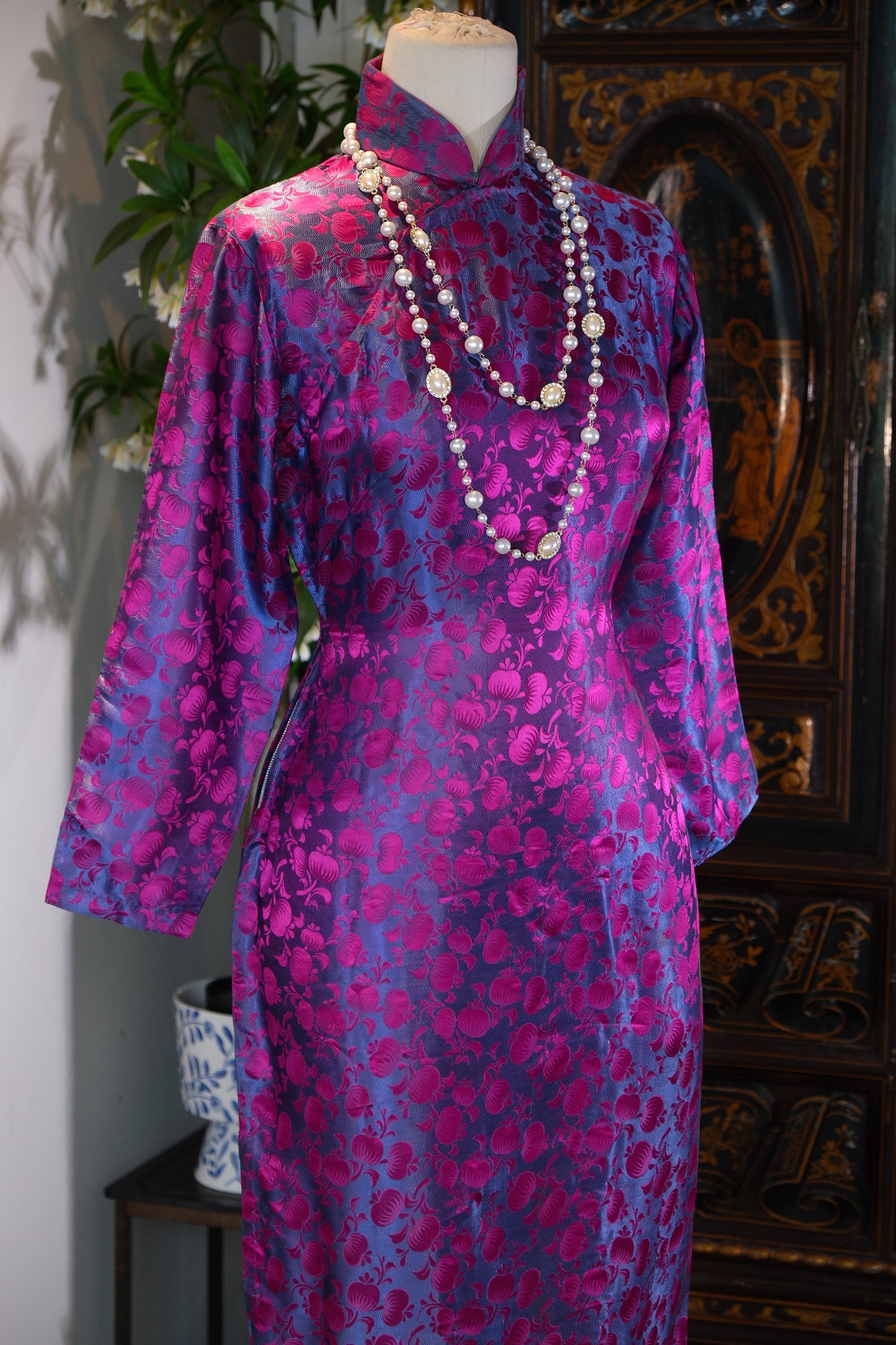
旗袍面料上的图案并非简单的花卉堆砌,而是经过精心设计的“簇叶纹样”变体。这种纹样在20世纪30-40年代的传世旗袍中极为流行,其特点在于将中国传统吉祥题材以西方艺术手法重新演绎。图中可见,粉紫色的果实或花苞状图案密集排列,形态饱满圆润,带有明显的立体明暗法处理,这与当时受印象主义、后印象主义影响的织物设计潮流一脉相承。这种“西化表现”既保留了东方“多子多福”、“富贵满堂”的吉祥寓意,又通过点彩与光影的运用,赋予图案一种现代的、近乎油画般的质感,是“五彩彰施”时代精神的绝佳体现。
历史故事:乱世中的优雅宣言
这件旗袍诞生于1940年代末,正值中国社会剧烈动荡之际。然而,正是在这样的背景下,上海作为“东方巴黎”,其时尚产业却迎来了最后的辉煌。彼时,明星名媛如胡蝶、周璇等成为时装的“带货女王”,她们在银幕内外穿着各式旗袍,引领着都市女性的审美风尚。据1947年《女声》杂志记载,即便是宋庆龄这样的政治人物,也在中秋游园会上更换不同花色的长旗袍,足见旗袍在当时社会生活中的重要地位。这件旗袍的主人,或许是一位在乱世中依然保持精致生活的知识女性或社交名媛,她选择这样一件色彩浓烈、图案繁复的旗袍,不仅是对美的追求,更是一种在动荡岁月中坚守自我、彰显生命力的无声宣言。
艺术风格与稀缺性:不可复制的时代孤品
从艺术风格上看,这件旗袍完美融合了东方的含蓄与西方的张扬。其立领、斜襟等传统元素,与西式立体剪裁(如胸省)相结合,使服装既贴合人体曲线,又不失端庄典雅。面料选用的是当时极为珍贵的“巴黎缎”,这种缎面光泽柔和、质地细腻,是富家千金嫁衣内衬或教堂婚礼头纱的首选,本身就象征着尊贵与神圣。而其图案的复杂程度与色彩的饱和度,更是当时机械印染技术所能达到的巅峰之作。如今,这类保存完好、品相上乘的古董旗袍已属凤毛麟角。正如收藏家金毅所言,要找回失落的技艺,必须从老物件入手。这件旗袍不仅是服装史的实物见证,更是研究20世纪中叶中国女性生活美学与社会变迁的珍贵文物,其艺术价值与历史价值无可估量。
Measurements / Size Guide:
Bust / Waist / Hips: 86/70/100 cm
Total Length: 108 cm
Detailed Description:
This artifact, an ancestral mainland-manufactured qipao from the late 1940s sculpted from premium Parisian satin (bali duan), serves as a peerless material monument to the cross-cultural aesthetics and sublime pattern-drafting that marked the absolute historical zenith of Haipai (Shanghai-style) culture. It functions far beyond the utility of standard dress; it operates as a fluid, living history, archiving the unyielding spirit, dignity, and cosmopolitan glamour of the women of that era.
The surface layout of this textile represents a highly calculated, sophisticated manifestation of the "cluster-foliage motif" (cuye wen) variant. Rather than a flat, superficial aggregation of standard botanical elements, this specific iconography reigned supreme across elite qipaos of the 1930s and 1940s, celebrated for translating classic Chinese auspicious themes through the rigorous lens of Western fine art execution.
As observed in the textile, the powder-violet fruits or swelling floral buds are densely arranged, presenting a plump and rounded form engineered with visible volumetric and chiaroscuro shading principles. This directly aligns with the mid-century textile design trends heavily influenced by Western Impressionism and Post-Impressionism. This Western stylistic interpretation elegantly preserves traditional Eastern allegories of abundance ("many sons, many blessings") and domestic fulfillment ("wealth and honor filling the hall"). Yet, through the deliberate deployment of pointillism, light, and shadow, it lifts the print into a modern, near oil-painted texture—standing as a definitive physical testament to the historic spirit of "radiant polychromatic display" (wucai zhangshi).
To accurately decode the structural soul of this qipao, its production coordinate must be evaluated against the profound social re-alignments of the late 1940s, a period marked by intense turbulence across Chinese society. However, it was precisely against this backdrop that Shanghai, celebrated as "The Paris of the East," experienced the final brilliant crescendo of its fashion industry.
During this era, silver-screen icons and high-society elite like Hu Die and Zhou Xuan operated as supreme trendsetters, utilizing their presence both on and off the screen to lead the aesthetic style of urban independent women. Historical records from a 1947 issue of Women’s Voice (Nü Sheng) magazine meticulously note that even prominent political figures like Soong Ching-ling would alternate between various heavily patterned full-length qipaos during Mid-Autumn garden assemblies, cementing the garment's vital status within the fabric of contemporary social life.
The original custodian of this artifact was undoubtedly a highly educated urban intellectual or prominent social diplomat who fiercely maintained an exquisite standard of living through turbulent historical shifts. Her choice of such an intensely saturated, visually commanding floral landscape represents far more than an appreciation for fine dress; it stands as a defiant, silent manifesto of personal autonomy, preserving dignity and celebrating an unthrottled life-force amidst a world in upheaval.
From the perspective of technical garment construction, this specimen achieves absolute equilibrium between Eastern linear modesty and Western post-war structural physics. Its traditional elements, such as the high mandarin collar and diagonal closure line (pajin), are cross-engineered with radical Western three-dimensional pattern darting (such as structural bust darts). This layout successfully maps the fabric flawlessly against the natural contours of the figure without losing its dignified, elegant poise.
The foundational textile is an immaculate, heavyweight Parisian satin (bali duan). Celebrated across the mid-century for its soft drape, liquid-smooth hand-feel, and quiet, low-refraction moonlit sheen, this specific luxury satin was historically reserved for elite bridal trousseaus, ancestral dowry linings, or sacred church wedding veils—permanently carrying an implicit cultural association with high sanctity and aristocratic prestige. Furthermore, the intense chromatic saturation and micro-precise overlay of the multi-register print boundaries capture the absolute technological ceiling of mechanical roller-printing and manual dye chemistry of that era.
In the contemporary global textile connoisseurship landscape, mid-century specimens that preserve their structural integrity, dye vibrancy, and material stability are extraordinary anomalies, now matching the scarcity of phoenix feathers and unicorn horns (fengmao lingjiao).
As the prominent costume historian and archival collector Jin Yi profoundly observed: "To fully resurrect and map a lost master technique, one must rigorously interrogate and learn directly from the physical ancestral objects themselves." This 1940s Parisian-satin masterpiece operates far beyond the boundaries of standard vintage dress; it stands as a primary material document, an invaluable sociological record tracing mid-century female aesthetics, and a timeless monument to global trade and cross-cultural art history whose cultural value remains completely immeasurable.