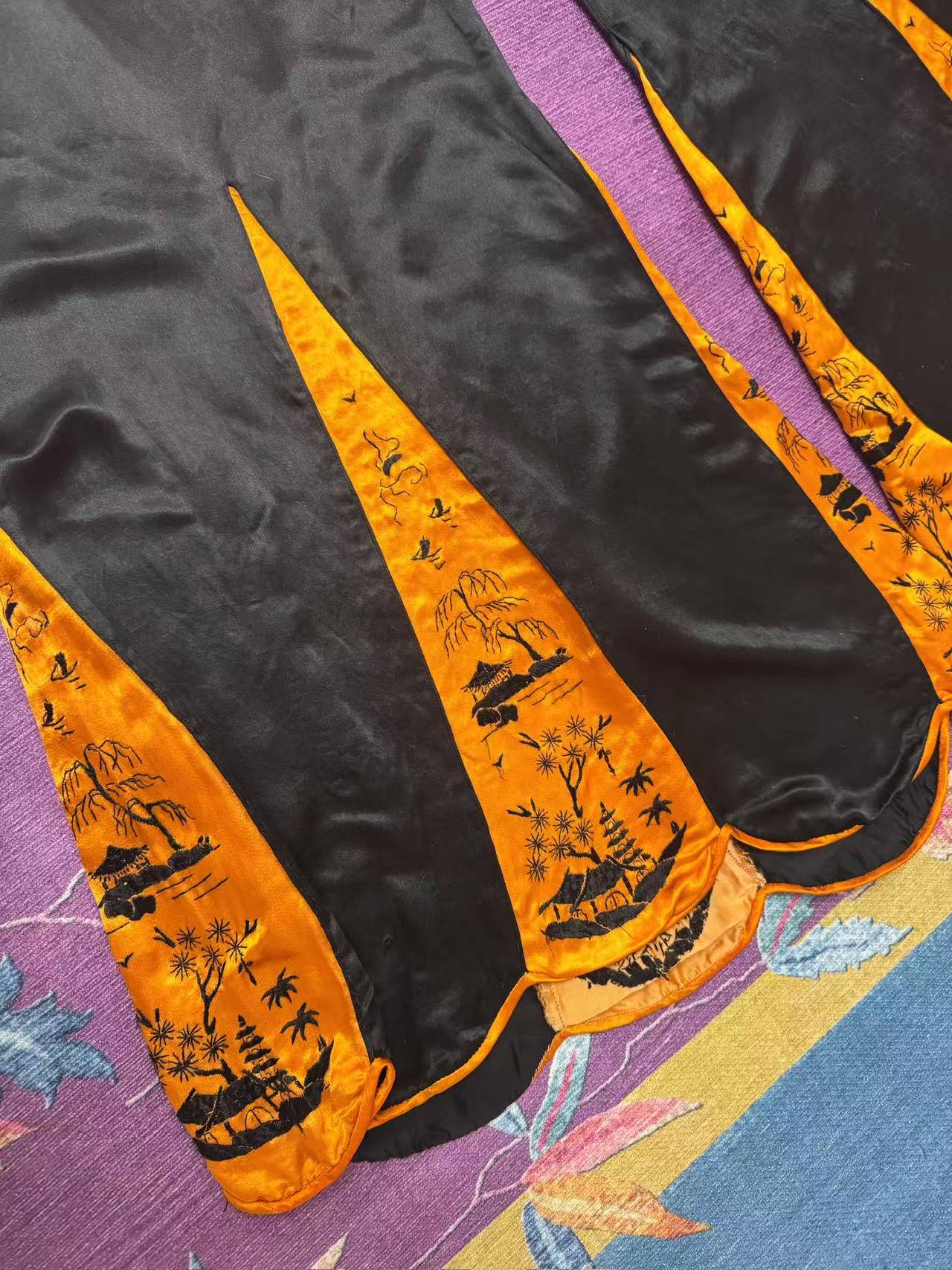
赤金夜话:民国廿年撞色真丝苏绣睡衣与心形暗语
一、衣上山水:真丝撞色的“视觉惊雷”
这套民国二十年代的真丝睡衣,以“赤金夜话”之姿,将Art Deco的撞色美学与东方苏绣的写意凝于经纬。上衣主体采用橙黄色真丝,经纬间闪烁着“赤金熔炉”的暖光;袖子与裤身则以深黑色真丝拼接,形成“冷暖交织”的视觉冲击——这种撞色设计,恰合1920年代西方“装饰艺术”的“大胆突破”精神,却又以东方真丝的温润中和了西方的张扬,成就了“刚柔并济”的造物哲学。
衣襟与裤脚的苏绣山水,以藏蓝色丝线绣成,每一针都需匠人以“劈丝分线”的绝技,将丝线劈为三十二分之一,方能绣出“远山如黛,近水含烟”的细腻。苏绣的针法借鉴了“平针”与“乱针绣”的结合,却又以“西方式构图”重构了传统山水的布局——亭台楼阁如“星子散落”,柳枝竹叶如“墨痕轻扫”,恰如《长物志》所言“宁古无时,宁朴无巧”。
二、心形暗语:睡衣上的“私密浪漫”
上衣左侧的心形图案,是这套睡衣的“点睛之笔”。心形以黑色丝线勾勒,内部填充橙黄色真丝,形成“外冷内暖”的对比,暗合“心有所属,情有所寄”的私密浪漫。这种心形图案,在1920年代的西方睡衣中极为罕见,却以“东方式含蓄”重构了西方的“直白示爱”——它不是张扬的告白,而是藏在睡衣上的“心形暗语”,唯有亲近之人方能读懂。
三、百年旧梦:从温哥华唐人街到蒙特利尔“赤金之夜”
这套睡衣的主人,正是前文所述加拿大“老钱”家族的闺秀。二十年代,她或许在蒙特利尔的“赤金之夜”中,以此睡衣搭配前文的刺绣晨袍惊艳四座:橙黄色真丝的暖光衬得她肤色胜雪,黑色苏绣的细腻如“山水入梦”,心形图案的私密如“情话低语”。
四、艺术孤品:跨文化的“衣冠孤本”
此睡衣的珍稀,在于它是“跨文化时尚”的活化石。全球存世的民国撞色真丝睡衣不足百件,而“橙黄真丝+黑色真丝+苏绣山水+心形图案”的组合,更是孤品中的孤品。撞色设计需西方设计师“以色为墨,以布为纸”的构图功夫,苏绣山水则需中国绣娘“以线为墨,以针为笔”的刺绣技艺,心形图案则需“跨文化浪漫”的创意灵感,三者结合,成就了“衣以载道”的跨文化杰作。
五、结语:穿在身上的“赤金夜话”
当指尖拂过衣襟的苏绣山水,仿佛能触摸到百年前蒙特利尔的“赤金之夜”——那是Art Deco的撞色美学,是东方苏绣的写意,是加拿大“老钱”家族在异域的浪漫与含蓄。这套睡衣,是“私密美学”的活化石,是百年时尚史的“衣冠孤本”。
Crimson Gold Night Talk: A Republic of China Year 20 (1930s) Color-Blocked Silk Suzhou-Embroidered Pajamas and Heart-Shaped Codes
I. Landscapes Upon the Garment: The "Visual Thunder" of Silk Color-Blocking
This silk pajama set from the 1920s and 1930s takes the posture of a "crimson gold night talk," condensing the color-blocking aesthetics of Art Deco and the freehand expression of Eastern Suzhou embroidery within its warp and weft. The main body of the top utilizes an orange-yellow silk, with a warm light of a "crimson gold furnace" shimmering through its threads; meanwhile, the sleeves and trousers are pieced with deep black silk, creating a visual impact of "interweaving warmth and cold." This color-blocked design perfectly aligns with the "bold breakthrough" spirit of Western decorative art in the 1920s, yet tempers Western flashiness through the gentle softness of Eastern silk, achieving a design philosophy of "strength tempered with gentleness."
The Suzhou-embroidered landscapes along the lapel and cuffs are crafted with navy blue silk threads. Each single stitch requires the artisan's supreme mastery of splitting silk threads into thirty-seconds to achieve a delicacy where "distant mountains appear like dark brows, and nearby waters seem enveloped in mist." The embroidery needlework draws inspiration from the combination of Suzhou embroidery's "satin stitch" and "random stitch embroidery," yet reconstructs the layout of traditional landscapes through "Western-style composition"—the pavilions and towers scattering like "falling stars," and the willow branches and bamboo leaves sweeping like "light ink strokes," precisely as The Treatise on Superfluous Things (Chang Wu Zhi) describes: "Rather antique than fashionable; rather simple than artful."
II. Heart-Shaped Codes: The "Private Romance" Upon Pajamas
The heart-shaped pattern on the left side of the top is the crowning touch of this pajama set. The heart is outlined with black silk thread and filled with orange-yellow silk, creating a contrast of "cold on the outside and warm on the inside," subtly echoing a private romance of "belonging to someone, with emotions safely placed." This heart-shaped motif was extremely rare in Western pajamas of the 1920s, yet it reconstructs Western "direct professions of love" through "Eastern implicitness"—it is not an ostentatious confession, but a hidden "heart-shaped code" upon the pajamas, readable only by those closest to the wearer.
III. Century-Old Dreams: From Vancouver's Chinatown to Montreal's "Crimson Gold Night"
The owner of this pajama set was precisely a lady from the aforementioned Canadian "old money" family. In the 1920s and 1930s, she might have stunned the crowd during a "Crimson Gold Night" in Montreal, pairing these pajamas with the previously mentioned embroidered morning gown: the warm glow of the orange-yellow silk making her skin appear as fair as snow, the delicacy of the black Suzhou embroidery appearing like "landscapes entering a dream," and the privacy of the heart-shaped motif evoking "soft whispers of love."
IV. Artistic Masterpiece: A Cross-Cultural "Unique Fashion Chronicle"
The rarity of these pajamas lies in their status as a living fossil of "cross-cultural fashion." Fewer than a hundred color-blocked silk pajamas from the Republic of China era survive worldwide, and the combination of "orange-yellow silk + black silk + Suzhou-embroidered landscapes + heart-shaped pattern" makes this a unique piece among unique pieces. The color-blocked design required the compositional skill of Western designers "using color as ink and fabric as paper"; the landscape embroidery required the embroidery skills of Chinese needlewomen "using thread as ink and the needle as a pen"; and the heart-shaped motif required the creative inspiration of "cross-cultural romance." The fusion of these three elements achieves a cross-cultural masterpiece where "the garment carries the culture."
V. Conclusion: "Crimson Gold Night Talk" Worn on the Body
When fingertips brush across the Suzhou-embroidered landscapes of the lapel, it feels as though one can touch the "Crimson Gold Night" of Montreal from a century ago—reflecting the color-blocking aesthetics of Art Deco, the freehand expression of Eastern Suzhou embroidery, and the romance and implicitness of a Canadian "old money" family in a foreign land. This pajama set is a living fossil of "private aesthetics" and a unique fashion chronicle in a century of fashion history.