溯源
无法加载取货服务可用情况
拂去岁月尘埃:名媛的远渡重洋与衣香鬓影
在近代服装史的版图中,若要论及“衣以载道,物以传情”的极致,张乐怡女士的旗袍收藏必是绕不开的丰碑。她不仅是民国金融巨擘宋子文的贤内助,更是那个时代“海派”与“国际”审美交汇的集大成者。
上世纪四五十年代,张乐怡女士随夫远渡重洋旅居美国。在异国他乡的岁月里,她不仅带去了东方的优雅,也将中式服饰的精致美学深深植根于西方的日常之中。这两件旗袍,正是她从美国回流、重现世人面前的至珍遗物。它们不仅是布料的堆叠,更是张乐怡女士在海外依然恪守的东方生活格调,是一位顶级名媛“行走在世界中央”的文化名片。
🎨 远渡重洋的艺术:意大利面料上的东方神韵
五十年代的香港,是东西方文化碰撞的最前沿。此时的旗袍剪裁已彻底告别了传统的平铺直叙,大胆吸收西式立体剪裁(如肩省、腰省),呈现出极致的“沙漏型”黄金比例。
这两件旗袍最令人惊叹之处,在于其面料的选择。在旅居美国期间,张乐怡女士并未局限于中国传统的丝绸印花,而是将目光投向了拥有顶级织染工艺的意大利。她选用了极具西方古典美学特色的“油画风格”真丝面料——
这种面料打破了传统水墨的晕染界限,其色彩的过渡如同油画般厚重、饱满且富有层次。将西方的油画艺术与东方的旗袍廓形完美结合,这种跨越国界的大胆尝试,在当时堪称前卫。它不仅展现了五十年代港式旗袍工艺的巅峰水准,更记录了民国名媛在西方世界依然引领风潮的审美自信。
🌿 一花一世界:名媛的双重生活画卷
张乐怡女士素以“素雅高洁”的品位著称,这两件旗袍虽同为绿色系,却折射出她旅居海外时截然不同却又和谐共生的心境。
1. 【草花微雨图】—— 烟雨江南,魂牵梦绕
这件旗袍以鲜活的草绿为底,间以白、墨、浅绿的自然晕染,宛如一幅印象派的草地写生。其花卉并非具象,而是一种“气韵”。
在旅美的张乐怡女士眼中,这或许不仅是意大利的面料,更是她心中那片魂牵梦绕的江南烟雨。白居易诗云:“乱花渐欲迷人眼,浅草才能没马蹄。”她身着此衣,立于异国的庭院之中,或许正借此寄托着对故土草木最深切的乡愁。这是一件“游子衣”,承载着东方的诗魂与故土的思念。
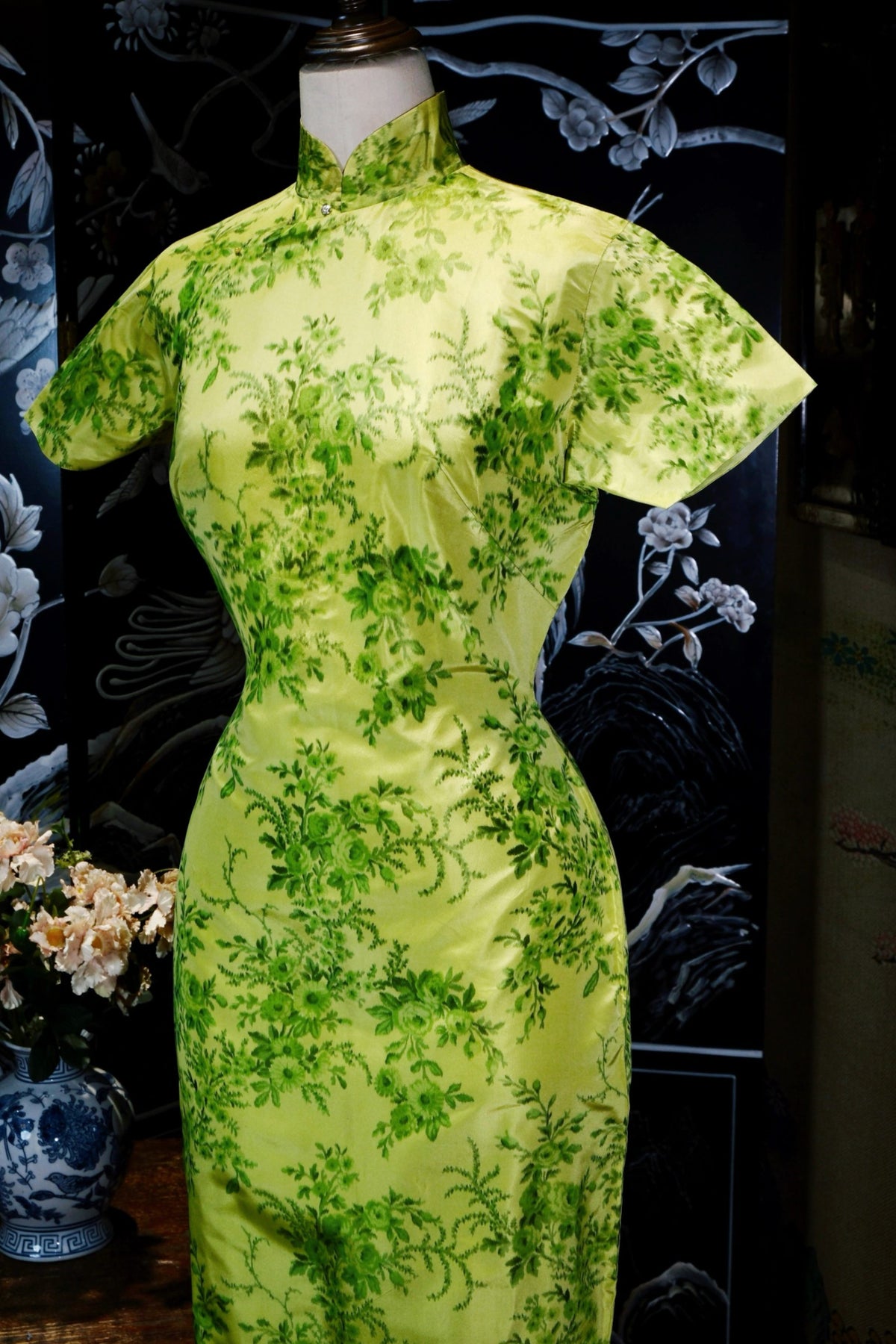
2. 【藤影摇香图】—— 蔷薇满架,名媛气度
另一件则以温润的鹅黄为底,缀以清晰规整的绿色蔷薇藤蔓。这种纹样带有明显的欧式“法式藤蔓”(Toile de Jouy)特征。
如果说第一件是内心的诗意,那么这一件则是她作为“宋氏家族代表”向世界展示的从容与体面。鹅黄是尊贵的底色,藤蔓则是蓬勃的生机。在异国他乡的社交场合,这件旗袍既符合西方人对自然与田园的向往,又通过旗袍的端庄剪裁,彰显了她作为东方女性的端庄与华贵。
【结语】
从民国到旅居美国,再到如今的回流重现,这两件旗袍经历了半个多世纪的风雨洗礼。它们是张乐怡女士私人品味的结晶,更是中国近现代服装史上一段“西风东渐、中西合璧”的鲜活物证。
今日我们凝望它们,不仅是在欣赏一件绝世华服,更是在与一位远渡重洋的民国名媛进行一场跨越时空的对话。
注明:每件1180加币
Brushing Away the Dust of Time: A Socialite's Transoceanic Journey Amidst Fragrant Robes and Shadowed Tresses
Within the landscape of modern costume history, when speaking of the supreme realization of "garments conveying the Way, and objects transmitting emotion," the Qipao collection of Madame Zhang Leyi (Zhang Leyi) stands as an inescapable monument. Not only was she the devoted consort of Republican-era financial titan T. V. Soong (Song Ziwen), she was also the ultimate synthesizer of that era's convergence between "Haipai" (Shanghainese) sophistication and international aesthetics.
During the 1940s and 1950s, Madame Zhang crossed the oceans to reside in the United States alongside her husband. Throughout her years in a foreign land, she not only carried Eastern elegance abroad, but rooted the refined aesthetics of Chinese dress deeply within Western daily life. These two Qipaos are treasured heirlooms from her American estate, newly returned to public view. Far more than mere assemblies of silk, they embody the Eastern lifestyle ethos Madame Zhang steadfastly upheld overseas—serving as the cultural calling card of a premier socialite "walking at the center of the world."
In the 1950s, Hong Kong stood at the forefront of East-West cultural collision. By this decade, Qipao tailoring had bid a decisive farewell to traditional flat, linear cuts, boldly absorbing Western three-dimensional construction—such as shoulder and waist darts—to achieve the ultimate golden proportions of the hourglass silhouette.
What makes these two Qipaos truly astonishing lies in their choice of textiles. While residing in the United States, Madame Zhang did not confine herself to traditional Chinese printed silks; instead, she turned her gaze toward Italy, renowned for its supreme weaving and dyeing mastery. She selected "oil-painting style" silk textiles imbued with Western classical aesthetics—fabrics that broke beyond the fluid wash boundaries of traditional ink painting, offering color transitions as rich, full-bodied, and layered as impasto oil on canvas.
Uniting Western oil-painting artistry with the Eastern Qipao silhouette was an audacious, avant-garde cross-cultural experiment for its time. It not only showcases the pinnacle of 1950s Hong Kong Qipao craftsmanship, but chronicles the aesthetic self-assurance of a Republican-era socialite who continued to set the standard of elegance in the Western world.
Long celebrated for her "understated, noble, and pure" taste, Madame Zhang left behind two Qipaos that—though both anchored in verdant hues—reflect contrasting yet harmoniously coexisting states of mind during her years abroad.
Tailored against a vibrant grass-green ground interspersed with natural washes of white, ink-black, and pale celadon, this Qipao resembles an Impressionist plein-air meadow study. Rather than figurative realism, its florals capture an ethereal essence (Qiyun).
Through the eyes of Madame Zhang in America, this was perhaps far more than Italian silk—it was the misty rain of Jiangnan forever lingering in her heart. As Bai Juyi wrote: "Wildflowers gradually dazzle the wandering eye; young grass barely rises high enough to cover a horse's hooves." Standing in a foreign courtyard clad in this robe, she may well have entrusted to it her deepest nostalgia for the flora of her homeland. It is a "traveler's garment," carrying an Eastern poetic soul and longing for native soil.
The second Qipao is set upon a warm goose-yellow ground adorned with crisp, orderly vines of green roses—a motif bearing distinct hallmarks of European pastoral toile (Toile de Jouy).
If the first piece embodies inward poetry, this second robe represents the composure and dignity she projected onto the world stage as a matriarch of the Soong family. Goose yellow provides a regal, aristocratic ground, while the trailing vines pulse with vigorous vitality. In international social salons, this Qipao harmonized effortlessly with Western affection for nature and pastoral grace, while asserting her stately elegance and nobility as an Eastern woman through the disciplined tailoring of the Qipao.
From the Republican era to life across the ocean in America, and finally returning home today, these two Qipaos have weathered more than half a century of history. They stand as the crystallization of Madame Zhang Leyi’s personal taste, and as living physical testimony to the "eastward sweep of Western winds and the fusion of East and West" in modern Chinese dress history.
Gazing upon them today, we are not merely admiring peerless couture—we are engaging in a dialogue across time and space with a legendary Republican-era socialite who carried the grace of China across the oceans.
Note: $1180 for each