深圳溯源
无法加载取货服务可用情况
一、面料:流动的液态黄金
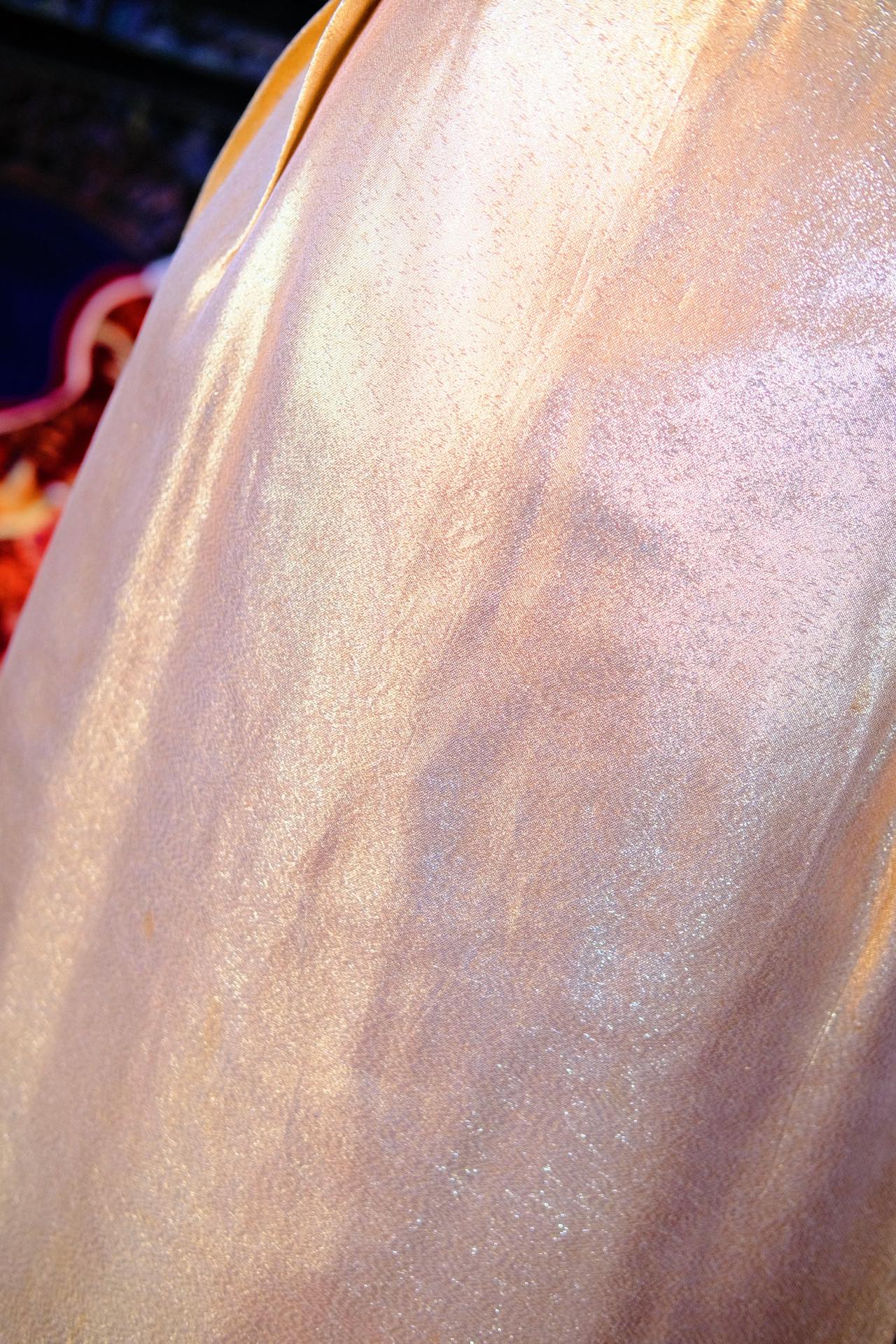
这件礼服的面料,是六十年代意大利进口的织金面料。
- 光泽:在灯光下,面料呈现出如同液态黄金般的流动光泽,
- 质感:织金面料的质地厚实而挺括,赋予了礼服极佳的廓形感,
二、形制:西方廓形与东方韵味的“跨界融合”
这件礼服采用无袖高腰大摆设计,
- 廓形:高腰设计拉长了腿部线条,
- 细节:礼服的背部采用深V设计,既增加了性感元素,
三、故事:Woo女士的“双城记”
这件礼服的主人Woo女士,是加拿大Super Store的老板之一,亦是六十年代“全球买手”的先驱。
- 在六十年代,像Woo女士这样的海外华商,每年必赴欧洲(
- 这件礼服就是这种生活方式的见证:
四、稀缺性:消逝的“港产高定”生态
如今这件礼服的珍贵,不仅在于面料与工艺,
- 六十年代的香港,曾有数百家旗袍工坊,师傅们以“一人一版”
The structural foundation of this evening gown resides in a premium gold-weft fabric imported from Italy during the 1960s. Diverging sharply from ordinary flat textiles, this material yields a luxurious, metallic luster governed entirely by the kinesis of the wearer:
The Luminous Glow: Under lighting, the textile matrix presents a fluid brilliance resembling liquid gold, shimmering with every movement of the body as if sunlight itself had been shattered and woven into the fabric. This exceptional sense of luster was extraordinarily precious within 1960s European haute couture, operating as a definitive symbol of wealth and social status.
Textural Structural Integrity: The heavy, dense gauge of the gold-weft fabric gives the gown an innate architectural crispness. It effortlessly commands its own spatial layout—holding a proud, stable contour that naturally suspends the flare of the skirt to showcase elegant curves. The production process for this textile was remarkably complex, requiring metallic gold or silver filaments to be intricately interlaced with fine silk threads, establishing it as an absolute zenith of mid-century European textile engineering.
The silhouette of the gown relies on a classic 1960s Western eveningwear framework—a clean, sleeveless high-waisted ballgown architecture—yet hides meticulous Eastern charm within its structural details:
The Volumetric Flare: The high-waisted engineering visually elongates the lines of the lower body, while the dramatic, expansive skirt infuses the silhouette with a definitive sense of ceremony and formal weight. This specific silhouette stood as the premier choice among elite European high-society women for attending formal presentations.
The Back and Front Counterpoint: The back of the gown features a striking deep V-cut, introducing a subtle hint of allure while establishing a sophisticated visual counterbalance against the high-neck symmetry of the front. This deliberate structural pairing—juxtaposing conservative front coverage with open back exposure—serves as the perfect material metaphor for the mid-century interception of global cultures: balancing a structured, understated Eastern composure with unapologetic Western openness.
The custodian of this artifact, Ms. Woo, operated as a co-director of a major Canadian enterprise, standing as a definitive visionary within the early network of global luxury textile procurement:
During the 1960s, elite international Chinese merchants made regular, calculated sourcing journeys across Europe (specifically targeting Italy and France) to secure the latest advanced fabric volumes. These precious materials were subsequently routed back to Hong Kong, where master tailors transformed the raw textiles into bespoke, custom silhouettes.
This evening gown stands as an absolute historical marker of that exact transoceanic lifestyle: the Italian gold-weft records the pinnacle of European material luxury; the precision-engineered construction tracks the absolute mastery of Hong Kong's artisan tailoring traditions; and its ultimate presentation within the executive landscapes of Canada highlights a profound narrative of identity. As the fashion historian Anne Hollander noted, "Dress is an extension of the body." Ms. Woo’s selection functions beautifully as a material expression of personal refinement and a concrete manifestation of cultural authority on the global stage.
The modern rarity of this evening gown extends far beyond its raw material worth or its complex optical performance; it stands as a pristine archive of a highly specialized, completely vanished sartorial ecosystem:
During the 1960s, Hong Kong’s custom apparel trade thrived across hundreds of master tailors who engineered garments based on a strict "one person, one pattern" blueprint philosophy, where senior artisans meticulously draped rare European imported fabrics to match individual anatomical requirements.
With the subsequent global ascension of mechanized, mass-market ready-to-wear production scales, this resource-heavy, time-intensive synthesis of European textile technology and custom Hong Kong craftsmanship permanently dissolved. The few surviving specimens left in existence operate now as precious historical monuments, recording the romance, industry, and uncompromising artistry of a golden era.