深圳溯源
无法加载取货服务可用情况
衣服尺寸:
胸围/腰围/臀围:84/66/94 厘米
衣长:105 厘米
细节描述:
图案与肌理:暗夜里的星河
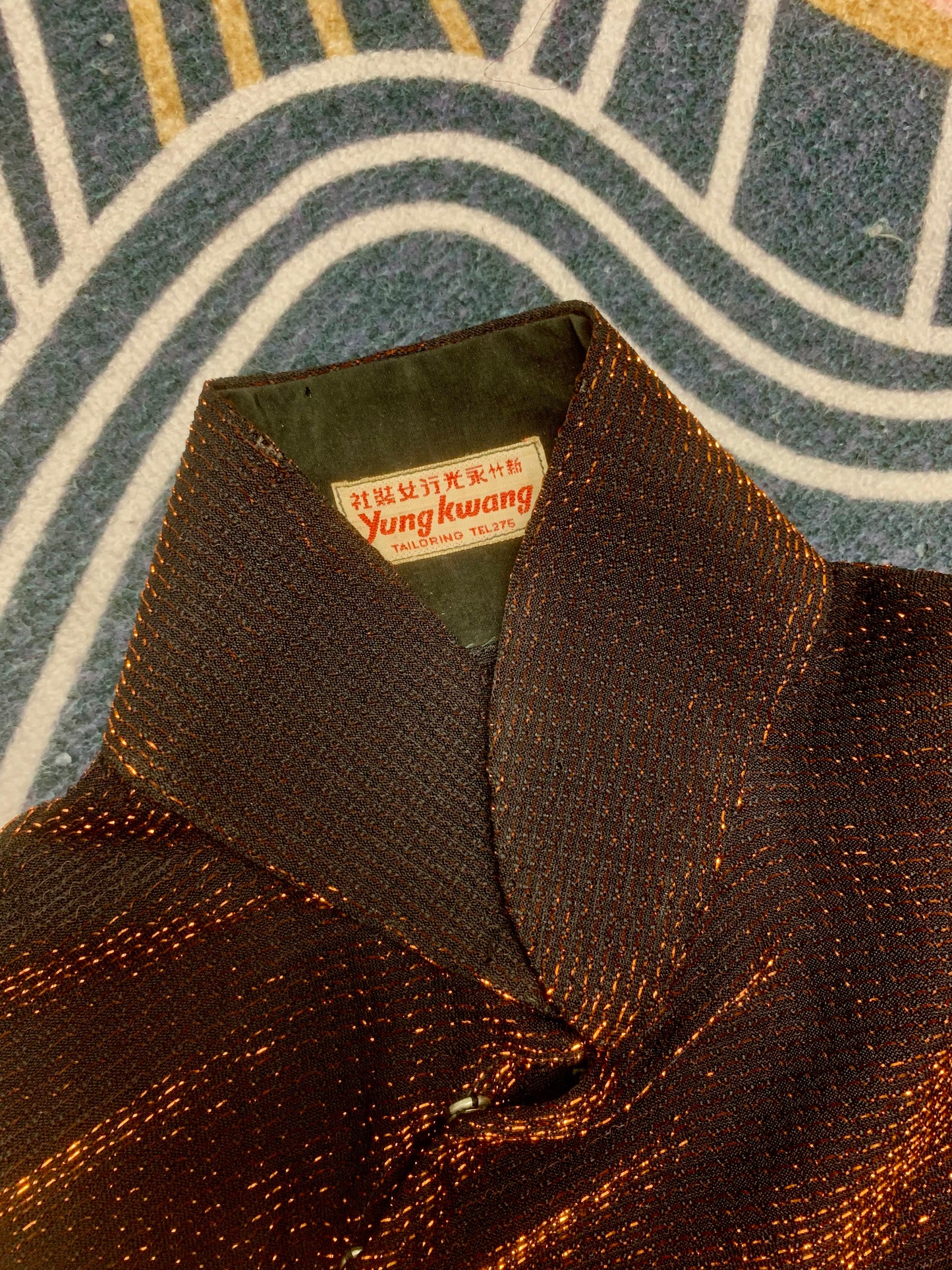
这件旗袍之美,初看是深沉的黑,细观则如夜幕降临,万千星辰悄然点亮。其面料并非寻常素缎,而是采用了上世纪六十年代台湾纺织业巅峰时期的特殊织造工艺——“织金”或称“闪丝”。
在黑色底纱的经纬之间,巧妙织入了极细的铜金或金葱丝线。这种工艺不同于大面积的铺金,而是以一种疏密有致的点状或短线状呈现。在静态时,它呈现出一种低调的磨砂质感,隐约透着幽暗的光泽;而当光线流转或人行走间,无数金点便如银河倾泻,熠熠生辉,仿佛将整片璀璨星空披于身上。这种“黑地闪金”的视觉效果,既保留了黑色的神秘与庄重,又增添了奢华与灵动,是那个时代对“摩登”二字最奢华的注解。
旗袍通体无繁复印花,全靠面料本身的肌理取胜。这种“以料代饰”的手法,正是高级定制中“少即是多”的东方哲学体现。
故事与溯源:新竹永光行的时代回响
衣领内侧,“新竹永光行女装社”的标签赫然在目。这不仅仅是一个商标,更是一枚时代的印章。
上世纪五六十年代,是台湾旗袍制作的黄金年代。随着历史变迁,许多上海的红帮裁缝与江浙的制衣好手迁往台湾,将海派旗袍的精髓带到了宝岛。新竹作为当时重要的文化与商业重镇,汇聚了众多技艺精湛的裁缝铺。永光行便是其中的佼佼者。
这件旗袍,或许曾属于一位新竹名门望族的夫人,或是某位归国华侨的晚宴盛装。在那个没有快时尚的年代,一件旗袍的诞生,从选料、量体、裁剪到缝制,往往需要数周甚至数月。它承载的不仅是蔽体的功能,更是一个女性对美的极致追求,以及一个家庭对体面生活的向往。
标签上的“TAILORING TEL.275”,那简短的号码,仿佛是通往半个世纪前繁华街景的密码。它让我们联想到那个年代新竹街头的裁缝铺,剪刀的咔嚓声、熨斗的蒸汽声,以及顾客试衣时的欢声笑语。这件旗袍,便是那段流金岁月的实物见证。
艺术与稀缺:东西交融的绝唱
从艺术风格来看,这件旗袍完美融合了东方的含蓄与西方的现代感。
其剪裁沿袭了海派旗袍的经典轮廓:高立领、收腰、开衩,强调女性的S型曲线,这是东方审美的核心。然而,其面料的选择——这种带有工业感的金属丝织物,却是受到当时西方现代主义思潮影响的产物。六十年代正值太空时代(Space Age)风格兴起,金属感面料在西方高级时装中备受推崇。这件台湾产旗袍,正是将这种国际潮流与本土传统工艺结合的典范,体现了那个时代台湾作为东西文化交汇点的独特地位。
其稀缺性不言而喻:
- 面料稀缺:此类织金面料在当时即属昂贵进口或特制材料,历经半个多世纪,保存完好且光泽依旧者,凤毛麟角。
- 工艺稀缺:永光行这样的老铺,其手工剪裁与缝制技艺,如今已难觅踪迹。机器化生产无法复制那种对人体曲线的精准把握与面料张力的微妙控制。
- 时代稀缺:它是冷战时期台湾经济起飞、文化繁荣的缩影,是海派文化在海外延续与发展的珍贵物证。
正如《长物志》所言:“随方制象,各有所宜。”这件旗袍,便是那个特定时代、特定地域、特定人群“所宜”之物。它不仅仅是一件衣服,更是一件流动的艺术品,一段被织物封存的记忆。
Measurements / Size Guide:
Bust / Waist / Hips: 84/66/94 cm
Total Length: 105 cm
Detailed Description:
The beauty of this cheongsam (qipao) appears as a profound black at first glance, but upon closer inspection, it reveals a night sky where thousands of stars are quietly lit. Its fabric is not an ordinary plain satin; instead, it employs a special weaving technique known as "Zhi-Jin" (gold weaving) or "Shan-Si" (shimmering silk), which represented the pinnacle of the Taiwanese textile industry in the 1960s.
Between the warp and weft of the black base gauze, extremely fine copper-gold or lamé threads are ingeniously interlaced. Unlike broad areas of gold plating, this craft presents the gold in a scattered, rhythmic arrangement of dots or short lines. In a static state, it exudes a low-key matte texture with a faint, somber luster. However, as light shifts or the wearer moves, countless golden points pour forth like the Milky Way, shimmering brilliantly as if a radiant starry sky has been draped over the body. This "gold-shimmer-on-black" visual effect preserves the mystery and solemnity of black while adding opulence and vitality—a most luxurious interpretation of the term "modern" for that era.
The cheongsam is devoid of complex prints, relying entirely on the texture of the fabric itself. This approach of "letting the material serve as the ornament" is a manifestation of the Eastern philosophy of "less is more" within the realm of haute couture.
Inside the collar, the label for "Hsinchu Yung Kuang Hong Ladies' Tailor" is clearly visible. This is more than just a trademark; it is an imprint of an era.
The 1950s and 60s were the golden age of cheongsam production in Taiwan. Following historical changes, many "Hong Bang" tailors from Shanghai and skilled garment makers from Jiangsu and Zhejiang moved to Taiwan, bringing the essence of Shanghainese-style qipao to the island. As an important cultural and commercial hub at the time, Hsinchu gathered numerous exquisite tailor shops, and Yung Kuang Hong was among the most prominent.
This cheongsam might have once belonged to the wife of a prominent family in Hsinchu or served as the evening gala attire for a returned overseas Chinese. In an era before fast fashion, the birth of a cheongsam—from fabric selection and body measurement to cutting and sewing—often took weeks or even months. It carried more than just the function of clothing; it represented a woman's ultimate pursuit of beauty and a family's aspiration for a dignified life.
The short number on the label, "TAILORING TEL. 275," acts as a code leading to the bustling streets of half a century ago. It evokes images of tailor shops in old Hsinchu—the rhythmic snip of scissors, the hiss of steam from the iron, and the laughter of customers during fittings. This cheongsam is a material witness to those gilded years.
From an artistic perspective, this cheongsam perfectly blends Eastern modesty with Western modernity.
Its cut follows the classic silhouette of the Shanghainese qipao: high standing collar, cinched waist, and side slits, emphasizing the feminine "S-curve" which lies at the heart of Eastern aesthetics. However, the choice of fabric—a metallic thread textile with an industrial feel—was a product influenced by Western modernist trends. The 1960s saw the rise of the Space Age style, where metallic fabrics were highly esteemed in Western high fashion. This Taiwanese-made cheongsam is a paragon of combining international trends with local traditional craft, reflecting Taiwan's unique status as a crossroads of Eastern and Western cultures.
Its scarcity is self-evident:
Scarcity of Fabric: Such gold-woven fabrics were expensive imported or specially made materials at the time. After over half a century, those that remain well-preserved and still retain their luster are exceptionally rare.
Scarcity of Craftsmanship: The manual cutting and sewing skills of old shops like Yung Kuang Hong are now nearly impossible to find. Mechanized production cannot replicate that precise grasp of human curves or the subtle control of fabric tension.
Scarcity of the Era: It is a microcosm of Taiwan's economic takeoff and cultural prosperity during the Cold War, and a precious material proof of the continuation and development of Shanghainese culture overseas.
As stated in A Treatise on Superfluous Things: "Create forms according to the occasion; each has its own suitability." This cheongsam was precisely what was "suitable" for that specific era, region, and people. It is not just a garment, but a flowing piece of art—a memory sealed within the fabric.