深圳溯源
无法加载取货服务可用情况
一、衣上星河:纯银编织的“冷光美学”
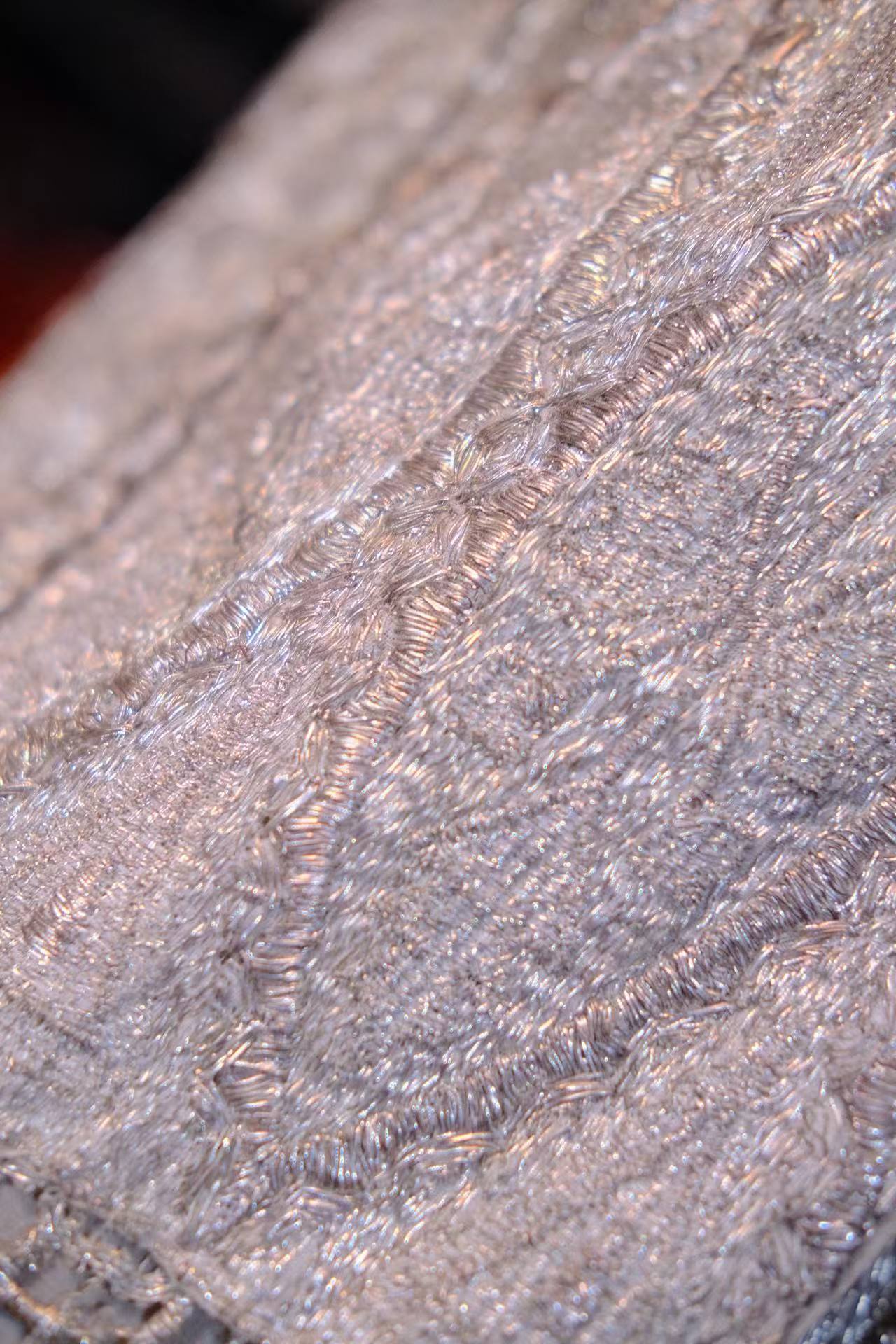
这件民国二十年代的埃及风连衣裙,以“银线织梦”之姿,将Art Deco的几何美学与埃及图腾的神秘感凝于经纬。
领口与肩带的施华洛世奇水钻,以“满天星”之势点缀,
二、图腾密码:埃及风的“东方重构”
裙身的图案,是Art Deco与埃及图腾的“跨文化对话”。几何化的太阳轮、
三、百年旧梦:从温哥华唐人街到蒙特利尔“银月之夜”
此裙的主人,正是前文所述加拿大“老钱”家族的闺秀。二十年代,
四、艺术孤品:跨文化的“衣冠孤本”
此裙的珍稀,在于它是Art Deco运动的“东方孤本”。
五、结语:穿在身上的“银月星河”
当指尖拂过裙摆的纯银编织纹路,仿佛能触摸到百年前蒙特利尔的“
This Egyptian-style dress from the 1920s and 1930s takes the posture of "silver threads weaving a dream," condensing the geometric aesthetics of Art Deco and the mystery of Egyptian totems within its warp and weft. The body of the dress features a mesh fabric woven from pure silver wire, with a cold light of an "inverted galaxy" shimmering through its threads. Distinct from the smooth softness of ordinary threads, this pure silver weaving craftsmanship requires blending ultra-fine silver wire with pure silk to weave a hazy, ethereal texture that is "neither purely silver nor purely gauze." This perfectly aligns with the design philosophy from The Treatise on Superfluous Things (Chang Wu Zhi): "Rather antique than fashionable; rather simple than artful."
The Swarovski crystals on the neckline and shoulder straps are embellished like a "sky full of stars." Each crystal requires the artisan's immense patience through "thousands of stitches and lines" to flawlessly merge the cold brilliance of the rhinestones with the faint shimmer of the pure silver wire, forming a visual tension of "strength tempered with gentleness." Just as The Book of Songs (Shi Jing) states, "Elegant is our lord, like gold and tin, like sceptre and mace," this dress melts the hardness of silver wire and the softness of rhinestones into one furnace, achieving a luxurious poetic masterpiece where "the garment carries the culture."
The patterns on the dress body are a "cross-cultural dialogue" between Art Deco and Egyptian totems. Geometric sunbursts, stepped ziggurat patterns, and palm leaves are woven with pure silver wire into variations of the traditional "fret pattern" (huiwen). This not only echoes the decorative art style of artifacts unearthed from King Tutankhamun's tomb but also reconstructs the wildness of Egyptian totems through "Eastern symmetry." The openwork lace at the hem is presented in the form of "ice-crackle patterns" (bingliewen), subtly channeling the Eastern philosophy of "the round sky and the square earth," yet breaking the shackles of traditional motifs through "Western-style geometry."
The owner of this dress was precisely a lady from the aforementioned Canadian "old money" family. In the 1920s and 1930s, she might have stunned the crowd at a "Night of the Silver Moon" gala in Montreal, pairing this dress with the previously mentioned black satin Art Deco coat: the cold luster of the pure silver weaving dancing under the chandeliers like the "clear radiance of a silver moon," the shimmering of the crystals appearing like an "inverted galaxy," and the lace of the hem swaying gently with her steps like "ripples on crackled ice."
The rarity of this dress lies in its status as a "unique Eastern chronicle" of the Art Deco movement. Fewer than ten Egyptian-style dresses from the Republic of China era survive worldwide, and the combination of "pure silver weaving + Swarovski crystals + Art Deco geometric patterns" makes this a unique piece among unique pieces. The pure silver weaving required the craftsmanship of the Jiangnan Weaving Bureau "using silk as the bone and silver as the flesh," while the crystal embellishments required the embroidery skills of Chinese needlewomen "using diamonds as ink and the needle as a pen." The fusion of these two elements achieves a cross-cultural masterpiece where "the garment carries the culture."
When fingertips brush across the pure silver woven textures of the hem, it feels as though one can touch the "silver moon and galactic night" of Montreal from a century ago—reflecting the cold glamour of Art Deco, the mystery of Egyptian totems, and the glory and forbearance of a Canadian "old money" family in a foreign land. This ensemble is the ultimate expression of "diaspora aesthetics": it wraps the snow and wind of the "Maple Leaf Country" within the cold light of pure silver weaving; replicates the flower tidings of the ancestral home through the shimmering of crystals; and narrates the elegance and resilience of an "old money" family in a foreign land through the flowing grace of lace.