深圳溯源
无法加载取货服务可用情况
一、衣上经纬:图案里的东方美学与西方现代性
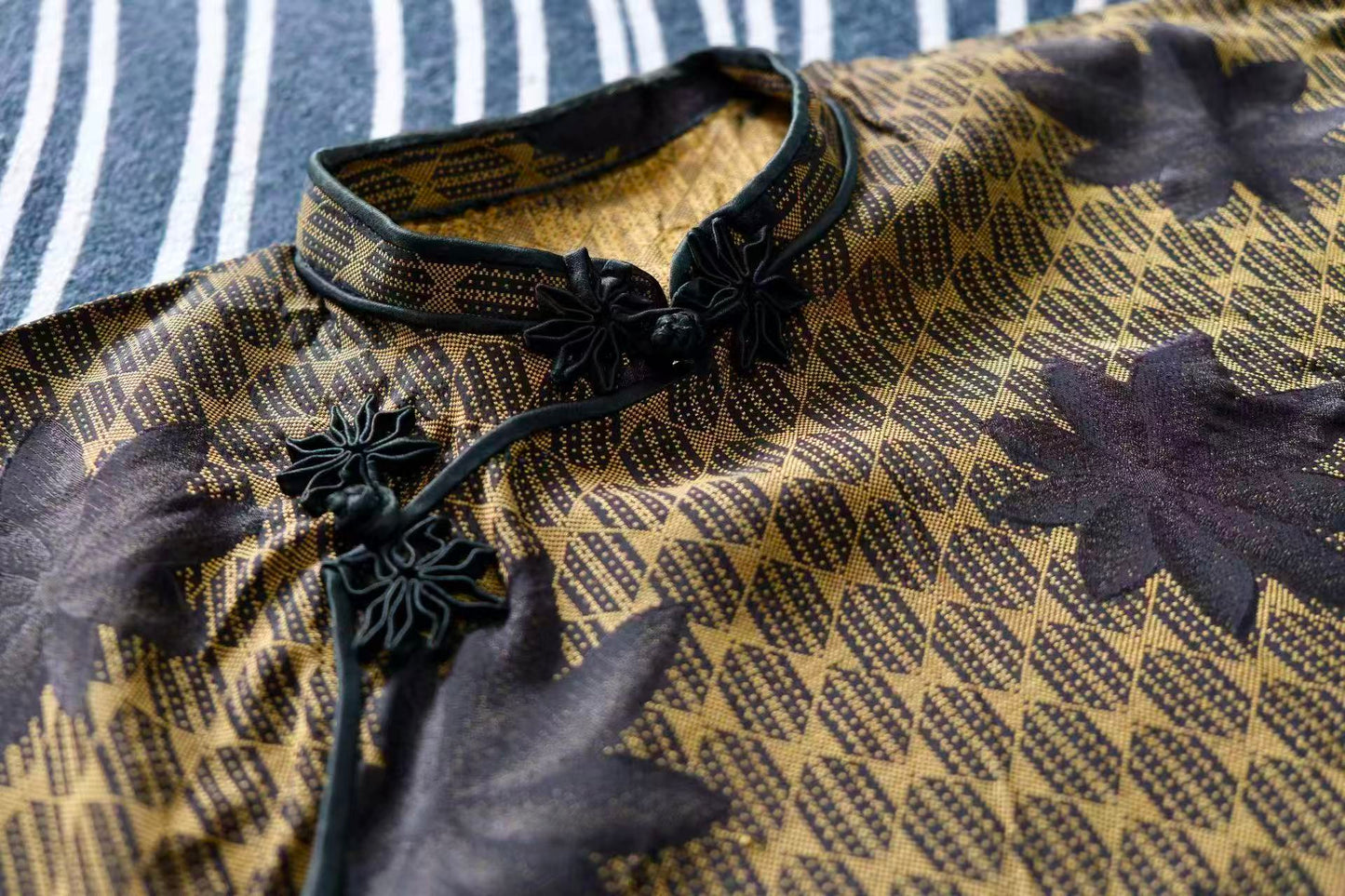
1. 旗袍:枫叶染秋,几何织梦
旗袍面料以金棕为底,黑色枫叶图案错落分布,叶脉以立体织花工艺凸起,如“霜叶红于二月花”的具象化表达,却暗合Art Deco风格的几何秩序感——枫叶轮廓被简化为锐利的多边形,与底布细密的菱形暗纹形成“自然意象”与“工业理性”的对话。领口、襟边缀以黑色滚边,盘扣作缠枝花卉造型,一针一线皆是海派旗袍“中西合璧”的基因密码。
2. 外套:银丝流光,金属的诗意
纯银金属丝混纺面料织就的外套,表面泛着珍珠母贝般的虹彩,光线流转间如“月照流银”(《西京杂记》载汉宫“金釭衔璧,银缕为帷”)。衣身采用30年代流行的“箱型廓形”,肩部微垫,袖口收紧,翻领处暗藏波浪纹提花,与旗袍的枫叶形成“刚柔相济”的视觉张力。金属丝的光泽并非浮夸,而是如宋瓷开片般内敛,暗合民国名媛“低调的奢华”审美。
二、衣中故事:1940年代上海滩的时尚密码
这套服饰诞生于1940年代的上海,彼时“孤岛”时期的租界仍保留着纸醉金迷的浮华,而内地战火纷飞,催生出一种“末世的精致”——名媛们以服饰为铠甲,在乱世中坚守体面。旗袍的枫叶图案,或暗喻“秋士悲”(《楚辞·九辩》“悲哉秋之为气也”),却以Art Deco的现代性将其转化为“向死而生”的倔强;纯银外套则可能是某位富商赠予爱妻的“定情物”,银丝象征“情比金坚”,却因战乱流落民间,成为历史的切片。
1943年《玲珑》杂志曾载:“沪上名媛竞尚新装,银线织衫,金纱裁裙,一掷千金而不惜。”这套服饰正是彼时风尚的活化石:旗袍保留传统立领、斜襟,却以无袖设计展露臂膀,呼应西方“Flapper”风格的解放;外套的金属丝面料,据考可能来自法国里昂进口的“Lurex”(早期金属纤维),经上海裁缝改良,成为“东方身体”与“西方材质”的完美嫁接。
三、艺术风格:Art Deco的东方变奏
Art Deco风格1925年巴黎博览会后传入中国,在上海演变为“装饰艺术派”建筑与服饰的共同语言。这套服饰的稀缺性,正在于其将Art Deco的“机械美学”(几何纹样、金属光泽)与东方“自然美学”(枫叶、缠枝)熔于一炉:
- 几何与自然的共生:旗袍底布的菱形纹是Art Deco标志性的“重复几何”,枫叶则是东方文人画的经典意象,二者的碰撞如张爱玲所言“传统与现代的撕扯,却撕出新的美”。
- 材质的革命性:纯银金属丝在1940年代属顶级奢侈品,其混纺工艺需将银拉成0.01毫米细丝,与真丝交织,难度堪比“以发织锦”(《天工开物》载“金银线织锦,工费十倍于常”)。现存民国金属丝服饰不足百件,且多藏于博物馆,民间流通者凤毛麟角。
四、稀缺性:时间的孤本,时尚的绝唱
这套服饰的稀缺性,不仅在于材质的珍稀,更在于其承载的“时代折叠”——它是民国时尚的“末代贵族”,也是Art Deco东传的“最后见证”。旗袍的剪裁已初现1950年代“贴身收腰”的雏形,外套的廓形却保留30年代的宽松,这种“过渡性”使其成为研究民国服饰演变的“活标本”。
正如本雅明在《机械复制时代的艺术作品》中所言:“古董衣的‘光晕’,在于其不可复制的历史现场感。”当指尖抚过银丝外套的虹彩,仿佛触摸到1940年代上海滩的霓虹;凝视旗袍上的枫叶,似能听见张爱玲笔下“生命是一袭华美的袍,爬满了蚤子”的喟叹。这不仅是一套服饰,更是一段被织物封存的民国史诗。
1. The Cheongsam: Autumn Maple and Geometric Dreams The fabric features a golden-brown base adorned with scattered black maple leaf patterns. The leaf veins are rendered with a three-dimensional jacquard technique, creating a tactile presence that serves as a literal interpretation of the poetic line: "Frost-bitten leaves are redder than early spring flowers." Yet, it subtly aligns with the geometric order of Art Deco—the leaf silhouettes are simplified into sharp polygons, engaging in a dialogue between "natural imagery" and "industrial rationality" against the dense rhombic under-patterns of the base cloth.
2. The Jacket: Shimmering Silver, the Poetics of Metal Crafted from a blend featuring sterling silver metallic threads, the jacket’s surface glows with a mother-of-pearl iridescence. In shifting light, it resembles "moonlight reflecting on flowing silver." The silhouette adopts the "box-cut" popular in the 1930s, with subtle shoulder padding and tapered cuffs. The lapels hide a wave-patterned jacquard, creating a visual tension of "strength tempered by softness" when paired with the maple leaves of the cheongsam. This metallic luster is not ostentatious but restrained, mirroring the "understated luxury" preferred by socialites of the Republican era.
This ensemble was born in 1940s Shanghai. During the "Orphan Island" period, the foreign concessions maintained a facade of extravagant opulence amidst the surrounding turmoil of war, giving rise to an "exquisiteness of the apocalypse." Noblewomen used fashion as armor, maintaining their dignity in a chaotic world. The maple motifs might hint at the "sorrow of the autumn scholar" (Chu Ci), yet the Art Deco modernity transforms this into a defiant "will to live." The sterling silver jacket might have been a "pledge of love" from a wealthy merchant to his wife—silver threads symbolizing a bond stronger than gold—only to be scattered among the people by the tides of war, becoming a preserved fragment of history.
In 1943, Ling Long magazine reported: "Shanghai socialites compete in new fashions, weaving shirts with silver threads and cutting skirts from golden gauze, sparing no expense." This outfit is a living fossil of that trend: the cheongsam retains the traditional standing collar and diagonal bodice but adopts a sleeveless design, echoing the liberation of the Western "Flapper" style. The metallic fabric likely used imported Lurex from Lyon, France, masterfully grafted onto the "Oriental body" by Shanghainese tailors.
After the 1925 Paris Exhibition, Art Deco became the common language of architecture and fashion in Shanghai. The scarcity of this set lies in its fusion of "mechanical aesthetics" (geometric patterns, metallic luster) and "natural aesthetics" (maples, intertwining vines):
Symbiosis of Geometry and Nature: The rhombic patterns are iconic Art Deco "repetitive geometry," while the maple leaf is a classic literati image. As Eileen Chang noted, it is a "tearing between tradition and modernity that creates a new beauty."
Revolutionary Materials: Sterling silver thread was a pinnacle of luxury in the 1940s. The blending process required drawing silver into 0.01mm filaments to interweave with silk—a feat of "weaving brocade with hair." Fewer than a hundred Republican-era metallic garments survive today, mostly in museums.
The rarity of this set stems not only from its materials but from the "temporal folding" it carries—it is the "last aristocrat" of Republican fashion and the final witness to the eastward spread of Art Deco. The cheongsam’s cut prefigures the "slim-fit" silhouette of the 1950s, while the jacket retains the 1930s loose frame. This "transitional" nature makes it a vital "living specimen" for studying the evolution of Chinese costume.
As Walter Benjamin wrote in The Work of Art in the Age of Mechanical Reproduction, the "Aura" of an antique garment lies in its irreplaceable sense of historical presence. When fingertips brush the iridescence of the silver jacket, one touches the neon lights of 1940s Shanghai; gazing at the maple leaves, one hears the sigh from Eileen Chang’s pen: "Life is a gorgeous robe, crawling with fleas." This is not just an outfit; it is a Republican epic sealed in fabric.