溯源
无法加载取货服务可用情况
【文物综述】
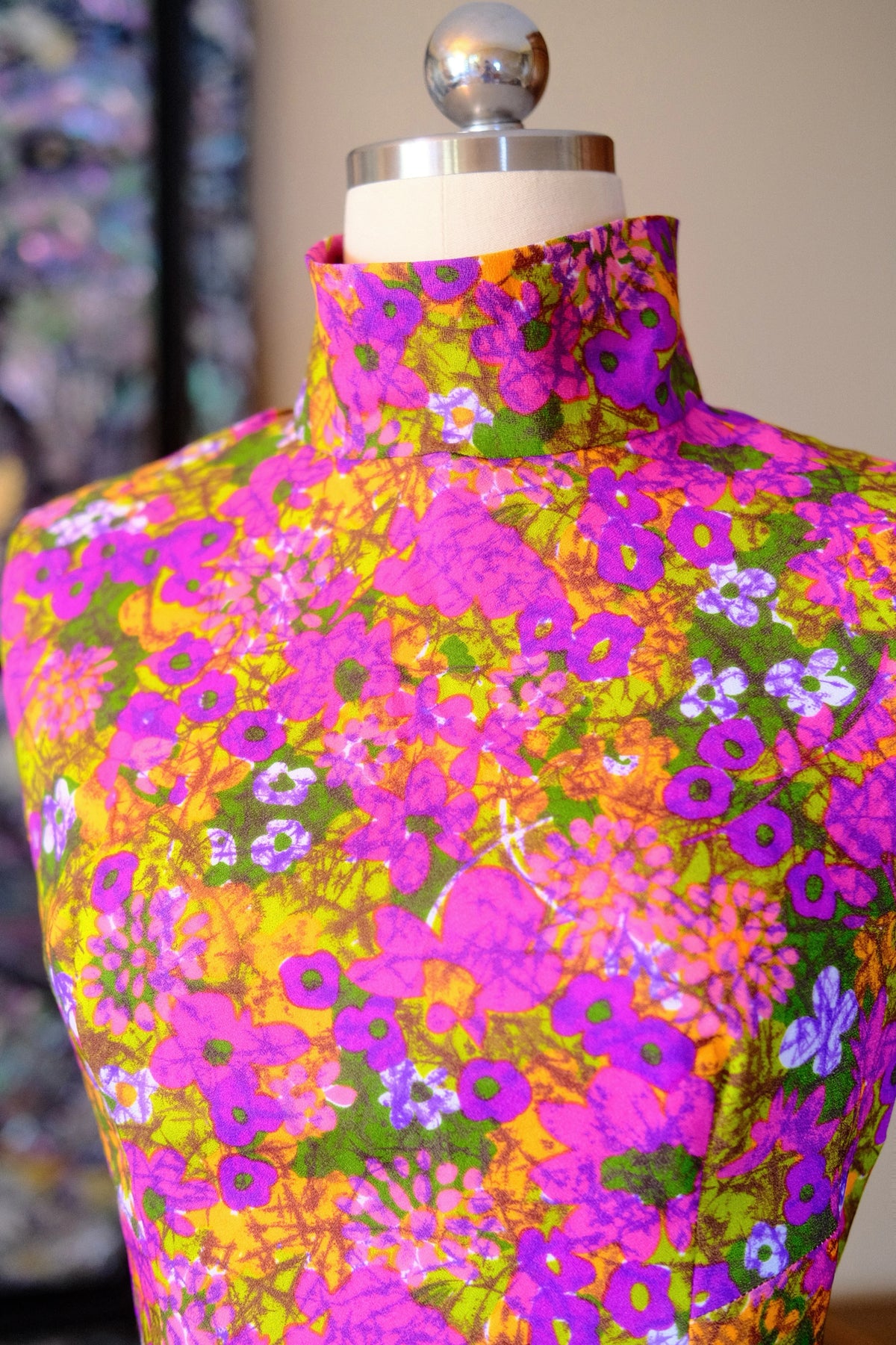
此件时装裙断代为20世纪60年代,产地为中国香港。其形制融合了中式立领(筒子领)的端庄与西式剪裁的立体感,面料采用极具时代特征的抽象花卉油画风格印花。整衣色彩高饱和度,以洋红、明黄、翠绿交织,呈现出一种热烈而迷幻的视觉张力,是“摇摆六十年代”美学在东方语境下的独特回响。
【文案正文】
标题:繁花入梦,摩登倾城——记一件60年代港产抽象印花旗袍裙
张爱玲曾言:“对于不会说话的人,衣服是一种语言,随身带着的是袖珍戏剧。”
当我们凝视这件诞生于上世纪60年代的香港时装裙时,仿佛听到了一场关于东西方文化剧烈碰撞、交融的华丽独白。那不仅仅是一件衣裳,更是一段被织物封存的流金岁月。
一、 领口间的东方风骨:筒子领的坚守与演变
视线上移,最先映入眼帘的是那挺括的“筒子领”。在服装史的演变中,这种领型源自民国二十年代旗袍,经由民国时期的改良,至60年代已演变为一种极具辨识度的符号。
不同于传统旗袍领口的温婉低回,60年代的筒子领往往做得更高、更硬挺,紧紧包裹住修长的颈项。这是一种克制的性感,正如李碧华笔下那种“冷艳”的东方韵味。它在视觉上拉长了颈部线条,赋予了穿着者一种不可侵犯的高贵与疏离感。在这件衣服上,领口的剪裁利落干脆,没有多余的滚边装饰,完全依靠面料本身的张力支撑,展现了当时香港裁缝精湛的“归拔”工艺——那是用熨斗和汗水将平面布料塑造出立体弧度的指尖魔法。
二、 布料上的波普狂想:当莫奈遇见安迪·沃霍尔
目光下移,便跌入了一个色彩斑斓的迷幻世界。
这件裙装的面料,是典型的60年代“Abstract Floral”(抽象花卉)风格。彼时,西方正经历着“波普艺术”与“欧普艺术”的洗礼,传统的写实花卉被解构、重组,变成了色块与线条的狂欢。
你看那大块的洋红与明黄肆意泼洒,如同野兽派画家马蒂斯手中的剪刀与彩纸;而那细碎的紫罗兰色小花点缀其间,又似印象派光影下的莫奈花园。这种印花并非传统的丝绸手绘,而是当时新兴的化纤或混纺面料上的工业印染。它带着一种生猛的生命力,甚至可以说是一种“俗艳”的勇气。
在60年代的香港,这种面料是“摩登”的代名词。它不再追求苏绣般的细腻温婉,而是拥抱工业化带来的视觉冲击。穿着它的女子,不再是深闺中的仕女,而是穿梭于中环写字楼与夜总会之间的都市丽人,她们眼中闪烁着对现代生活的渴望与自信。
三、 廓形里的时代精神:从束缚到释放
从版型上看,这件裙装虽保留了东方的立领,但身姿已是彻底的西化。
它摒弃了传统旗袍那极度强调S型曲线的紧身剪裁,转而采用了一种更为宽松、直线条的“A字”或“H型”轮廓(虽图中有收腰,但整体趋势向下的摆量增大)。这是受到当时伦敦“迷你裙革命”与巴黎“未来主义”时尚的影响。
裙身无袖的设计,大方展露手臂线条,是对身体解放的宣言。腰线的处理含蓄而精准,既保留了女性的柔美,又给予了肢体活动的自由。这种设计语言在诉说着一个事实:60年代的女性,正在从繁复的礼教中出走,她们需要行动的自由,需要在职场与社交场中游刃有余。
【结语】
这件60年代的港产时装裙,是一首穿在身上的散文诗。
它以中式的领口为韵脚,以西式的剪裁为句式,以抽象的印花为修辞,书写着那个时代特有的矛盾与和谐。它既有旧上海的遗梦,又有新世界的喧嚣。
如今,当我们再次抚摸这略显粗糙却色彩依旧惊心动魄的面料时,我们触摸到的,是那个黄金时代的体温。那是属于香港的芳华,也是属于所有不甘平庸、勇于追逐潮流的灵魂的永恒纪念。
This fashion dress is dated to the 1960s and originated in Hong Kong. Its design seamlessly fuses the dignified elegance of a traditional Chinese stand collar (funnel collar) with the structural precision of Western tailoring. The fabric features an abstract floral oil-painting style print characteristic of its era. With a highly saturated color palette driven by vibrant magenta, bright yellow, and emerald green, the garment exhibits a rich and psychedelic visual energy—serving as a unique echo of "Swinging Sixties" aesthetics within an Eastern context.
Title: Blooms of a Dream, Modernist Grace: An Appreciation of a 1960s Hong Kong Vintage Abstract Print Qipao Dress
As Eileen Chang once observed: "To those who cannot speak, clothes are a language—a pocket drama carried on one's person."
Gazing upon this Hong Kong fashion dress born in the 1960s, one can almost hear a magnificent monologue on the dramatic collision and coalescence of Eastern and Western cultures. It is far more than a garment; it is a golden era preserved in fabric.
Lifting one's eyes, the first detail to captivate attention is the crisp "funnel collar." In costume history, this neckline evolved from the Qipao of the 1920s; through decades of refinement, it became a highly recognizable aesthetic motif by the 1960s.
Unlike the soft and understated low collars of classic Qipao, the funnel collar of the 1960s was often constructed higher and firmer, closely encircling a slender neck. This embodies a form of restrained sensuality—much like the cool, alluring Eastern charm described by Lilian Lee. Visually elongating the neck, it endows the wearer with an aura of unassailable nobility and poise. On this garment, the collar is cleanly and sharply tailored without extraneous piping or trim, relying entirely on the fabric’s own structural tension for support. It showcases the masterly guiba (iron-shaping) technique of Hong Kong tailors from that era—the touch of magic that transformed flat cloth into a fluid, three-dimensional curve through steam, iron, and patience.
Lowering one's gaze, one tumbles into a vibrant, psychedelic realm of color.
The fabric of this dress is a quintessential example of 1960s "Abstract Floral" style. During this period, the Western art world was undergoing the revolution of Pop Art and Op Art; traditional realistic flora was deconstructed and rearranged into a celebration of raw color blocks and expressive lines.
Observe how broad strokes of magenta and sun yellow are splashed with bold abandon, echoing the paper cutouts of Henri Matisse; meanwhile, delicate scatterings of violet blossoms are dotted throughout, recalling Monet’s garden under impressionist light and shadow. This pattern is not traditional silk hand-painting, but an industrial print on synthetic or blended fabrics that emerged at the time. It carries a raw, vibrant energy—a daring, unapologetic color confidence.
In 1960s Hong Kong, such fabric was the very definition of modern. Moving away from the delicate reserve of Su embroidery, it embraced the visual impact of industrialization. The woman who wore this was no longer a recluse in a traditional boudoir, but a modern urbanite navigating between Central's office towers and bustling nightspots, her eyes shining with confidence and a longing for modern life.
In terms of silhouette, while the dress retains its Eastern stand collar, its structure is thoroughly Westernized.
Departing from the traditional Qipao cut that strictly emphasized an exaggerated S-curve silhouette, it embraces a more relaxed, straight-lined A-line or H-line frame. This design reflects the global influence of London’s "Miniskirt Revolution" and Paris’s "Futurism" fashion movements of the era.
The sleeveless design proudly uncovers the arms, serving as a declaration of body liberation. The waistline treatment is subtle yet precise—preserving feminine softness while granting full freedom of movement. This design language speaks to a clear historical reality: women in the 1960s were stepping out from restrictive social conventions, seeking mobility and ease in both professional and social spheres.
This 1960s Hong Kong fashion dress is prose poetry worn on the body.
Using a Chinese collar as its rhyme scheme, Western tailoring as its syntax, and abstract prints as its rhetoric, it articulates the unique harmony amidst contradiction that defined its era. It holds both the lingering dreams of old Shanghai and the vibrant energy of a new world.
Today, as we touch this slightly textured yet colorfully breathtaking fabric, we feel the living warmth of a golden age. It stands as a timeless monument to the glamour of Hong Kong and to every soul brave enough to pursue fashion and defy the ordinary.