深圳溯源
无法加载取货服务可用情况
衣服尺寸:
胸围/腰围/臀围:94/76/94 厘米
衣长:112 厘米
细节描述:
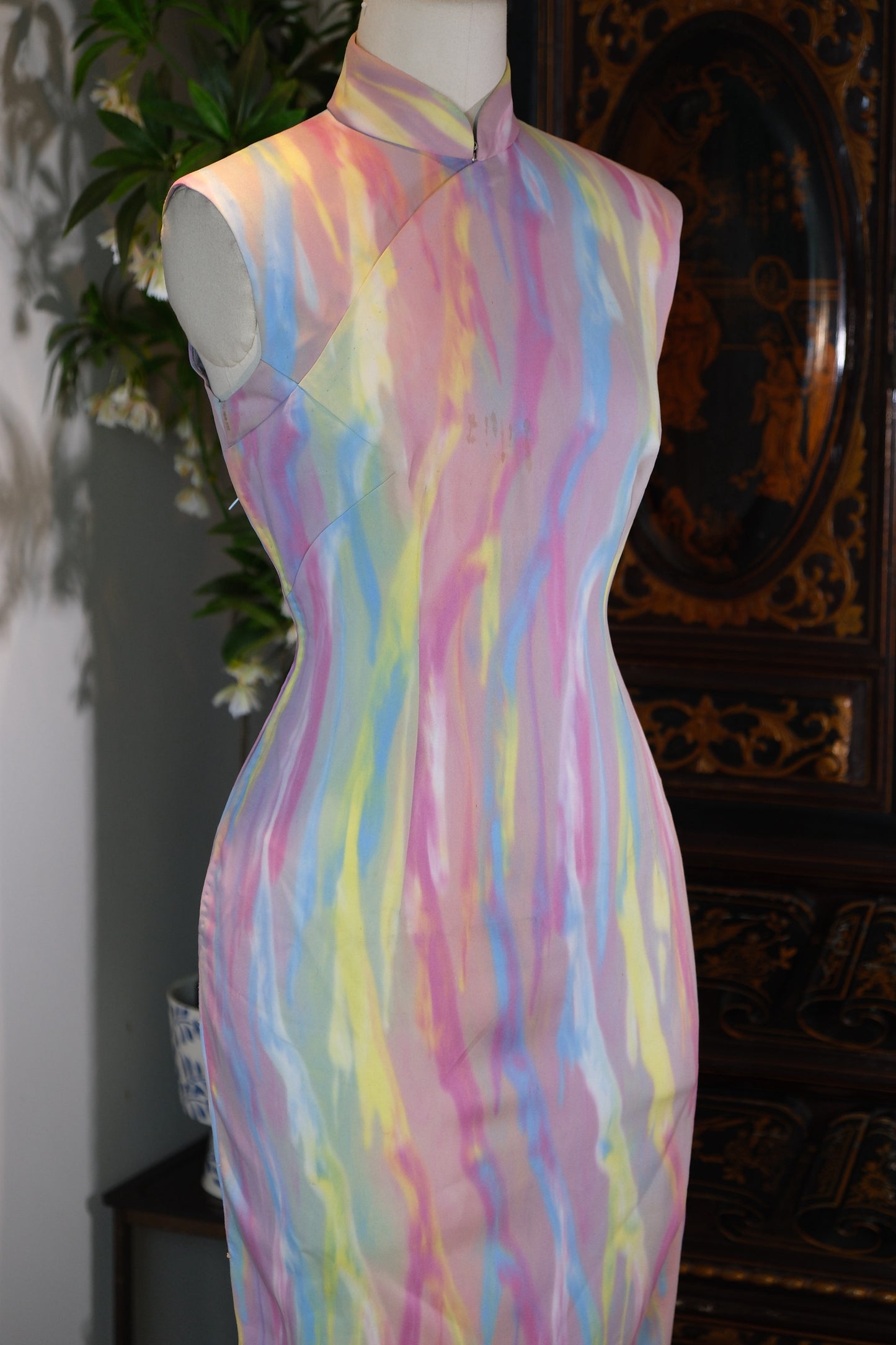
这件诞生于六十年代香港的无袖旗袍,以马卡龙色系晕染出流动的光影,恰似将维多利亚港的晨曦与晚霞织入经纬。衣身图案如云霞漫卷,粉、蓝、黄、紫诸色交融渗透,既无明确的几何边界,亦非具象的花鸟纹样,而是以抽象的“水波纹”与“烟霞纹”为基底,暗合宋代米芾“云山墨戏”的写意笔法——色彩在丝绸上自然流淌,形成“如雾如烟如幻”的视觉效果,恰似《长物志》所言“随方制象,各有所宜”,将东方水墨的留白意境与西方抽象表现主义的色彩张力巧妙融合。
六十年代的香港,正处于东西方文化碰撞的黄金时代。彼时的旗袍设计,既保留着传统立领、斜襟、收腰的经典形制,又大胆吸收西方时装的无袖剪裁与色彩理念。这件旗袍的无袖设计,打破了传统旗袍的保守感,露出纤细臂膀,既符合当时香港女性追求“摩登”的审美,又暗合《诗经》“手如柔荑”的古典意象;而马卡龙色系的运用,则是对西方“太空时代”(Space Age)流行色的一种东方化转译——粉蓝如地中海晴空,鹅黄似普罗旺斯薰衣草,淡紫若威尼斯暮色,却在丝绸的柔光中沉淀出江南水乡的温婉,形成“西色东韵”的独特美学。
在工艺上,这件旗袍的晕染图案需经多次套色印染方能完成,每道色彩的过渡都需工匠精准把控,稍有不慎便会破坏整体的流动感。这种“天工与人巧”的结合,恰如《考工记》所言“天有时,地有气,材有美,工有巧,合此四者,然后可以为良”。如今,六十年代香港产的古董旗袍存世量已极为稀少,尤其是这种采用抽象晕染图案、无袖设计的款式,更是凤毛麟角。它不仅是一件衣物,更是一段流动的历史——穿着它的女子,或许曾在尖沙咀的霓虹灯下漫步,或许曾在中环的写字楼里书写传奇,衣袂间流转的不仅是色彩,更是一个时代的呼吸与心跳。
“衣裳是文化的表征,衣裳是思想的形象。”这件旗袍,便是六十年代香港“中西合璧”文化精神的绝佳注脚,其稀缺性与艺术价值,早已超越了衣物本身,成为可触摸的历史与可穿戴的艺术。
备注:有瑕疵但可以补救
Measurements / Size Guide:
Bust / Waist / Hips: 94/76/94 cm
Total Length: 112 cm
Detailed Description:
This sleeveless Qipao, born in 1960s Hong Kong, uses a Macaron-colored gradient to capture flowing light and shadow, as if weaving the dawn and dusk of Victoria Harbour into its warp and weft. The patterns on the garment roll like clouds and mists, with shades of pink, blue, yellow, and purple blending and penetrating one another. It features no defined geometric boundaries nor concrete floral or faunal motifs; instead, it uses abstract "water ripples" and "misty clouds" as a foundation. This aligns with the freehand brushwork of Mi Fu’s "Cloudy Mountains Ink Play" from the Song Dynasty—colors flow naturally across the silk, creating a visual effect that is "like mist, like smoke, like a dream." As Zhang Wu Zhi (The Treatise on Superfluous Things) states, "form images according to the occasion, each fitting its place," skillfully merging the "white space" imagery of Oriental ink wash with the tonal tension of Western Abstract Expressionism.
Hong Kong in the 1960s was in a golden age of collision between Eastern and Western cultures. The Qipao design of that time preserved the classic forms of the high collar, diagonal closure, and cinched waist, while boldly absorbing the sleeveless tailoring and color philosophies of Western fashion. The sleeveless design of this piece breaks the traditional sense of conservatism, revealing slender arms that both met the "modern" aesthetic sought by Hong Kong women of the era and echoed the classical imagery of "hands like soft young shoots" from the Classic of Poetry. The use of Macaron tones is an Oriental translation of the popular colors of the Western "Space Age"—the powder blue of a Mediterranean sky, the primrose yellow of Provence lavender, and the pale mauve of a Venetian twilight—yet they settle into the gentleness of a Jiangnan water town within the silk’s soft luster, forming a unique aesthetic of "Western Color, Eastern Charm."
In terms of craftsmanship, the gradient pattern of this Qipao required multiple rounds of over-dyeing to complete. Every tonal transition demanded precise control by the artisan; a slight error would destroy the overall sense of fluidity. This combination of "heavenly craft and human skill" is exactly as described in Kao Gong Ji (The Artificers' Record): "Heaven has its seasons, Earth has its Qi, materials have their beauty, and craftsmen have their skill. When these four combine, a fine work is born." Today, the number of surviving 1960s Hong Kong-made antique Qipaos is extremely small, and sleeveless designs featuring such abstract gradient patterns are truly one in a million. It is not just a garment but a segment of flowing history—the woman who wore it might have strolled under the neon lights of Tsim Sha Tsui or written her own legend in a Central office building. What flows between her sleeves is not just color, but the breath and heartbeat of an era.
"Clothing is the manifestation of culture; clothing is the image of thought." This Qipao is an exquisite footnote to the "East-meets-West" cultural spirit of 1960s Hong Kong. Its rarity and artistic value have long surpassed the garment itself, becoming a touchable history and a wearable art.
PS: Minor imperfections with potential for restoration.