深圳溯源
无法加载取货服务可用情况
衣服尺寸:
胸围/腰围/臀围:86/72/98 厘米
衣长:100 厘米
细节描述:
一、衣上纹章:植物诗学与工艺的私语
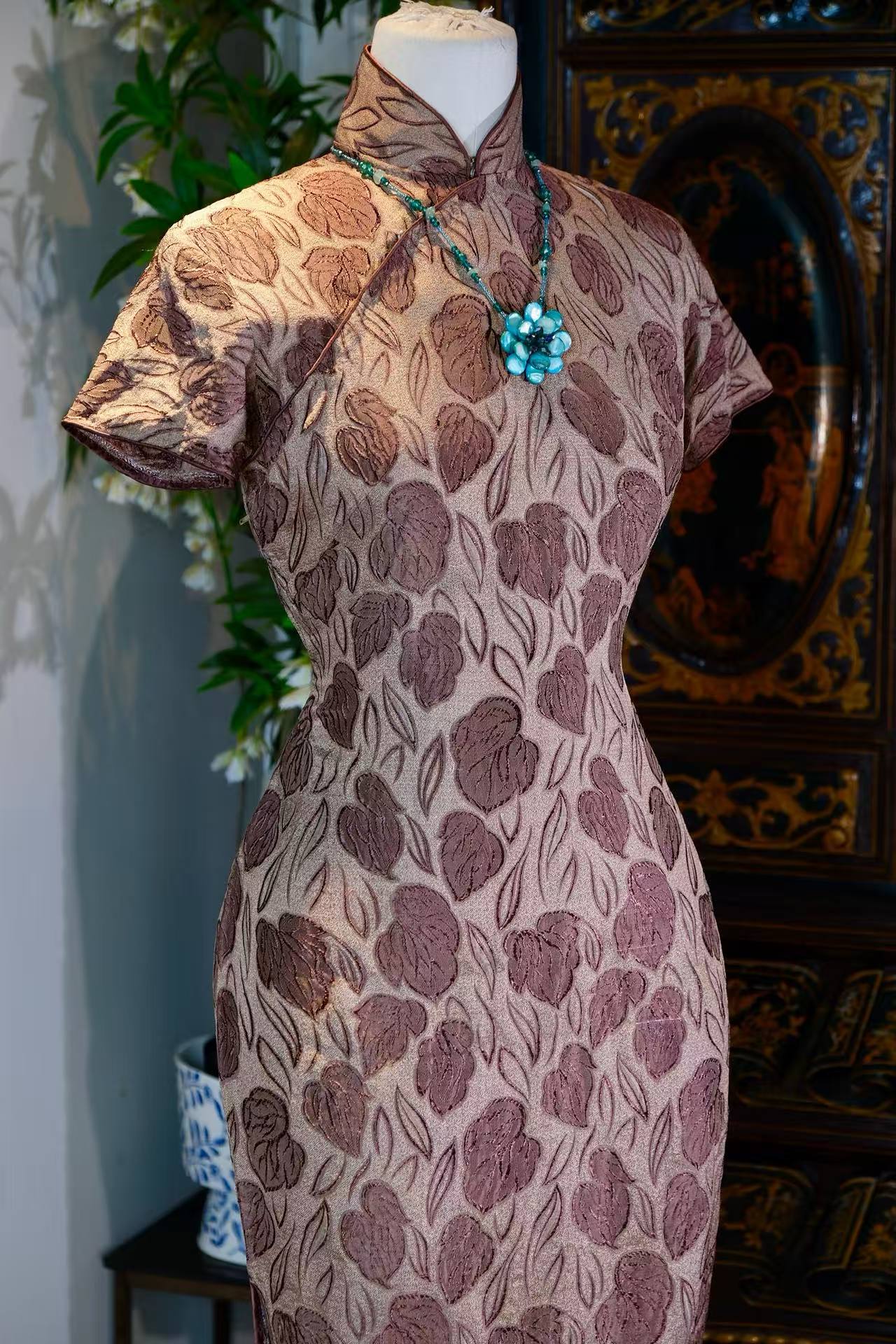
这件诞生于上世纪五十年代的香港产旗袍,以提花织锦为骨,以线香绲边为魂,将东方美学的含蓄与西式剪裁的利落熔于一炉。衣身满铺的植物纹样,既非写实的牡丹芍药,亦非传统的缠枝莲纹,而是以抽象化的叶片与果实为母题——饱满的椭圆形叶脉以暗紫色丝线凸起织就,边缘晕染着岁月沉淀的哑光金棕,叶间穿插着细长的藤蔓纹,如风中摇曳的芦苇,又似岭南庭院里肆意生长的芭蕉。
这种“非具象植物纹”是五十年代香港旗袍的典型特征:彼时西方抽象艺术思潮东渐,设计师摒弃了清代旗装的繁复堆砌,转而以几何化的植物符号构建现代感。提花工艺更见匠心,每一片叶脉的凹凸肌理都需经数十道经纬交织,光线流转时,衣料表面会泛起如水面涟漪般的微光,恰似《长物志》所言“织文隐现,若雾中看花”,将“藏”与“露”的东方美学演绎到极致。
二、线香绲边:指尖上的微型建筑
旗袍的领口、襟线、袖口与下摆,皆以“线香绲边”收束——这种仅3毫米宽的极细绲边,需将棉线裹入斜裁布条中,以针尖挑着布边0.1毫米的余量缲缝,稍有不慎便会扭曲变形。五十年代的香港裁缝以“三针一线”为傲:针距必须均匀如尺量,线迹需隐于绲边内侧,最终呈现出如“线香”般挺括笔直的轮廓,既加固了衣身结构,又为柔美的提花面料注入筋骨。
这种工艺如今几近失传。当代机器绲边虽快,却失了手工的温度——唯有指尖摩挲这件古董旗袍的绲边时,方能感受到棉线在岁月中微微泛硬的质感,以及每一针背后裁缝屏息凝神的专注,恰如张爱玲在《更衣记》中所写:“衣服的本身是不重要的,重要的是它背后的时间与记忆。”
三、香江旧梦:一件旗袍的时空漂流
五十年代的香港,是东西方文化碰撞的熔炉。这件旗袍的主人,或许是一位穿梭于中环写字楼与浅水湾舞会的职业女性:她清晨穿着它去银行处理账目,午后赴茶楼与友人闲谈,夜晚则换上高跟鞋,在霓虹灯下跳一支恰恰。旗袍的修身剪裁既保留了传统旗袍的曲线美,又吸收了西方连衣裙的简洁,正是当时“港式摩登”的缩影。
面料的选择更暗藏玄机:金棕底色与暗紫纹样的搭配,避开了上海旗袍常见的艳丽色彩,转而以“低调的奢华”呼应香港商埠的务实气质。彼时香港进口的法国提花时装料,成就了这种兼具垂坠感与挺括度的独特版型,如今存世量不足百件。
四、稀缺性:时间的孤本与艺术的标本
这件旗袍的稀缺性,不仅在于其保存完好的状态(无虫蛀、无褪色、绲边完整),更在于它承载的历史切片价值:
- 工艺孤本:线香绲边与提花织锦的结合,是五十年代香港旗袍的“技术天花板”,后因成本高昂逐渐被机器绲边与印花面料取代;
- 时代符号:抽象植物纹与修身剪裁,标志着中国女性服饰从“传统礼教载体”向“现代自我表达”的转型,是研究亚洲现代服饰史的关键物证;
- 文化杂交性:香港作为“东方之珠”的多元身份,在这件旗袍上具象化为西方抽象艺术、中国传统织造与岭南地域审美的三重奏。
正如大英博物馆收藏的清代宫廷旗袍代表着“过去的辉煌”,这件五十年代港产旗袍则见证了“未来的萌芽”——它不是博物馆里冰冷的展品,而是仍能穿在身上的“流动的历史”。当你将它披上身,线香绲边会贴合你的肩颈曲线,提花纹样会在灯光下流转,那一刻,你便与半个世纪前那位香江女子,共享了同一段关于美与自由的时光。
结语:衣以载道,物以传情
这件旗袍的价值,从不在于其“古董”的标签,而在于它让抽象的历史变得可触、可感、可穿。它是五十年代香港女性独立精神的物化,是传统工艺与现代设计对话的结晶,更是时间留给我们的“美的遗嘱”。若说衣服是“穿在身上的文化”,那么这件旗袍,便是一部用丝线与针脚写就的香江断代史——每一道褶皱里,都藏着一个时代的呼吸。
Measurements / Size Guide:
Bust / Waist / Hips: 86/72/98 cm
Total Length: 100 cm
Detailed Description:
[I. Motifs on Fabric: A Dialogue of Botanical Poetics and Craftsmanship] Born in 1950s Hong Kong, this antique Qipao features a structural body of jacquard brocade anchored by the soul of artisan Xianxiang (incense-thin) piping, welding traditional Eastern reserve with the sharp clean lines of Western tailoring. The botanical patterns blanketing the garment reject both the literal representation of tree peonies and the classical conventions of scrolling lotuses. Instead, it introduces abstract foliage and fruits as its core motifs—plump, elliptical leaf veins raised in deep purple silk threads, their margins washed in a muted, time-softened golden brown. Slender, winding tendrils interlace between the leaves like reeds swaying in the wind or wild plantains growing freely in a Lingnan courtyard.
This "non-figurative botanical motif" is a defining hallmark of 1950s Hong Kong Qipaos. During this era, Western abstract art movements surged eastward, prompting designers to discard the heavy, cluttered encrustations of Qing Dynasty court robes in favor of geometric botanical symbols that projected an absolute sense of modernity. The jacquard weaving demonstrates a virtuoso focus: the sculptural, raised texture of every single leaf vein required dozens of meticulous interlacings of warp and weft. As light shifts across the surface, the fabric ripples with a subtle, kinetic luster—perfectly embodying the aesthetic lauded in the Ming Dynasty text Treatise on Superfluous Things (Chang Wu Zhi): "the woven patterns reveal and conceal themselves like watching blossoms through a mist," executing the Eastern philosophy of "concealment and revelation" to its absolute peak.
[II. Xianxiang Piping: Micro-Architecture Upon the Fingertips] The mandarin collar, diagonal opening (Xiejin), cuffs, and hem are all strictly bound by Xianxiang piping. This ultra-fine manual piping—measuring a mere 3 millimeters in width—demands that a core cotton cord be wrapped inside a bias-cut fabric strip, then blind-stitched (Qi縫) with a needle point navigating a hair-thin margin of just 0.1 millimeters. The slightest lapse in focus would warp or distort the entire edge. 1950s Hong Kong tailors took ultimate pride in their "three stitches per line" uniformity: the stitch density had to be as exact as if measured by a ruler, with the thread tracks hidden entirely within the inner fold of the piping. The resulting edge is as crisp, structural, and straight as a stick of incense (Xianxiang), simultaneously reinforcing the garment's architecture while injecting rigid skeletal strength into the supple jacquard fabric.
This artisanal mastery has nearly vanished today. While modern industrial sewing machines are rapid, they lack the literal warmth of human hands. Only when one's fingertips brush against the piping of this antique Qipao can they feel the subtle firmness of the inner cotton cord hardened by decades of time, and the breathtaking, breathless concentration of the tailor behind every single stitch. It substantiates what Eileen Chang elegantly penned in Chronicle of Changing Clothes: "The garment itself is not what matters; what matters is the time and memory it contains."
[III. Dreams of Victoria Harbour: The Temporal Odyssey of a Garment] 1950s Hong Kong was a fierce yet miraculous melting pot of East and West. The original custodian of this Qipao might well have been a professional woman navigating the corporate offices of Central and the high-society galas of Repulse Bay: she might have worn it in the morning to balance Ledgers at a bank, spent her afternoon conversing at a traditional teahouse, and stepped into high heels at night to dance the cha-cha under neon lights. The body-conscious silhouette preserved the traditional fluid curves of the Qipao while absorbing the streamlined simplicity of Western day dresses—standing as the absolute epitome of "Hong Kong Modernity."
The textile choice harbors its own subtle genius: the pairing of a golden-brown base with deep purple motifs deliberately avoided the vibrant, loud color palettes common to Shanghainese Qipaos, opting instead for an "understated luxury" that dialogued with the pragmatic, mercantile spirit of Hong Kong as a trading port. Crafted from premium French jacquard dress fabrics imported into Hong Kong during the mid-century, this textile achieved a singular drape and structural crispness. Today, fewer than a hundred specimens of this caliber survive worldwide.
[IV. Rarity: A Frozen Fragment of Time and an Artistic Specimen] The rarity of this Qipao rests not only upon its pristine state of preservation (completely free of moth damage, fading, or loose piping) but upon its immense value as a physical artifact of fashion history:
Rarity of Craftsmanship: The marriage of manual Xianxiang piping with high-precision jacquard brocade represents the absolute "technical ceiling" of 1950s Hong Kong tailoring—a practice later driven to extinction by mass-production machinery and flat printed fabrics.
An Era's Totem: The abstract botanical print combined with a highly ergonomic fit marks the profound transition of Chinese women’s apparel from a "vessel of traditional ritual decorum" to a "medium of modern self-expression," serving as an essential physical record for Asian fashion historians.
Cultural Hybridity: Hong Kong’s pluralistic identity as the "Pearl of the Orient" is tangibly materialized in this garment as a complex trio of Western abstraction, traditional Chinese weaving, and regional Lingnan aesthetics.
While the Qing Dynasty court robes curated in the British Museum represent the "grandeur of the past," this 1950s Hong Kong Qipao witnesses the "sprouts of the future"—it is not a cold museum exhibit, but a piece of "fluid history" meant to be worn. The moment you drape it over your shoulders, the structural Xianxiang piping contours flawlessly to your neck and shoulders, and the jacquard motifs come alive under the light, allowing you to share the exact same fragment of beauty and liberation with that Hong Kong woman from half a century ago.
Epilogue: Apparel as a Vessel of Culture, Objects as Bearers of Emotion The true value of this Qipao has never resided merely in its "antique" label, but in its ability to render abstract history tangible, sensory, and wearable. It stands as the physical crystallization of the independent spirit of 1950s Hong Kong women, a masterclass of tradition dialoguing with modernity, and a testament of beauty left to us by time. If clothing is indeed "culture you wear," then this Qipao is a definitive history of Hong Kong written in silk threads and hand-stitches—where every single fold conceals the breath of an era.