深圳溯源
无法加载取货服务可用情况
衣服尺寸:
胸围/腰围/臀围:100/84/104 厘米
衣长:104 厘米
细节描述:
一、图案:提花织就的“东方密码”
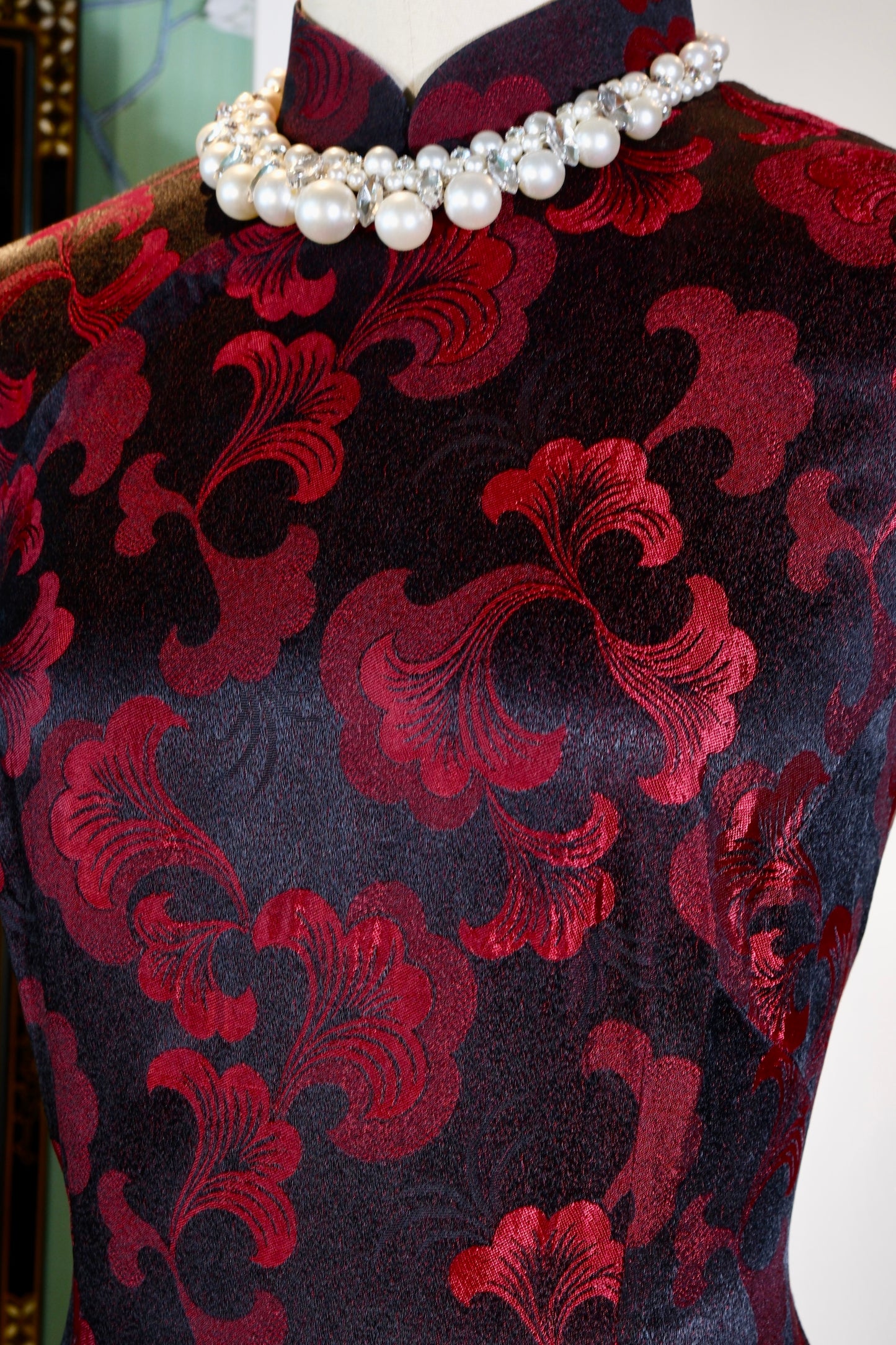
这件旗袍的面料,是上世纪六十年代香港纺织业黄金时代的缩影。深紫底色如夜幕般沉静,其上以提花工艺织就的银杏叶纹样,似被时光镀上一层暗红鎏金——叶片舒展如扇,脉络纤毫毕现,每一片都像是从宋锦纹样中脱胎而来,却又带着六十年代摩登气息的重新演绎。
银杏在中国文化中素有“活化石”之称,《本草纲目》载其“叶如鸭掌”。而在这件旗袍上,银杏叶不再是单纯的植物符号,而是化作了一种流动的韵律:它们或聚或散,或正或侧,在深色底布上形成一种“密不透风、疏可走马”的视觉节奏。这种提花面料在当时属于高档货色,需由熟练工匠在老式织机上经纬交织而成,成品率低,故存世极少。如今抚摸其上,仍能感受到丝线间传来的温度与力度,那是机器时代无法复刻的手工灵魂。
二、形制:海派剪裁的“黄金分割”
从形制上看,这是一件典型的六十年代改良旗袍。彼时,受西方立体剪裁影响,香港旗袍已褪去民国初年的宽大平直,转而追求极致的曲线美。
- 领口:保留了传统元宝领的含蓄,但高度适度降低,既修饰颈部线条,又不至于束缚呼吸,展现出一种“克制的性感”。
- 袖型:采用了无袖或极短的连肩袖设计,露出圆润的肩头,这是六十年代夏季旗袍的典型特征,旨在适应香港湿热的气候,同时也迎合了当时女性走向职场、追求干练的社会风尚。
- 腰身:收腰位置精准地卡在人体自然腰线略偏上的位置,配合臀部的适度放松,勾勒出符合人体工学的S型曲线。这种剪裁不仅显瘦,更让穿着者在行走时步态摇曳,正如张爱玲所言:“旗袍是紧身的,它把女人的身体变成了一种风景。”
三、故事:香江岁月的“织物档案”
这件旗袍不仅仅是一件衣服,它是六十年代香港“东方好莱坞”时期的见证者。
那个年代,香港正处于东西方文化剧烈碰撞与融合的熔炉之中。电影明星如林黛、尤敏身着此类旗袍出入名利场,将东方韵味推向世界。这件旗袍的主人,或许是一位在湾仔写字楼里雷厉风行的女秘书,或许是一位在夜总会登台献唱的歌女,又或许只是一位注重生活品质的家庭主妇。
想象一下,在一个闷热的夏夜,她穿上这件旗袍,戴上那串温润的珍珠项链(如图所示),推开窗,窗外是维多利亚港璀璨的灯火和嘈杂的人声。丝绸摩擦的细微声响,混合着发胶与脂粉的香气,构成了那个时代独有的嗅觉记忆。它见证了女性在传统与现代夹缝中的挣扎与绽放,记录了那个物资尚不丰裕但精神极度昂扬的年代。
四、艺术风格与稀缺性:不可再生的“时间胶囊”
从学术角度审视,这件旗袍具有极高的服饰史研究价值:
1. 面料的绝版性:六十年代的香港纺织业虽然发达,但这种高精密度的色织提花面料,随着七十年代成衣工业的崛起和化纤面料的普及,早已停产。现在的仿古面料多为数码印花,缺乏这种经纬交织带来的浮雕感和光泽变化。
2. 审美的独特性:它处于中国传统平面裁剪向西方立体裁剪过渡的完成期。它既有东方的写意(图案),又有西方的写实(版型),是中西美学完美平衡的标本。
结语:
这不仅是一件用来遮体的衣物,更是一首穿在身上的诗,一段被封存在丝线里的历史。在这个快时尚泛滥的年代,拥有一件六十年代的香港古董旗袍,便是拥有了一份对抗时间的优雅与从容。它等待着下一位懂它的主人,续写这段关于美、关于岁月、关于东方女性的传奇。
Measurements / Size Guide:
Bust / Waist / Hips: 100/84/104 cm
Total Length: 104 cm
Detailed Description:
The textile of this qipao serves as a pristine miniature of the 1960s golden age of the Hong Kong textile industry. A deep purple ground, as serene and quiet as the midnight sky, is overlaid with a ginkgo leaf motif engineered via specialized jacquard weaving, appearing as if naturally brushed with a layer of muted, dark-red gold gilt. The foliage expands in elegant fan shapes with the structural veins rendered sharp and completely visible; every independent leaf seems to have evolved directly from the classical lineage of traditional Song dynasty brocades, yet reinterpreted with the expressive, modern breath of the 1960s.
Within Eastern cultural spheres, the ginkgo is celebrated as a "living fossil," with the historical text Compendium of Materia Medica (《本草纲目》) recording its morphology as "leaves resembling duck feet." Atop this qipao, the ginkgo leaves transcend their primary classification as simple botanical symbols, transforming instead into a fluid rhythm: they cluster and disperse, flashing front and profile faces across the dark textile background to execute a masterful compositional cadence—dense to the point of absolute closure, yet spacious enough to let a horse gallop through. Yardage of this caliber operated as a premium luxury commodity during its day, requiring master weavers to operate old-school looms where warp and weft lines intersect under immense tension, yielding a low production run and rendering surviving specimens exceptionally rare. Touching its surface today reveals an honest weight and structural tension running through the filaments—a living, manual soul that the modern machine age can never replicate.
From the perspective of its structural architecture, this garment stands as a classic textbook example of the 1960s modified qipao. During this window, deeply influenced by the global eastward shift of three-dimensional pattern drafting, Hong Kong qipao construction completely shed the wide, flat, and straight rules of the early Republican era to pursue a definitive contouring of the female form.
The Collar: It carefully preserves the modest reserve of the traditional Yuanbao collar, yet its height is calibrated slightly lower to frame and elongate the lines of the neck beautifully without restricting breathing, projecting an ethos of highly restrained elegance.
The Sleeve Silhouette: It adopts a sleeveless or micro-extended cap sleeve layout, exposing the natural curvature of the shoulder. This design choice operated as a defining marker of mid-century summer qipaos, engineered simultaneously to accommodate the humid, tropical climate of Hong Kong and to align with the social movement of women entering professional corporate offices, projecting a capable, efficient cosmopolitan poise.
The Waistline: The waist reduction is precisely positioned slightly above the natural anatomical waistline, paired with a balanced, unforced ease across the hip measurement to draft an ergonomic S-curve profile. This structural calibration not only streamlines the stature but causes the wearer’s stride to ripple with natural movement. As Eileen Chang famously observed: "The qipao is tight-fitting; it transforms a woman's physical body into a moving landscape."
This qipao transcends its primary identity as a functional garment, acting as a physical archivist of Hong Kong's legendary "Eastern Hollywood" chapter during the 1960s.
During this unique era, Hong Kong operated as a high-friction cultural crucible where ancestral Eastern traditions and Western modernism intensely collided and dynamically coexisted. Screen icons like Lin Dai and Lucilla You Min donned qipaos of this technical grade to navigate global high-society galas, broadcasting Eastern grace across the international silver screen. The original custodian of this specific piece might have been an efficient, sharp secretary navigating a modern corporate office block in Wan Chai, a prominent torch singer stepping onto night club stages, or an elite housewife committed to an elevated standard of lifestyle.
Picture a sweltering mid-century summer evening: she steps into this qipao, locks a classic strand of warm, muted pearls (pictured as an accessory) around her throat, and pushes open the window. Outside lies the brilliant, chaotic neon expanse of Victoria Harbour. The low friction of the woven filaments against her skin, mingled with the faint scent of setting spray and pressed powder, constructs the exact sensory memory of that generation. It stands as a physical monument to how women blossomed between the boundaries of tradition and modernism, recording an era that was not yet materially overabundant but remained infinitely elevated in spirit.
Evaluated through the lens of textile conservation and costume history, this specimen commands ultimate curatorial value across two key technical dimensions:
The Extinction of the Material Chassis: Although the 1960s Hong Kong textile sector was highly advanced, yardage of this high-twist, yarn-dyed precision jacquard caliber completely exited production lines following the post-war explosion of automated ready-to-wear manufacturing and cheap petrochemical synthetic fibers in the 1970s. Modern reproductions rely almost exclusively on digital surface printing, which entirely lacks the low-relief tactile depth, structural weight, and shifting filament luster achieved by true warp-and-weft loom weaving.
The Equilibrium of Aesthetics: This piece sits precisely at the historical peak when traditional Chinese flat pattern drafting completed its integration with Western three-dimensional structural darting. It perfectly balances Eastern freehand poetic imagery (the motif layout) with Western realistic anatomy (the architectural fit), serving as a rare, untarnished specimen of design equilibrium.
This is far more than an object designed to shield the body against the elements; it stands as a piece of tangible visual poetry, a chapter of history frozen directly into the silk threads. In a contemporary landscape saturated by fast fashion, possessing an authentic 1960s Hong Kong custom qipao means holding onto a piece of timeless composure and dignity to withstand the friction of time. It awaits its next true custodian, ready to continue its peerless legend of craftsmanship, lineage, and Eastern grace.
Suyuan Archival Textile Registry — Documenting the material culture, preserving the technical lineage of ancestral craft.