深圳溯源
香江遗珍:一袭织锦里的六十年代风华 | A Lost Treasure of Hong Kong: The Splendor of the 1960s Woven into Silk Brocade
香江遗珍:一袭织锦里的六十年代风华 | A Lost Treasure of Hong Kong: The Splendor of the 1960s Woven into Silk Brocade
无法加载取货服务可用情况
香江遗珍:一袭织锦里的六十年代风华
衣服尺寸:
胸围/腰围/臀围:90/76/96 厘米
衣长:128 厘米
细节描述:
衣上繁花,锦绣乾坤
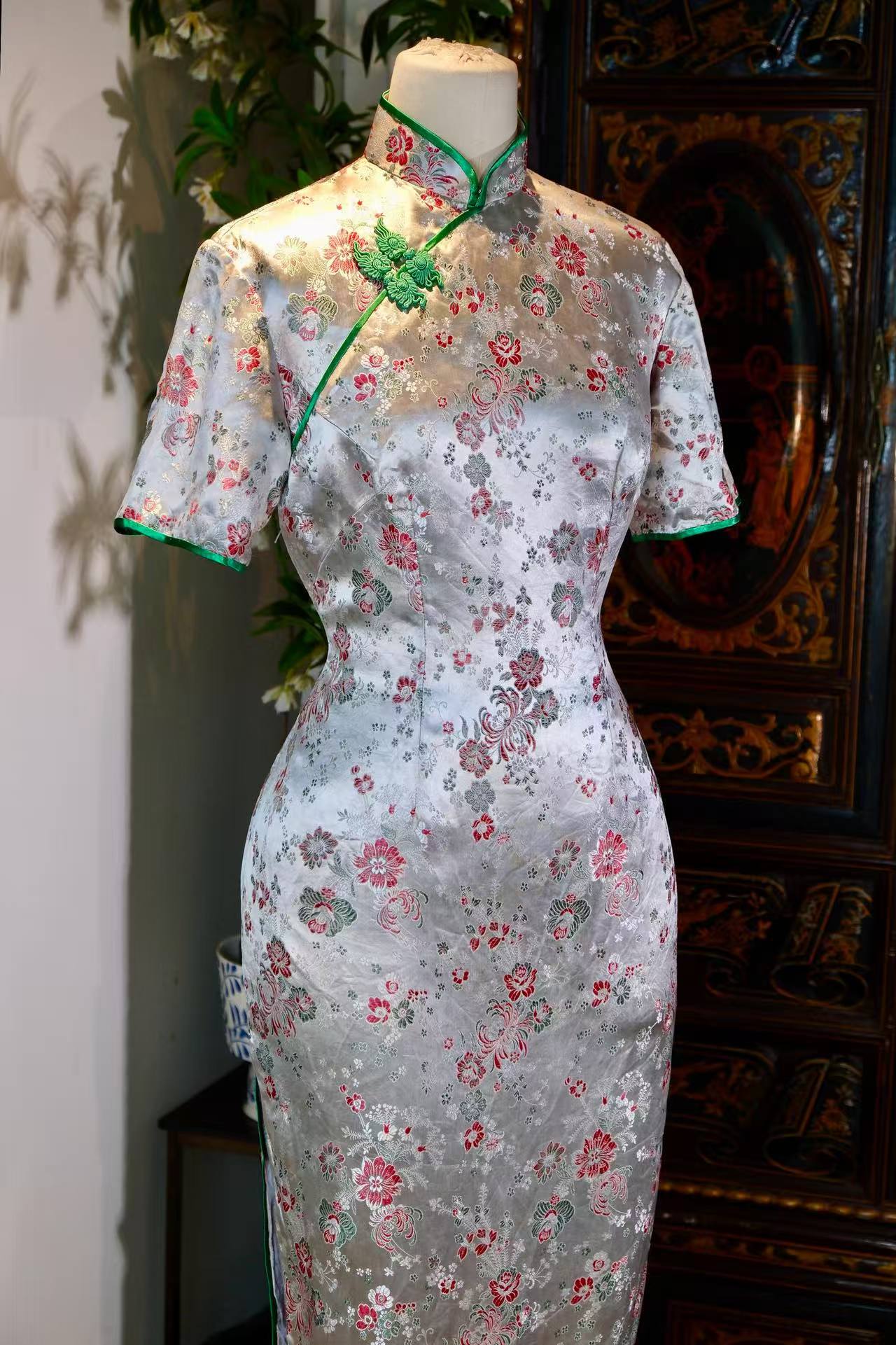
这件六十年代香港制的织锦缎旗袍,最摄人心魄的,便是那流光溢彩的衣上乾坤。其面料并非寻常丝缎,而是极尽工巧的提花织锦,以银灰色为底,经纬交织间,仿佛将一整座江南园林的春色都织了进去。
细观其纹样,并非单调的重复,而是错落有致的“百花齐放”。主花以朱红、洋红晕染,或盛放如牡丹之雍容,或清丽似海棠之娇羞;辅花则以灰绿、黛青点缀,或如兰草之幽雅,或似菊瓣之卷曲。更有细碎的白色小花如星子般散落其间,枝叶藤蔓以金银线勾勒,于光影流转中泛起粼粼波光。这并非简单的“印花”,而是通过复杂的提花工艺,将图案织入缎面肌理,使得每一朵花都立体饱满,触手生温。
尤为精妙的是其配色:银灰底色的冷静克制,完美中和了花卉的繁复艳丽,而领口、袖口及襟边那一抹鲜嫩的翠绿滚边,恰如“万绿丛中一点红”的诗眼,瞬间点亮整件衣裳的生机。这抹绿,与胸前那枚手工盘制的翠绿花形扣相呼应,宛如新抽的柳芽,为这袭华服注入了春日的灵动。
香江旧梦,衣以载道
这件旗袍,诞生于上世纪六十年代的香港——那个东西方文化激烈碰撞又奇妙融合的“东方之珠”。彼时,上海滩的旗袍师傅们南迁香江,将海派旗袍的精致考究与香港的国际视野相融,造就了这一时期旗袍独特的“海派遗风,香江新韵”。
它不仅仅是一件衣服,更是一个时代的缩影。在六十年代的香港,旗袍仍是名媛淑女、电影明星出席重要场合的首选。想象一下,在某个华灯初上的夜晚,一位身着此衣的女子,款款步入中环的宴会厅,织锦缎在灯光下流转着低调的奢华,翠绿的滚边与盘扣衬得她肤若凝脂。她或许正听着周璇的老歌,又或许在谈论着刚刚上映的《花样年华》——不,那是后来的电影,但那种东方女性的婉约与风情,早在这件旗袍的经纬里埋下了伏笔。
织锦为骨,风雅为魂
“锦,金也。作之用功重,其价如金。”《释名》中对“锦”的诠释,道尽了织锦缎的珍贵。这种面料,自唐宋以来便是宫廷御用,其工艺之复杂,有“寸锦寸金”之说。而这件旗袍所选用的织锦,更是将传统花卉纹样与现代审美结合,既有“花开富贵”的吉祥寓意,又不失六十年代追求的简约线条感。
它的剪裁,是典型的六十年代风格:立领挺括,勾勒出修长的脖颈;腰身收得极尽贴合,将女性曲线展露无遗,却又不显媚俗;下摆开衩适中,行走间隐约露出腿部线条,是含蓄的性感。这种剪裁,既保留了中国传统服饰的“藏”与“露”的哲学,又吸收了西方立体剪裁的精髓,堪称“中西合璧”的典范。
孤品天成,不可复制
古董衣的稀缺性,在于其不可复制性。这件旗袍的每一寸织锦,都是当年织机上的孤品;每一道滚边,都是老师傅手工缝制的温度;每一枚盘扣,都是指尖缠绕的心意。如今,那样的织锦工艺已近失传,那样的手工盘扣也少有人能做得如此精致。
它像一本穿在身上的历史书,记录着六十年代香港的风华,记录着海派旗袍的最后辉煌。它不仅仅是一件可以穿着的衣物,更是一件值得收藏的艺术品,一段可以触摸的时光。当你抚摸着那凹凸有致的织锦纹样,仿佛能感受到半个多世纪前,那位裁缝师傅的专注,那位穿着它的女子的优雅,以及那个时代独有的、新旧交替的脉搏。
这袭香江遗珍,等待的,是一位懂得欣赏它、珍视它的有缘人,让它在新的时光里,继续讲述属于东方的、永不褪色的风雅故事。
A Lost Treasure of Hong Kong: The Splendor of the 1960s Woven into Silk Brocade
Measurements / Size Guide:
Bust / Waist / Hips: 90/76/96 cm
Total Length: 128 cm
Detailed Description:
[I. Blooms on Fabric: An Opulent Microcosm of Art] The most spellbinding feature of this 1960s Hong Kong-made silk brocade Qipao is the radiant world brought to life upon its surface. The fabric is no ordinary silk or satin, but an exquisitely engineered jacquard brocade. Utilizing a serene silver-gray base, the warp and weft interlace as if weaving the entire vernal splendor of a Jiangnan garden directly into the textile's matrix.
A closer look reveals that the motifs are not repetitive patterns, but a masterfully orchestrated "symphony of a hundred flowers." The primary blossoms are washed in brilliant shades of vermilion and magenta—some blooming with the majestic opulence of tree peonies, others carrying the tender modesty of begonia petals. The secondary flora are accented in muted sage green and deep charcoal, resembling elegant wild orchids or sinuously curling chrysanthemum petals. Delicate, tiny white blossoms are scattered like constellations across the fabric, while the vines and tendrils are meticulously outlined in gold and silver threads, creating a shimmering, kinetic ripple under shifting light. This is far from a simple flat "print"; rather, through a sophisticated jacquard process, the patterns are structural components woven directly into the satin's texture, making every single blossom three-dimensionally plump and warm to the touch.
Most ingenious of all is the palette: the cool restraint of the silver-gray background perfectly tempers the vibrant opulence of the floral display. Meanwhile, the stark splash of fresh, vivid green along the mandarin collar, cuffs, and diagonal opening acts precisely as the poetic focal point—instantly illuminating the garment with vitality. This vibrant trim dialogues flawlessly with the hand-crafted floral frog closure at the chest, resembling newly sprouted willow buds and injecting a breath of spring spirit into this majestic attire.
[II. Lingering Dreams of History: A Garment as a Cultural Vessel] This Qipao was born in 1960s Hong Kong—the "Pearl of the Orient" where Eastern and Western cultures collided fiercely yet fused miraculously. During this epoch, haute couture tailors from Shanghai migrated south to Hong Kong, grafting the rigorous, uncompromising craftsmanship of the Shanghainese (Haipai) school onto a global metropolis, thereby forging a distinct signature: "the legacy of Shanghai, the modern rhythm of Hong Kong."
It is more than a garment; it is a monument to an era. In 1960s Hong Kong, the Qipao remained the supreme sartorial choice for socialites and cinema icons attending grand occasions. One can easily envision a woman wearing this piece stepping gracefully into a Central banquet hall as dusk falls. The silk brocade catches the light with a low-key, patrician luxury, while the fresh green piping and floral frog closure accentuate her luminous skin. She might have been listening to the nostalgic melodies of Zhou Xuan, or conversing about the newly released In the Mood for Love—no, that film came much later, yet that very aura of Eastern feminine grace and mystique had already been written into the warp and weft of this Qipao.
[III. Brocade as Bone, Elegance as Soul] "Brocade (Jin) is equivalent to gold (Jin); its creation demands immense labor, rendering its value equal to gold." This definition from the ancient lexicon Shiming substantiates the historic preciousness of silk brocade. Reserved strictly for imperial courts since the Tang and Song dynasties, its complex manufacturing gave rise to the adage "an inch of brocade is worth an inch of gold." The brocade chosen for this Qipao masterfully unites traditional floral motifs with a mid-century silhouette, retaining the auspicious blessing of "wealth and honor in full bloom" while capturing the clean, streamlined lines coveted in the 1960s.
Its tailoring is a textbook demonstration of the 1960s style: the crisp, structural mandarin collar frames a slender neckline; the waist is darted to contour the female form with exactitude without ever verging into the ostentatious; the side vents are cut to a modest height, offering an understated, elusive sensuality in movement. This pattern-making preserves the traditional Chinese sartorial philosophy of "concealing and revealing" while absorbing the absolute essence of Western three-dimensional draping—standing as a stellar paragon of East-meets-West design.
[IV. One-of-a-Kind, Beyond Replication] The ultimate rarity of an antique garment lies in its complete irreplicability. Every inch of this silk brocade was a unique output of the loom from a bygone era; every single line of piping carries the literal warmth of a master artisan's hand-stitching; every frog closure represents a dedicated meditation of fingertips. Today, such master-level jacquard weaving techniques have nearly vanished, and very few hands alive can twist fabric into frog closures of such breathtaking precision.
It reads like a history book you can wear, logging the golden glamour of 1960s Hong Kong and the final, brilliant twilight of the Shanghainese Qipao master class. It is far more than wearable apparel; it is a museum-tier piece of art, a tangible fragment of frozen time. When your hands trace the sculptural, raised textures of the brocade, you can almost feel the singular focus of the mid-century tailor, the effortless poise of the woman who once wore it, and the distinct, vibrant pulse of an era shifting between the old and the new.
This lost treasure of Hong Kong now awaits a true connoisseur—an appreciative custodian who will cherish its history and allow this timeless Eastern romance to bloom anew in a modern era.
分享