深圳溯源
无法加载取货服务可用情况
“衣裳是我们的第二层皮肤,也是我们穿在身上的文化。”——费孝通
一、 衣纹间的摩登密码
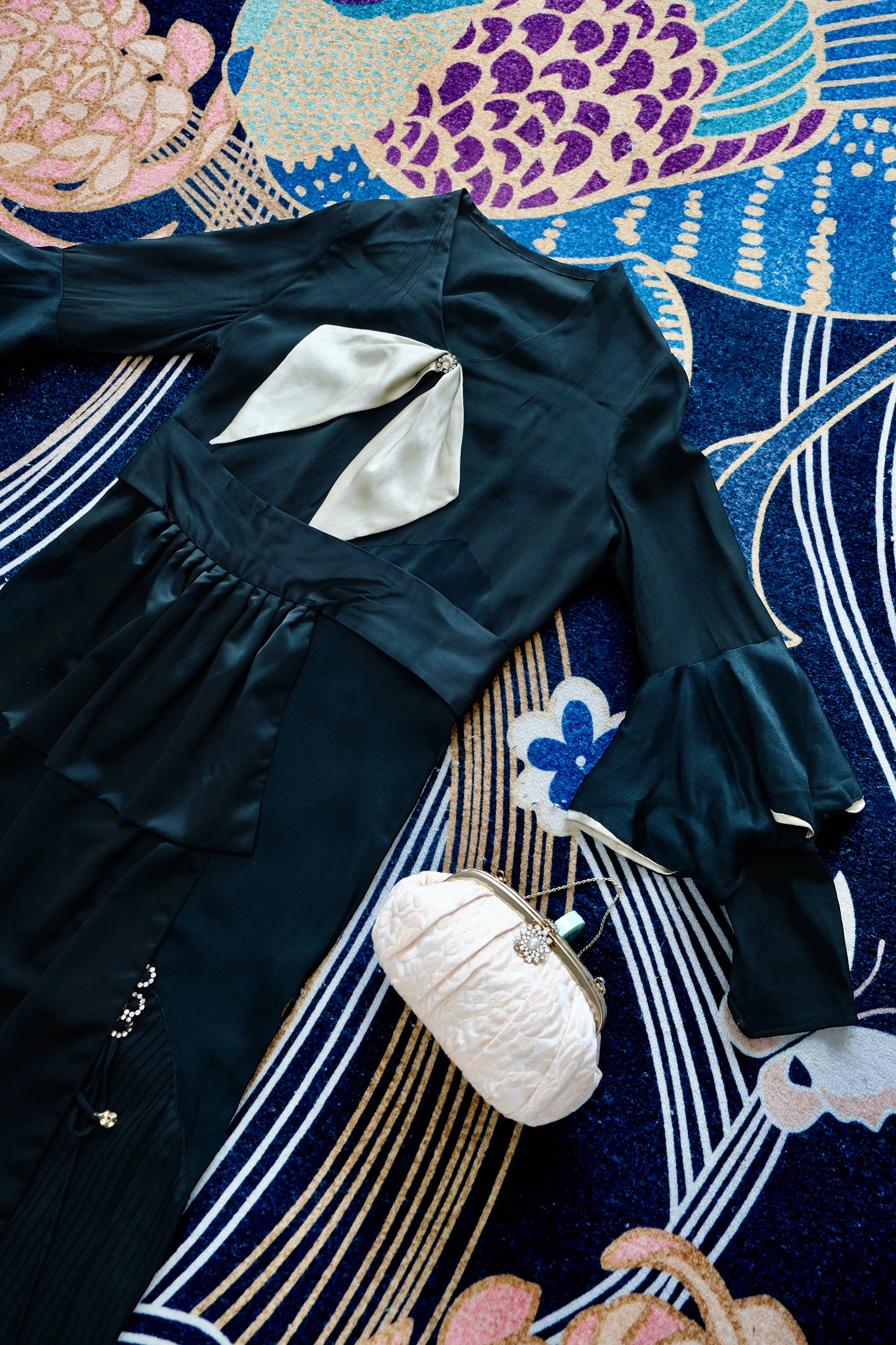
这件1920年代的真丝鸡尾酒礼服,宛如一部凝固的无声电影,将我们带回那个“镀金时代”的黄昏。它并非简单的织物堆砌,而是一首用丝绸与剪裁谱写的摩登交响诗。
材质与肌理:
主面料为顶级黑色重绉真丝,触感如凝脂,垂坠如夜幕。其光泽内敛而不张扬,恰如那个时代新女性内心深处的倔强与温柔。设计师巧妙地运用了面料的肌理对比,将光滑如镜的缎面拼接于袖口与领结,形成视觉上的“留白”,打破了黑色的沉闷,仿佛在无边的暗夜中投下几束月光。
结构与剪裁:
它摒弃了束缚女性身体的紧身胸衣(Corset),采用了标志性的直筒廓形(Shift Dress),腰线被刻意模糊甚至上移,强调一种无性别的、少年般的轻盈感。这种“去曲线化”的设计,是女性身体解放的宣言,正如林徽因在《你是人间的四月天》中所咏叹的:“我说你是人间的四月天;笑响点亮了四面风;轻灵 / 在春的光艳中交舞着变。”
细节与装饰:
最引人注目的,是胸前那个巨大的、不对称的米白色真丝缎面领结。它并非随意的系扎,而是一个精心设计的装饰性结构,中央镶嵌着一枚晶莹的水晶钻扣,如同夜空中最亮的星。这个领结打破了上半身的沉闷,成为视觉的绝对中心,既保留了东方审美的含蓄,又融入了西方装饰艺术(Art Deco)的几何与夸张。
二、 图案与工艺的独白
这件礼服的“图案”,并非传统意义上的印花或刺绣,而是一种“结构即图案”的高级表达。
- 几何构成的韵律: 袖口的荷叶边与领结的尖角形成了一种奇妙的呼应,如同建筑图纸上的几何图形,在流动的丝绸上构建出立体的视觉效果。这种设计语言,深受包豪斯学派“形式追随功能”理念的影响,却又多了一份女性的柔美。
- 面料的拼接艺术: 设计师大胆地将不同光泽度的真丝面料进行拼接。裙摆下部采用了细密的百褶工艺,行走时,光线在无数褶裥间折射,仿佛流动的水波,赋予了静态的礼服以动态的生命力。裙侧点缀的几颗水钻装饰,更是点睛之笔,让整件衣服在优雅中透出一丝俏皮与灵动。
三、 穿在身上的历史
这件礼服,是1920年代社会变革的缩影。
彼时,辛亥革命的浪潮已退,五四运动的余温尚在,新文化运动的思潮正席卷中华大地。女性开始走出闺房,走进学堂,走进社交场合。她们剪去长发,换下繁复的袄裙,穿上了这种便于行动、彰显个性的西式连衣裙。
这件礼服的主人,或许是一位在十里洋场上海滩的名媛,或许是一位留学归来的知识女性。她穿着它,出入于和平饭店的舞厅,或是在法租界的花园派对上,与友人谈笑风生。这件衣服,见证了那个时代女性对自由、独立与美的追求。它不仅是衣裳,更是一种身份的象征,一种生活态度的表达。
四、 艺术价值与稀缺性
从艺术史的角度看,这件礼服完美融合了东西方美学。
它既有中国传统服饰的“留白”与“意境”,又有西方现代主义设计的“结构”与“功能”。这种跨文化的融合,在当时的中国时尚界是极为罕见的,体现了海派文化的包容与创新。
其稀缺性体现在:
- 年代久远: 距今已近百年,能完好保存至今的真丝古董衣本就凤毛麟角。
- 工艺精湛: 全手工的剪裁与缝制,对真丝面料的处理技巧,都代表了当时最高水平的制衣工艺。
- 设计独特: 其不对称的领结设计、面料的拼接运用,都显示出设计师超前的审美眼光。
结语
这件1920年代真丝鸡尾酒古董礼服,不仅仅是一件衣服,更是一件行走的艺术品,一部穿在身上的历史。它承载着一个时代的记忆,诉说着一个关于美、自由与变革的故事。当你凝视它时,仿佛能听到百年前的爵士乐在耳边响起,看到那些风华绝代的女子,在时代的洪流中,翩翩起舞。
"Garments are our second skin, and the culture we wear upon our bodies." — Fei Xiaotong
This 1920s silk cocktail dress is like a frozen silent film, transporting us back to the twilight of the "Gilded Age." It is not a mere assembly of fabric, but a modernist symphony composed of silk and tailoring.
Material and Texture: The primary fabric is a top-tier black heavy silk crepe—touching like cream and draping like the night sky. Its luster is reserved rather than ostentatious, mirroring the inner stubbornness and tenderness of the "New Woman" of that era. The designer masterfully utilizes textural contrast, splicing mirror-smooth satin at the cuffs and bow-tie to create visual "white space" (Liu Bai). This breaks the monotony of the black, casting beams of moonlight into the boundless dark.
Structure and Silhouette: Discarding the restrictive corset, it adopts the iconic straight "Shift Dress" silhouette. The waistline is intentionally blurred or dropped, emphasizing a gender-neutral, boyish lightness. This "de-curving" design is a manifesto of female bodily liberation, echoing the poetry of Lin Huiyin: "You are the April day of this world; your laughter lights up the wind from all sides; ethereal / dancing in the brilliance of spring."
Details and Adornments: The most striking feature is the massive, asymmetrical cream-white silk satin bow-tie at the chest. It is not a random tie, but a meticulously designed decorative structure, centered with a crystalline rhinestone buckle that glows like the brightest star in the night. This bow breaks the somberness of the upper body, becoming the absolute visual focal point—preserving the reserve of Oriental aesthetics while integrating the geometric exaggeration of Art Deco.
The "pattern" of this gown is not a traditional print or embroidery, but a high-level expression where "structure is the pattern."
Geometric Rhythm: The ruffles at the cuffs echo the sharp angles of the bow, resembling geometric shapes on an architectural blueprint constructed upon flowing silk. This language is deeply influenced by the Bauhaus "form follows function" philosophy, yet retains a touch of feminine softness.
The Art of Splicing: The designer boldly splices silk fabrics of varying lusters. The lower hem features fine pleating; when in motion, light refracts among countless folds like rippling water, granting dynamic life to a static gown. The subtle rhinestone accents on the side are the finishing touch, infusing the elegance with a sense of playful agility.
This dress is a microcosm of the social upheaval of the 1920s. As the tides of the Xinhai Revolution receded and the echoes of the May Fourth Movement remained, the New Culture Movement swept across China. Women stepped out of the "inner quarters" and into schools and social circles. They bobbed their hair, shed complex traditional tunics, and donned Western-style dresses that allowed for movement and self-expression.
The owner of this dress might have been a socialite on the Shanghai Bund or an intellectual returning from studies abroad. She might have worn it to the Peace Hotel ballroom or a garden party in the French Concession. This garment witnessed an era of women pursuing freedom, independence, and beauty. It is more than clothing; it is a symbol of identity and an expression of a life attitude.
From the perspective of art history, this dress perfectly fuses Eastern and Western aesthetics. It possesses the "white space" and "mood" of traditional Chinese dress, alongside the "structure" and "function" of Western modernist design. This cross-cultural fusion was extremely rare in the Chinese fashion world at the time, embodying the inclusivity and innovation of Haipai (Shanghai-style) culture.
Its rarity lies in:
Age: Nearly a century old; silk antique garments preserved in such fine condition are few and far between.
Exquisite Craftsmanship: The entirely hand-cut and hand-sewn details, along with the treatment of the silk, represent the pinnacle of garment-making at the time.
Unique Design: Its asymmetrical bow and the strategic splicing of fabrics display a forward-thinking aesthetic vision.
Conclusion This 1920s silk cocktail dress is more than a garment; it is a piece of walking art and a history worn on the body. It carries the memory of an era, telling a story of beauty, freedom, and transformation.