深圳溯源
无法加载取货服务可用情况
图案解码:东方纹样的异域变奏
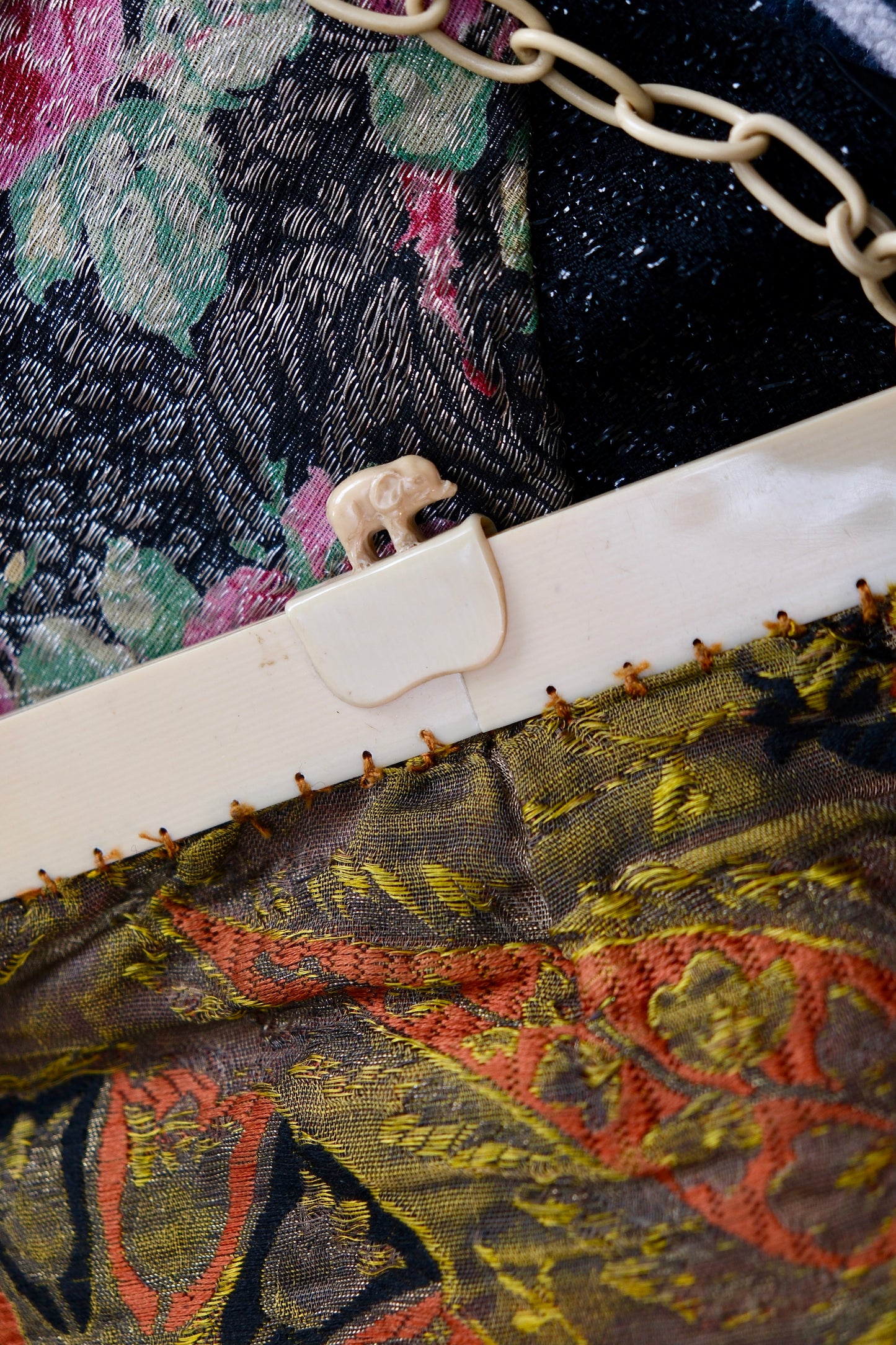
包身以Lamé金属丝织物为底,经纬间交织着1920年代典型的“东方主义”美学——主体纹样为变体“宝相花”与“卷草纹”,以黑、赭、金三色丝线提花,花朵呈放射状绽放,花瓣边缘缀以细密金线,仿若敦煌壁画中“飞天”衣袂的流光;卷草纹则以流畅曲线缠绕,暗合Art Deco风格的几何秩序感,却又保留着东方织物的温润肌理。
尤为精妙的是,纹样中隐现“佩斯利涡纹”的变体,这种源自波斯、经印度传入欧洲的纹样,在1920年代被西方设计师重构为“异域风情”的符号,与包口赛璐珞扣上的立体小象装饰遥相呼应,形成“东方意象的西方转译”——正如艺术史家贡布里希所言:“装饰是文明的密码”,这只包恰是爵士时代东西方文化碰撞的微缩景观。
故事回溯:从“飞来去器”晚宴到赛璐珞革命
1925年,巴黎世博会的“装饰艺术与现代工业”展厅里,Lamé织物因“在灯光下如液态黄金般流动”的特质,成为设计师Paul Poiret、Jeanne Lanvin的晚宴包首选材质。这只包的赛璐珞扣与链条,正是1920年代“塑料革命”的产物——赛璐珞作为最早的合成塑料,被用于替代昂贵的象牙与玳瑁,其温润的乳白色泽与半透明质感,恰与金属丝织物形成“工业与手工”的对话。
想象这样一幅场景:1926年纽约“飞来去器”晚宴上,一位Flapper女郎将口红、粉饼与香烟盒塞进这只包,赛璐珞链条在她裸露的肩头晃动,Lamé织物在爵士乐的切分音中闪烁,包口的小象装饰随步伐轻颤——这不仅是配饰,更是“新女性”挣脱束身衣、拥抱自由的宣言。正如《Vogue》1927年所言:“一只晚宴包,是女性向世界展示的微型舞台。”
稀缺性:时光淬炼的“织物琥珀”
Lamé织物的脆弱性决定了其存世量极低——金属丝易氧化断裂,丝线易褪色脆化,而这只包历经百年,纹样仍清晰可辨,赛璐珞扣未出现常见裂纹,足见当年工艺的精湛与保存的难得。更罕见的是,1920年代采用“东方纹样+赛璐珞装饰”的晚宴包,多为高级定制工坊出品,存世量不足百件,正如服装史家Valerie Steele在《The Chic List》中所言:“真正的古董包,是‘可触摸的历史’,其价值不在材质,而在它凝固的时代精神。”
如今,当我们凝视这只包,看到的不仅是金线与丝线的交织,更是爵士时代的狂欢、东西方的对话,以及女性解放的序章——它如一枚“织物琥珀”,将1920年代的光影、温度与野心,永远封存在方寸之间。
The body of the bag features a Lamé metallic fabric base, where the warp and weft interweave the quintessential "Orientalism" aesthetics of the 1920s. The primary motifs are variations of the "Baoxiang Flower" and "Acanthus Scrolls," jacquard-woven with black, ochre, and gold silk threads. The blossoms radiate outward, their petal edges traced with fine gold wire—reminiscent of the shimmering robes of "Apsaras" in Dunhuang frescoes. The scrolling vines entwine with fluid curves, aligning with the geometric order of Art Deco while preserving the warm, tactile texture of Oriental textiles.
Most exquisite is the subtle appearance of "Paisley" variations within the pattern. This motif, originating in Persia and traveling through India to Europe, was reconstructed by 1920s Western designers as a symbol of "exoticism." It echoes the 1920s three-dimensional elephant decoration on the celluloid clasp, creating a "Western translation of Oriental imagery." As art historian E.H. Gombrich noted: "Decoration is the code of civilization," and this bag is a miniature landscape of the cultural collision between East and West during the Jazz Age.
In the 1925 Paris Expo's "Decorative Arts and Modern Industries" pavilion, Lamé fabric became the preferred material for evening bags by designers like Paul Poiret and Jeanne Lanvin due to its quality of "flowing like liquid gold under light." The celluloid clasp and chain of this bag are products of the 1920s "Plastic Revolution"—celluloid, as the earliest synthetic plastic, was used to replace expensive ivory and tortoiseshell. Its warm, milky luster and translucent texture create a dialogue between "Industry and Craftsmanship" against the metallic weave.
Imagine this scene: At a 1926 "Boomerang" gala in New York, a Flapper tucks her lipstick, powder compact, and cigarette case into this bag. The celluloid chain sways against her bare shoulder, the Lamé fabric glimmers to the syncopated rhythms of jazz, and the little elephant on the clasp trembles with every step. This is not just an accessory; it is a manifesto of the "New Woman" shedding her corset and embracing freedom. As Vogue stated in 1927: "An evening bag is a miniature stage a woman presents to the world."
The fragility of Lamé fabric dictates its extremely low survival rate—metallic threads oxidize and break, while silk threads fade and embrittle. Yet, after a century, the patterns on this bag remain distinct, and the celluloid clasp shows none of the common age-cracks, testifying to the superb craftsmanship and remarkable preservation. Rarer still, 1920s evening bags featuring "Oriental Motifs + Celluloid Decoration" were mostly produced by Haute Couture ateliers, with fewer than a hundred pieces estimated to survive globally. As fashion historian Valerie Steele remarked in The Chic List: "A true antique bag is 'tactile history'; its value lies not in the material, but in the era's spirit it has frozen in time."
Today, as we gaze upon this bag, we see more than an interweaving of gold and silk; we see the revelry of the Jazz Age, the dialogue between East and West, and the prologue to female liberation. Like a piece of "Textile Amber," it forever seals the light, temperature, and ambition of the 1920s within its small frame.