溯源
无法加载取货服务可用情况
年代:约1960年代
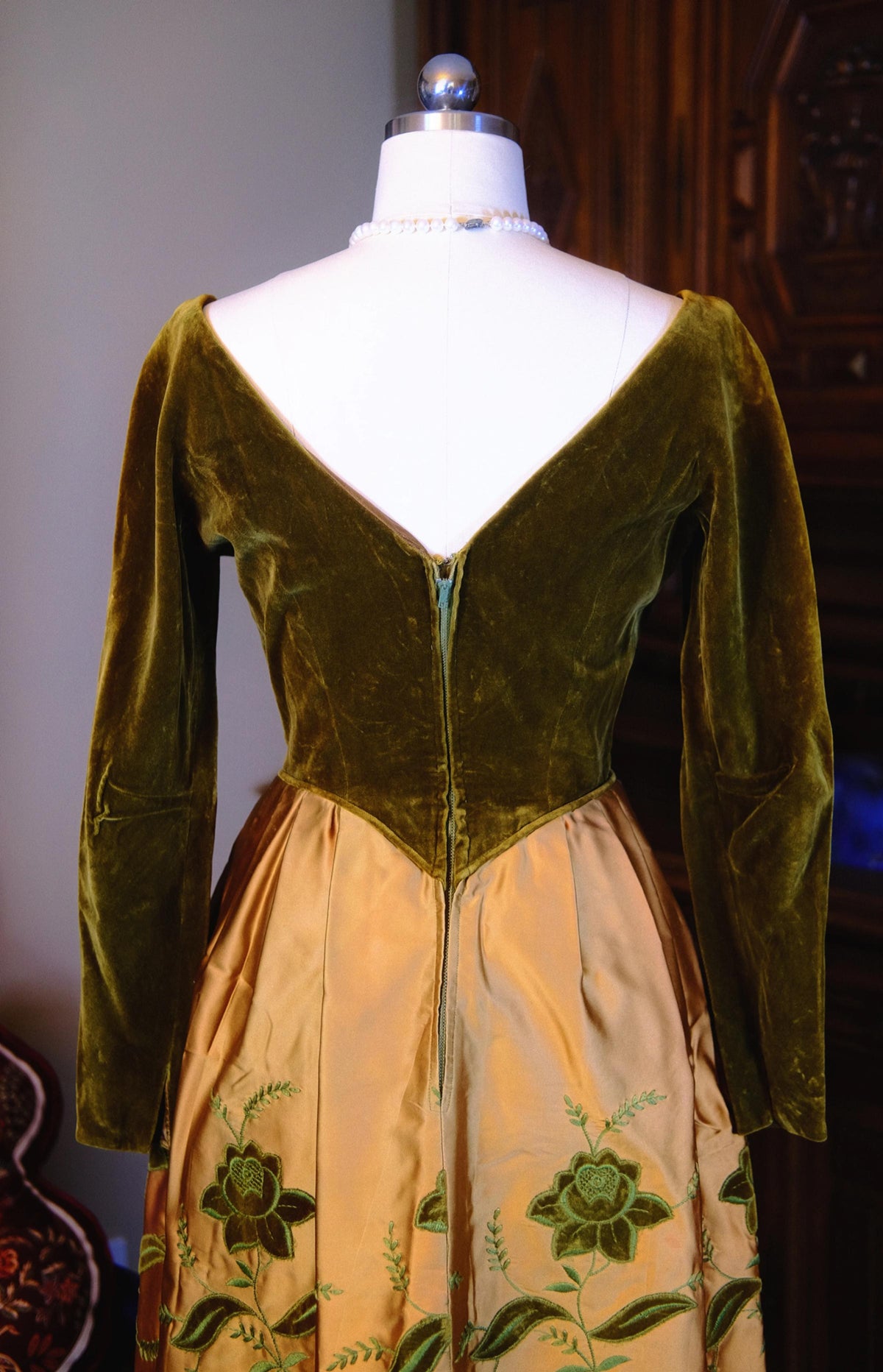
面料:橄榄绿天鹅绒(Upper Bodice)、英国产重磅婚纱级缎面(Skirt)、丝绒填充刺绣
版型工艺:公主线收腰(Princess Seams)、后中V型拉链开合(V-back Zip Closure)
【文物综述与美学解析】
在服装史的长河中,20世纪60年代无疑是一场静默而伟大的革命。当“摇摆伦敦”(Swinging London)的迷你裙浪潮席卷街头时,在英国的上流社会与传统工坊中,依然坚守着极致的古典主义剪裁。这件礼服,便是那个时代“旧世界的精致”与“新时代的优雅”相互妥协、碰撞下的艺术结晶。
一、 面料与色彩:光影的交响诗
此裙最引人之处,在于其面料的奢华质感与色彩搭配。上身采用橄榄绿天鹅绒,这种深色调的丝绒在60年代的英国贵族着装中极为常见,它不仅具有极高的保暖性以抵御英伦的阴冷潮湿,更在视觉上带有一种沉静、克制的高级感。
下身拼接的,则是您提到的英国产重磅婚纱级缎面(Bridal Satin)。在维多利亚与阿尔伯特博物馆(V&A)馆藏的众多英国高级定制档案中,这种缎面因其极高的克重、细腻的哑光光泽以及卓越的悬垂性,常被称为“液体黄金”。其香槟金色的底色,宛如秋日里的一杯白兰地,温润而贵气。当丝绒的“哑光”与缎面的“微光”相遇,仿佛一幅古典油画中,厚重的背景布幔与流淌的金色烛光,共同构建了视觉上的层次感。
二、 工艺与刺绣:指尖上的浮雕美学
裙身下摆的花卉刺绣是整件作品的灵魂。这种刺绣并非普通的丝线平绣,而是采用了极为考究的丝绒填充立体绣(Velvet Padded Embroidery)。在16世纪至17世纪的欧洲宫廷中,这种通过填充物将图案托起,形成浮雕般立体效果的刺绣被称为“垫绣”。制作者巧妙地运用了深橄榄绿的丝绒来绣制花瓣与叶片,并以鲜绿色的丝线勾边,不仅在色彩上与上身的天鹅绒形成完美的呼应,更在触感上赋予了裙身浮雕般的质感。这种工艺,正如《诗经》中所描绘的“有匪君子,如切如磋,如琢如磨”,一针一线皆是匠人耐心与技艺的凝结。
三、 版型与剪裁:黄金时代的余晖
在版型上,这件礼服完美保留了50年代至60年代初“New Look”的遗韵。
1. 上身的紧身剪裁:通过精准的“公主线”(Princess Seams)从肩部一直延伸至腰线,在不使用硬质鱼骨的情况下,依然勾勒出穿着者挺拔、收拢的背部与腰线。
2. 后中V型拉链设计:后背采用了一个极具建筑美感的深V型剪裁,并配以拉链。这种设计既保留了古典的端庄,又通过几何线条的延伸,在视觉上拉长了穿着者的身形。
3. 下身的量感与克制:裙摆并非无脑的宽大,而是通过腰部的自然抽褶,呈现出一种克制的、优雅的蓬松感。这既符合了60年代逐渐走向自由的女性身体解放趋势,又未脱离上流社会对礼仪与场合着装的严苛要求。
在中国古典文学中,我们常以“金枝玉叶”来形容女子的尊贵。这件礼服,恰如唐代诗人李贺笔下“画罗织扇总如云,细绣金线作舞裙”的西方映照。它不仅是一件御寒或遮体的衣裳,更是一部可以触摸的60年代英国纺织工业与高级定制工艺的“立体史书”。在那个胶片与天鹅绒交织的年代,它无声地诉说着一段关于优雅、秩序与极致美学的旧日时光。
Era: Circa 1960s
Materials: Olive-green velvet (Upper Bodice), British heavyweight bridal-grade satin (Skirt), Velvet-padded embroidery
Silhouette & Construction: Princess seams (Princess Seams), Center-back V-shaped zipper closure (V-back Zip Closure)
Within the grand river of fashion history, the 1960s undoubtedly constituted a silent yet monumental revolution. While the miniskirt wave of "Swinging London" swept the streets, Britain's upper echelons and traditional ateliers steadfastly preserved the absolute standards of classical tailoring. This gown stands as an artistic crystallization born from the compromise and collision between the "refinement of the old world" and the "elegance of a new era."
The most arresting attribute of this gown resides in its luxurious textile tactility and chromatic pairing. The upper bodice is crafted from olive-green velvet (Velvet). Such deep-toned silk velvet was exceptionally commonplace within 1960s British aristocratic attire; it not only provided supreme thermal insulation to withstand the damp chill of the British climate, but also projected a composed, restrained, and elevated sophistication.
Splice-joined below is the British-produced heavyweight bridal-grade satin (Bridal Satin). Across numerous British haute couture archives housed within the Victoria and Albert Museum (V&A), this grade of satin—prized for its massive gram weight, delicate matte luster, and peerless drape—is frequently dubbed "liquid gold." Its champagne-gold ground reads like a glass of autumn brandy: warm and profoundly patrician. When the velvet's matte absorption meets the satin's low-lit shimmer, it evokes a classical oil painting where heavy background drapery and flowing candlelit gold converge to construct sublime optical depth.
The floral embroidery cascading across the skirt hem serves as the very soul of the piece. Diverging from standard flat silk embroidery, it employs exceptionally rigorous velvet-padded three-dimensional embroidery (Velvet Padded Embroidery). In 16th- and 17th-century European royal courts, this technique of elevating motifs via internal padding to create a sculptural relief effect was known as stumpwork or padded embroidery. The artisan masterfully deployed dark olive-green velvet to render the petals and foliage, outlining them with vibrant green silk threads. This not only establishes a flawless chromatic echo with the bodice velvet, but endows the skirt with a tactile, bas-relief dimension. Such craftsmanship mirrors the ancient Chinese verse from the Classic of Poetry: "As if cut, as if filed, as if carved, as if polished"—where every single stitch embodies the concentrated patience and mastery of the artisan.
Structurally, this gown flawlessly preserves the lingering essence of the late 1950s to early 1960s "New Look" silhouette:
Bodice Fit: Employing precision princess seams (Princess Seams) extending continuously from the shoulders to the waistline, it sculpts an upright, tapered back and waist contour without relying on rigid whalebone boning.
Center-Back V-Zip Design: The reverse features an architectural deep V-cut (V-back) paired with a discreet zipper. This design preserves classical decorum while visually elongating the wearer's stature through geometric line extension.
Restrained Volume in the Skirt: The skirt hem avoids mindless excess, instead achieving a controlled, elegantly buoyant fullness through natural waist gathering. This aligns with the 1960s progressive liberation of the female form while respecting the stringent sartorial protocols demanded by upper-class social occasions.
In classical Chinese literature, we frequently invoke the term "golden branches and jade leaves" to denote a woman of supreme nobility. This gown serves as the Western mirror to Li He’s poetic imagery: "Painted gauze and woven fans like drifting clouds, fine golden threads embroidered into a dancing skirt." It transcends mere apparel designed for warmth or modesty to become a tangible "three-dimensional history book" chronicling 1960s British textile industry and haute couture engineering. In an era where photographic film and velvet intertwined, it speaks silently of bygone days consecrated to elegance, order, and ultimate aesthetic perfection.